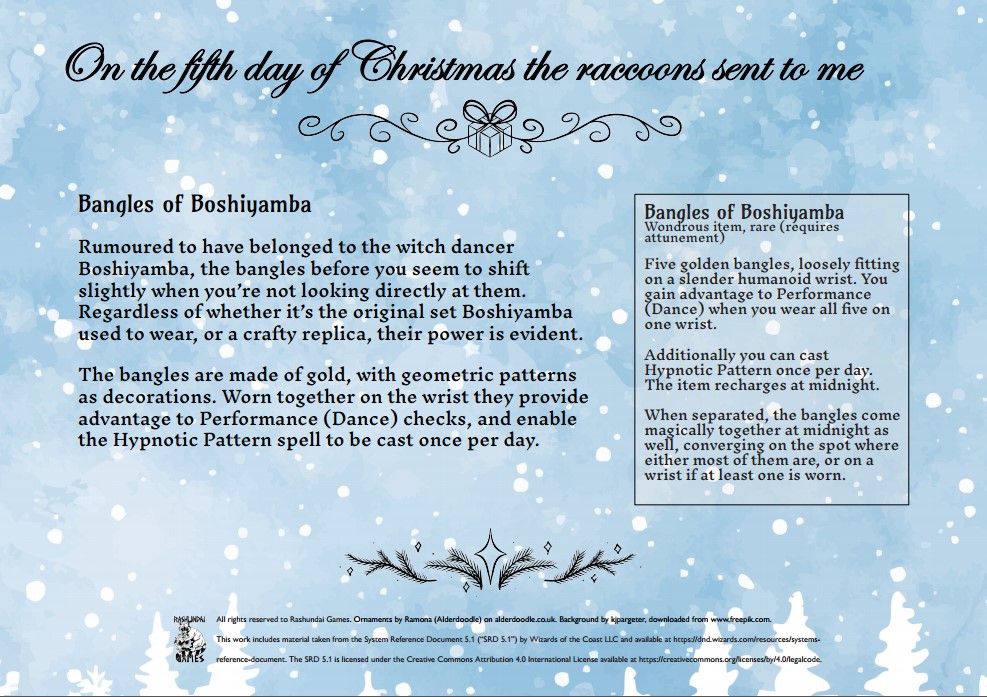
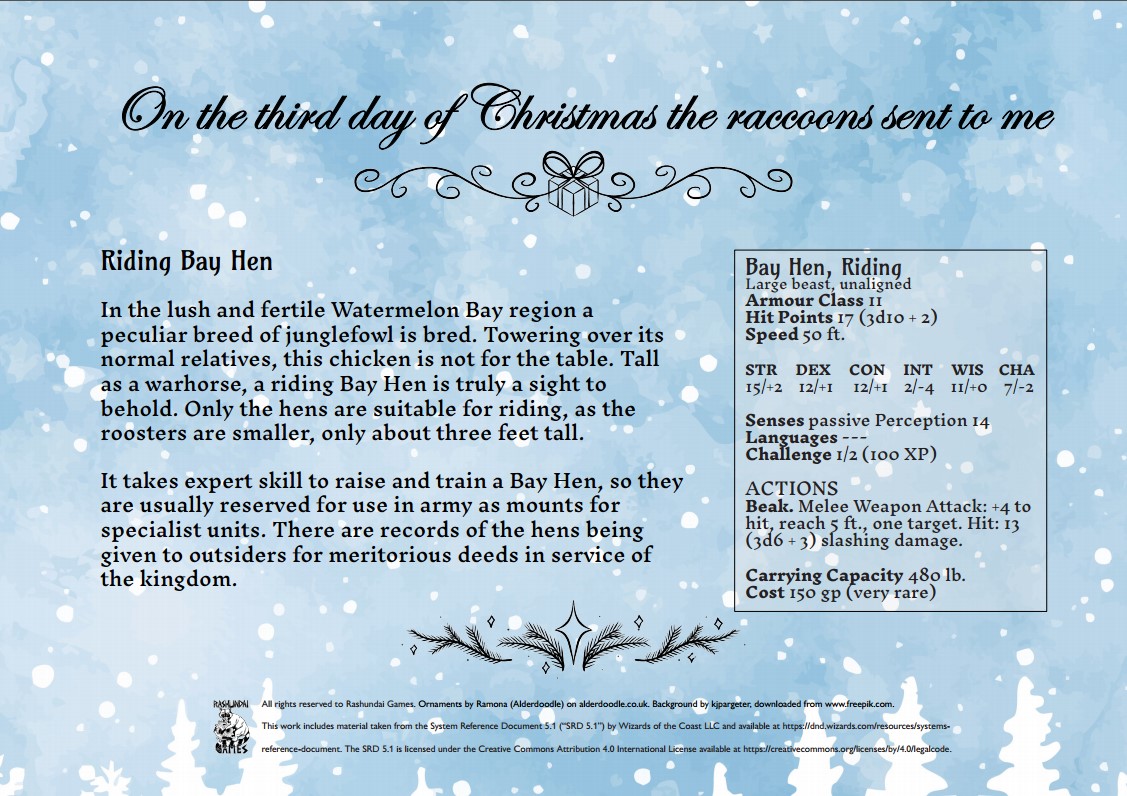
The raccoons have been playing with some cheap golden bangles. We let them, but today instead of three pieces they have five of them! Better let someone have a closer look.
After some chaotic chattering and exclamations the raccoons manage to get across the message. There have been sightings of a healthy mother with three cubs at the edge of the estate. The groundskeeper is overjoyed!
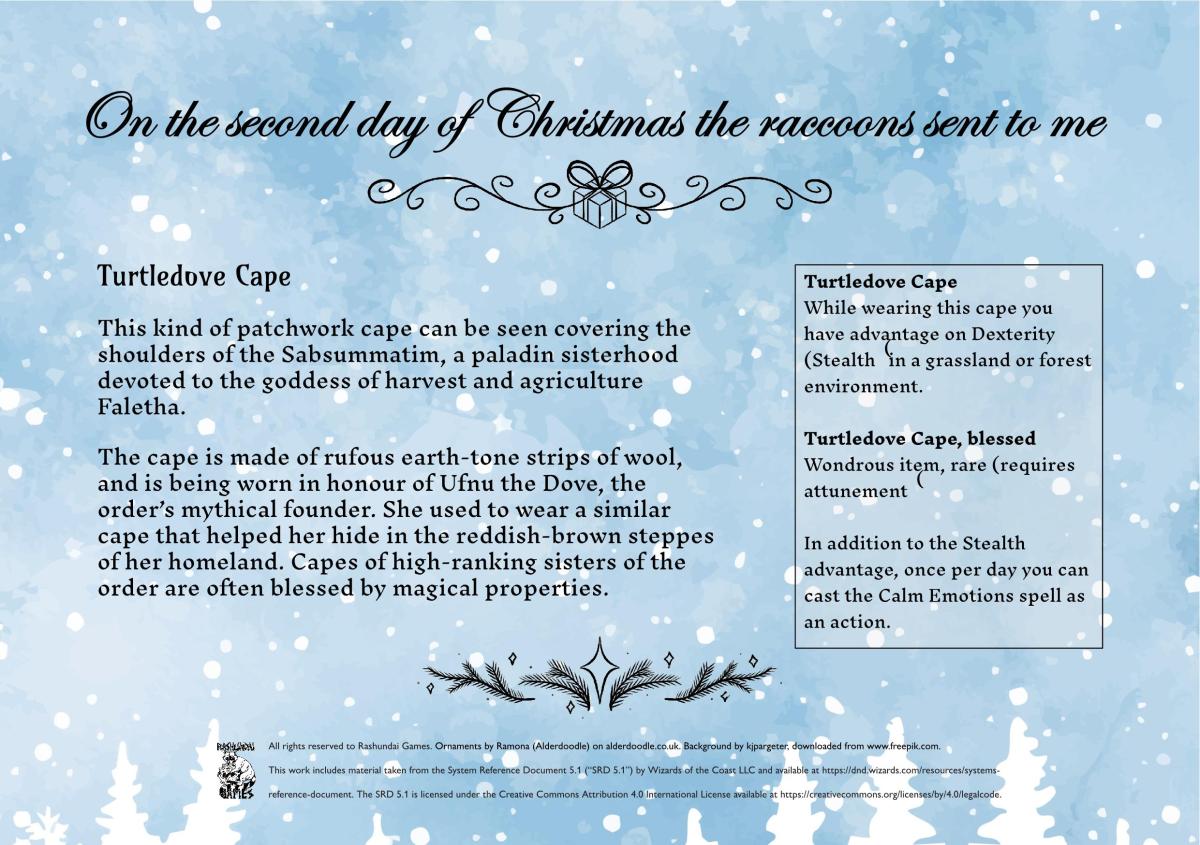
Hello again and welcome to another entry in my D12 Days of Christmas series.
On today’s card you’ll find something you’d expect in the possession of a ranger rather than a paladin. Not all paladins are armour-clad crusaders, and not all wear capes. The Sabsummatim do, and you can read a bit about those here:
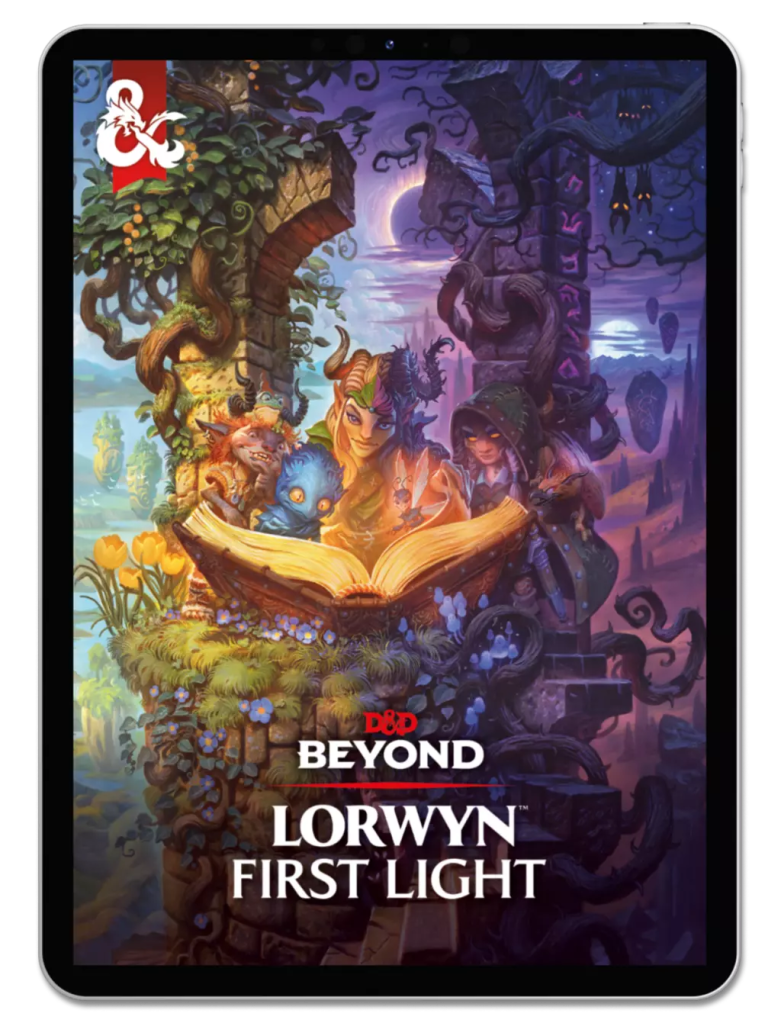
A review of the new Lorwyn: First Light D&D supplement based on the Magic: the Gathering blocks Lorwyn, Shadowmoor, and the upcoming set Lorwyn Eclipsed.
Estimated reading time: 20 minutes
The long awaited D&D supplement is finally out as of November 18. Since its latest announcement in September I’ve been a bit skeptical, so I waited a day before buying it. But being the Lorwyn fanboy I am, I couldn’t really let is pass.
Since the first announcement during MagicCon: Chicago in February I’ve been working on a series of articles about Lorwyn-Shadowmoor. Mostly they’ve been filled with my predictions and thoughts about how will certain things get handled by the creators.
We will be getting a supplement with lots of lore, stats for various monsters, place descriptions, etc. done by professionals with access to the original notes (hopefully). In the meantime I can offer my take on the already published stuff, and speculations about what will be in the sourcebook. – quote from my first article on D&D Lorwyn
I managed to finish a huge bundle of four (!) articles to this day, with the Shadowmoor Merrows still in the WIP phase. Blame my job, which is completely unrelated, and the oppressive need to provide sustenance and shelter for my family.
With Lorwyn: First Light finished I can compare my speculations with the finished product. This will be a complex review of both form and contents. I’ll take a good look at what First Light provides and what it doesn’t. Can you play a campaign in Lorwyn using the new supplement? How much work is left for the DM after reading it? Let’s get to it!
Form and Format
Lorwyn: First Light is a digital-only release available on the D&D Beyond Marketplace. When bought, you’re not given a download link for a PDF, but instead you can browse the contents on the site. This is probably normal for D&D Beyond, and it shows that I don’t have experience with the site. I have my rulebooks in hardback, and all the 3rd-party stuff as PDFs.
The supplement is divided into four chapters and an introduction. The introduction gives a short, well, introduction to the plane. It provides the basics of geography, cosmology, and history. Chapter 1 lists the character options, while in the second chapter we return to the geography of the plane. Following is the third chapter, the Bestiary, and the last one is called Lorwyn Adventures. We’ll get to each of them in a while.
An advantage of the D&D Beyond treatment is that there are keywords that either link to a relevant source (also on Beyond), or show a pop-up card with a spell description for example. I’m inventing the wheel here, but since I don’t use Beyond, this is our first encounter. It goes without saying that you need access to the linked source on D&D Beyond first, otherwise you’re redirected towards the Marketplace.
Introduction
The introduction gives a short summary of the Lorwyn-Shadowmoor plane, and it does its job quite well, actually. I can imagine someone unfamiliar with the setting getting a nice overview that can be expanded upon in later chapters. It mostly isn’t, but we’ll get to the other chapters later. The basic cosmology of the dual plane is explained, and there’s also a very brief history.
We learn where we are in the timeline, and that the supplement deals with one period only. We’re dealing with a post-Oona, post-Phyrexian period, with no guidelines how to play in different eras. Which makes sense, as it’s intended to be a companion to the upcoming Lorwyn Eclipsed MtG set.
The introduction also states one should receive what’s needed for playing D&D in Lorwyn. That’s quite a statement, it makes one expect a complex guide to the denizens and locales of the plane with all the rules necessary. I should be able to make a character using only this supplement. And get a good enough picture of the plane to run an adventure or campaign, right? We’ll see how it goes in the next chapters.
As a side note, there’s one thing that struck me as intriguing. It is the emphasis on light conditions in the plane and its aspects, Lorwyn and Shadowmoor. This is probably due to the workings of D&D Beyond and its tooltips, but it makes the light conditions really stand out in the text. It’s good to know how much light there is in the environment, but it’s not something I needed from an official supplement. Such things are well within the capabilities of most DMs. Plane specific lore and mechanics are what we expect.
We’re given some of those in the introduction, to be fair. There are short descriptions of the two elemental gods, Eirdu and Isilu. Not much is said about them, but we’re given stats. Sadly in the worst possible way, so we’re to use dragon stats for both of them. And while the Eirdu proxy seems passable, the one supposed to stand for Isilu feels wrong. I’m not going into more detail, as this is a paid product we’re talking about. It just looks as if the team worked on this in the last minutes before deadline and just picked something based on colours.
And another side note, the Marketplace pitch for Lorwyn: First Light mentions “2 new unique magic items”. They are both right there in the introduction, but probably aren’t what you imagine when you see “unique magic item”.
Character options
The first regular chapter is dedicated to character options such as backgrounds, feats, and playable species. According to the Marketplace we should be given 2 backgrounds, 2 feats, 2 new species, and guidelines for playing (sic!) 8 other species. Eight species, that sounds like we’re getting almost all Lorwyn-Shadowmoor tribes, right? One didn’t make it, maybe one of those you couldn’t really play as a PC, like giants or merrow.
backgrounds and Feats
For some reason this chapter starts with backgrounds. We are given two of them, one for Lorwyn, one for Shadowmoor. While the idea is not terrible, they’re extremely bland and generic. They say nothing about your character beyond “you’re at home in Lorwyn/Shadowmoor”. There are so many backgrounds one could fit in here just by looking at some cards.
The feats are not much better. It’s not that they are bad in themselves, it’s just the way they’re presented. Both come with the new backgrounds. We could assume that every Lorwyn-Shadowmoor native has one or the other background (an incredibly boring idea), and therefore one or the other feat. So every Lorwyn denizen could cast Faerie Fire and every being from Shadowmoor can cast Hex. It would be better if those feats were exclusive to the elemental gods’ chosen or something along those lines. And if there were additional backgrounds and feats to choose from.
Species adaptations
What we’re actually given are short descriptions of boggarts, elves, faeries, flamekin, and kithkin. Each tribe is treated differently, some have instructions on how to play them, some only a few terse sentences. Boggarts and elves get the most attention, though their entries are still rather brief. But out of the five (not eight, as advertised) species three actually require you to buy another supplement, because you’re sent to Mordekainen Presents: Monsters of the Multiverse for the stats. It’s okay for an expansion to require the core rules, i.e. Player’s Handbook, Dungeon Master’s Guide, or Monster Manual. It’s not okay to take my money and then tell me to pay more so I can get what I paid for in the first place.
Elves are actually the only adapted species that is different in Lorwyn-Shadowmoor from other settings. I don’t count slapping Darkvision on everything as making it different. There are two lineages, the Lorwyn Elf and the Shadowmoor Elf, that you can choose from. Why the other tribes didn’t get at least this much is beyond me.
To play a kithkin you just create a plain old halfling from the Player’s Handbook. Add Darkvision, if you want a Shadowmoor kithkin. Thoughtweft is mentioned, but never by name (why?), and it has absolutely no in-game effect. There’s even mention of the nomadic kithkin who severed their connection to the thoughtweft after the Phyrexian invasion. You have potentially three subspecies waiting just to be named and described in the laconic manner of First Light. More if you take clachan/doun differences into account. Why was this possible with the elves but not with the kithkin?
Faeries and flamekin are mostly just glorified hyperlinks to Monsters of the Multiverse. Their descriptions are short, both almost exactly a whopping one hundred words. You have no reason to stop there, because you won’t learn much about them.
As I said before, three species are missing. The merrow are found in the third chapter, as unplayable monsters. That was expected, I predicted it in my merrow article, the merrows would be hard to use in a normal campaign. Treefolk and giants are also creatures that would have difficulties fitting in a party, so it’s understandable they are only to be found in the Bestiary. But somehow we were offered 8 playable species adaptations plus 2 new ones. And we received only 5 adaptations.
New Species
The two new species are Changelings and Rimekin. Changelings are a staple of the old Lorwyn block, and while I never took them for something playable, why not? As with everything in First Light the description is terse, but you get the stats and basic idea.
Rimekin are a newcomer from Lorwyn Eclipsed, and it makes sense to see them among the new options. Though they are very much but a recolor of the flamekin, they nevertheless seem playable. One wonders why there’s no option for a cinder. They are mentioned next to the flamekin adaptation, but neither there nor in the new species we are given something to work with should one want to play a cinder.
Geography
The second chapter is called the Lorwyn-Shadowmoor Gazetteer, and provides the descriptions of some of the Lorwyn and Shadowmoor locales. It is one of the better chapters, because it actually delivers what it’s meant to, despite the ever-present brevity.
The settlements each have an overall description with a few prominent characters. There are some issues of scale. We are given rough inhabitant counts for each, but the descriptions evoke much larger settlements. Each location entry also offers three reasons to visit. These serve as adventure hooks mostly, which vary in their quality. Some are good on their own, and I can imagine a nice adventure coming out of them. Some are just curiosities you can add to a real adventure to spice things up a bit.
There are some contradictions between the Gazetteer and older lore, even the Planeswalker’s Guide. These are not critical, but it makes one wonder, what should be canon? Since we’re dealing with a MtG setting, I believe their lore has precedence.
In the Mudbutton Warren entry there’s Auntie Gobgot. And it’s a he. The aunties have always been, well, aunties, i.e. females. They’re supposed to be matrons of the boggarts, old crones smart and mean enough they didn’t randomly die to some example of boggart carelessness. The Planeswalker’s Guide explicitly states the aunties are matrons. Why would anyone need a male auntie is a mystery to me. That’s not even gender equality, that’s uncalled-for disregard.
All in all there are 5 major and 10 minor locations for Lorwyn. Shadowmoor has 4 major ones and 7 minor locales. The “minor” locations get only a few sentences, though we could argue whether they are minor to the setting. The likes of Glen Elendra, Velis Vel, Dark Meanders, or Wanderwine River could play rather important roles in a campaign. It’s not like Lorwyn-Shadowmoor is a huge setting such as the Forgotten Realms. There are exactly 6 known clachans/douns, why not describe all of them? It could take maybe another thousand words to describe all the known locations from the Lorwyn and Shadowmoor blocks. Possibly even less.
Bestiary
In this chapter we should find the various denizens of Lorwyn-Shadowmoor, that don’t belong to one of the playable tribes. Right from the start we are given a short description of faeries, and how we should just use stat blocks from Monster Manual. As in the previous chapter, I have nothing to add, faeries are simply not welcome in this supplement. They’re not my favourite either, but I would expect more space dedicated to one of the pivotal species in the setting. Other than that we are given guidelines on how to adapt scarecrows and treefolk, and the advertised 8 new monsters.
Scarecrows
In my article about Shadowmoor Kithkin I praised the block for the huge amount of scarecrows, and their variety. There were “classic” stick scarecrows, but also several flying types, scarecrows made of body parts (skulkin), and even a giant scarecrow spider. There was ample potential in the 23 scarecrow cards from Shadowmoor and Eventide.
By now you have probably realized that Lorwyn: First Light isn’t too generous with what it offers. How much effort was dedicated to this unique Shadowmoor feature? About 90 words of description, 13 of which make up the sentence telling us to use the scarecrow stat block from Monster Manual. There the description of a scarecrow is twice as long, not counting the stat block itself.
Treefolk
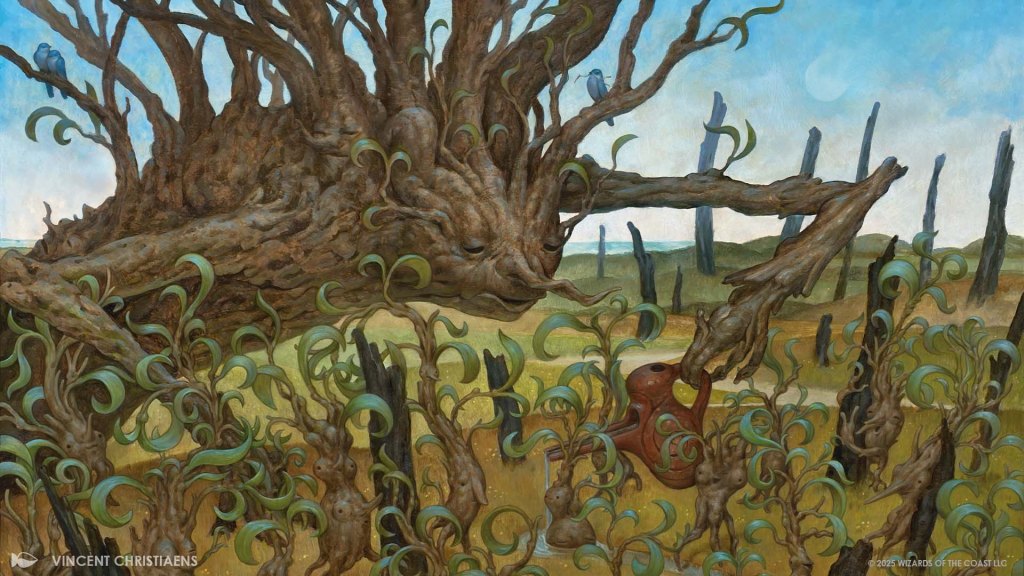
Treefolk suffer the same mistreatment as scarecrows. There are 32 treefolk cards in the Lorwyn and Shadowmoor blocks of yore. First Light managed to give us a condensed description of two sentences per aspect. A total of 156 words, again counting the advice to use a stat block from Monster Manual. This paragraph is more than a third of what we get in the supplement lengthwise.
With treefolk some variety is recognized even in Lorwyn: First Light. To spice things up you get to roll a dice (d4!) and obtain a very short description of the individual. The types are the same as in the Planeswalker’s Guide, but the descriptions even shorter. Perhaps making a table with stat changes depending on the type of tree and aspect of the plane would be more useful?
New monsters
The Marketplace promises 8 new monsters “drawn from Celtic-inspired myth”. The “Celtic-inspired myth” thing is quite unnecessary at this point, but whatever, it’s marketing stuff. They promise giants, faeries, and incarnations of nature. First Light mostly delivers on this promise, as we indeed receive 8 monsters. This time with their own stat blocks, so no more redirection!
We get two giants, one for each aspect. Once again the descriptions look as if the creators had to pay a hundred dollars for every letter. And the 34 giants in the MtG blocks got condensed into two. But no one said we’ll be getting more of them. Both giants are usable and fit into their aspects.
The supplement also provides us with elemental incarnations in the grand total of two. Again, we weren’t supposed to get more, so it’s fair. Here I have to praise Lorwyn: First Light, as the design of the two incarnations is good. Though I suspect the art came first and creatures intended for cards were just given stat blocks. That is fine, even expected. And I understand WotC couldn’t have spoiled too many of the new cards. But still, the Lorwyn and Shadowmoor blocks have 55 greater elementals or elemental incarnations. It’s a bit unsatisfying to get only two. They are something unique to the plane, with wonderfully weird designs. That’s something you could emphasize, not sideline.
Merrows almost get the faerie treatment (we are told to use the Monster Manual stat block), but then we’re given two unique stat blocks. That’s something, though once again I have to question the decisions made. The Lorwyn merrow is given a scepter and a longbow, while the Shadowmoor one doesn’t use weapons. It’s fine to be creative, but why not give them a blade, spear, or staff? The weapons we see merrows most often with? And a blowgun or spinebow instead of a longbow? Spinebows could easily be a new item unique to the supplement. Missed opportunities.
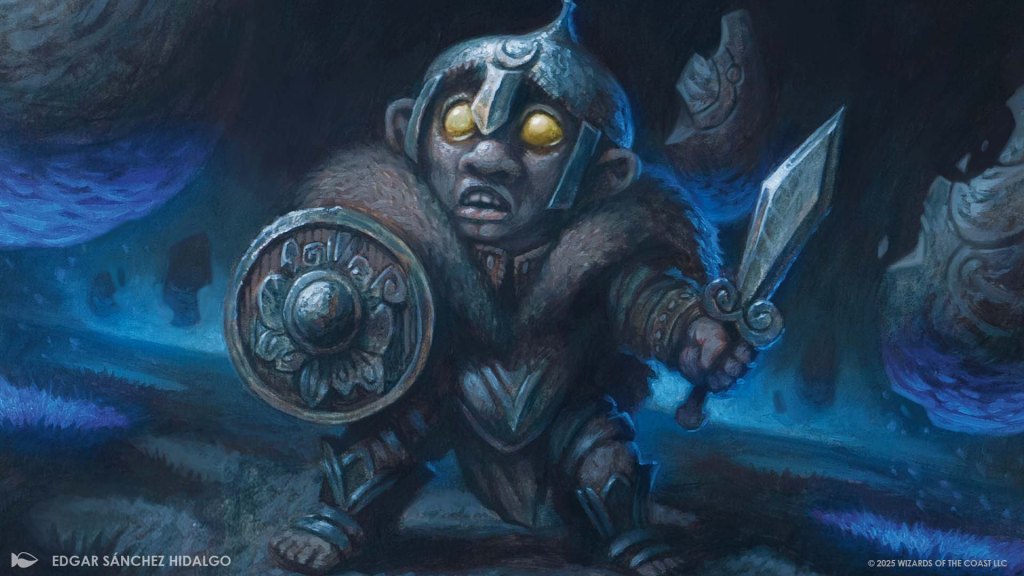
Finally we get two noggles! These charming creatures native to Shadowmoor are depicted on only four cards, and we get two in the adaptation! That’s much more like what I expected. I can’t say anything against these, by now I’m even used to the tight-lipped descriptions. And since we’re not losing unnecessary bandwidth on descriptions, what prevented the creative team from doing the same with bogles, ouphes, duergars, hags, imps, and trolls? You know, the actual creatures “drawn from Celtic-inspired myth”. All of those are mentioned in the Planeswalker’s Guide, so they weren’t forgotten. I hope we’ll see them in Lorwyn Eclipsed at least, along with kelpies, selkies, and pucas.
Adventures
With a bitter feeling I got to the last chapter of Lorwyn: First Light. We were supposed to get two ready-to-run adventures, according to the Beyond Marketplace. When I thought about it, even though the supplement itself is quite subpar, we’re probably paying for the two adventures. Fifteen bucks isn’t bad for two adventures and some fluff and stat blocks on top of that.
Well I don’t know what’s the standard for adventures these days, even one-session ones. But in First Light they amount to one location and two short “adventures” taking place there. I think each of them gives you maybe 2 hours of play, and I’m both being generous and counting all the unrelated banter that’s impossible to keep out of a session.
The “adventures” itself are incredibly simple, essentially just short strings of several combat encounters. There are no decisions to be made, nothing to discover, no opportunities to test the players’ creativity. Just a few fights, that’s all. I could flesh both “adventures” into proper adventures, even stretch them over a few sessions and make them make sense. But I already paid for someone else to do it for me. The stuff presented as adventures in Lorwyn: First Light is akin to something you scribble in your notes a few hours before an unexpected session starts.
The adventures were also meant to fit into the setting of Lorwyn-Shadowmoor. You know, the fabled fairy tale realm full of “Celtic-inspired myth”. Why is there an “expo” in Lorwyn? Did the kithkin get that idea from a memo? Did they also plan a live-stream on Teams for those who couldn’t attend because of scheduling conflicts? And what’s with the “refurbishment company”? Will there be an Extreme Makeover: Clachan Edition? I’ve been doing my best (and often failing) not to sound too dismissive in this review, but this shows either total disregard for the setting, or serious ineptitude. You have the entire Lorwyn-Shadowmoor at your disposal, probably even unreleased lore for Lorwyn Eclipsed, and the best you can do is an expo and refurbishment company troubles?
Conclusion
To conclude I would like to crunch some numbers and do some comparisons. Let’s take a look at Plane Shift. I randomly chose Plane Shift: Zendikar. Released in 2016 it is a nice 38-page PDF of about 12 thousand words. Written by one person and available for free! There are also instances where the author suggests using Monster Manual stat blocks. But each time he provides a lot of Zendikar-specific lore.
The Planeswalker’s Guide to Lorwyn Eclipsed came out in September this year. It was written by a team of three, is full of lore and a little over 12 thousand words. Since it’s an article on the MtG website, it’s also free. There are no rules or stat blocks, of course, but it does what you expect it to do.
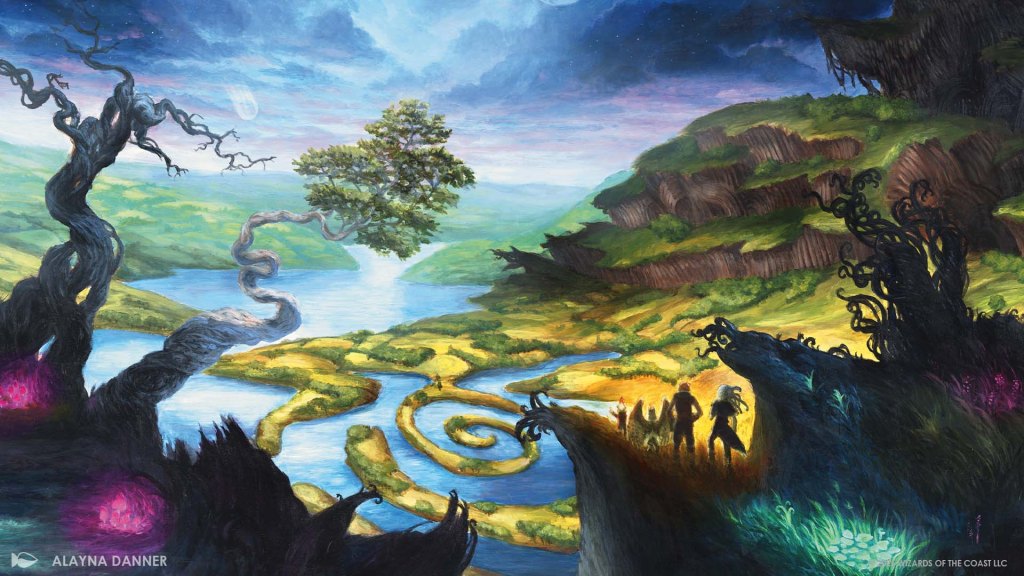
Lorwyn: First Light, the product for which you pay 15 dollars is a bit short of 14 thousand words. Made by a team of four designers, one rules developer, four editors, five producers, an art director, a graphic designer, and four consultants. That’s twenty not counting the artists. I suspect most if not all of the art is repurposed from the upcoming Lorwyn Eclipsed set. Not made for First Light exclusively. Save for the one map made by the great Mike Schley. Unfortunately it was used for “adventures” that certainly don’t do it justice.
Make of that what you will. I sincerely hope this was caused by executive meddling and not by laziness or incompetence. Lorwyn: First Light would be fine as a free teaser distributed before the full release of a normal setting book. The missing parts would presumably be remedied by the finished product. Or if it was just another Plane Shift download. Sure, it’s not exhaustive and it often leaves much unfinished, the Plane Shift books are often this way. But they’re all nice gestures from the publisher. This feels like a sloppy cash grab, a weak marketing move to promote the new MtG set among D&D players. There are some chapters that are better than others, namely the new monsters and the Gazetteer, but it’s not enough.
I have been harsh in this review, but I believe my points are clear and sound. If I seem to be nitpicking sometimes, it’s not self-serving. That’s just the thing with every sequel and remake, be it a movie, video game, or setting. There will be fans who have high expectations based on the source material. You can see in my articles that I’ve been hyped for the Lorwyn supplement from the beginning. When I had doubts, it was out of concern for a loved setting, not out of criticism. I am very much looking forward to Lorwyn Eclipsed, and I believe the money I will spend on the pieces of cardboard will bring me much more joy than Lorwyn: First Light. And more resources one could use to run a D&D game on the plane Lorwyn-Shadowmoor.
Finally a disclaimer, as it probably should be present in a review like this. The author is an independent person not affiliated with Wizards of the Coast, or any other figure in the industry. The reviewed product was bought with his own funds and he’s reviewing it in his spare time on his own. All art used in this article belongs to Wizards of the Coast and other respective owners, and was taken from D&D Beyond Marketplace or the Planeswalker’s Guide to Lorwyn Eclipsed.
Feel free to let me know in the comments what do you think about Lorwyn: First Light, or my review. Do you agree with my harsh views, or do you think I’m being too mean, and Lorwyn: First Light is well worth the money?
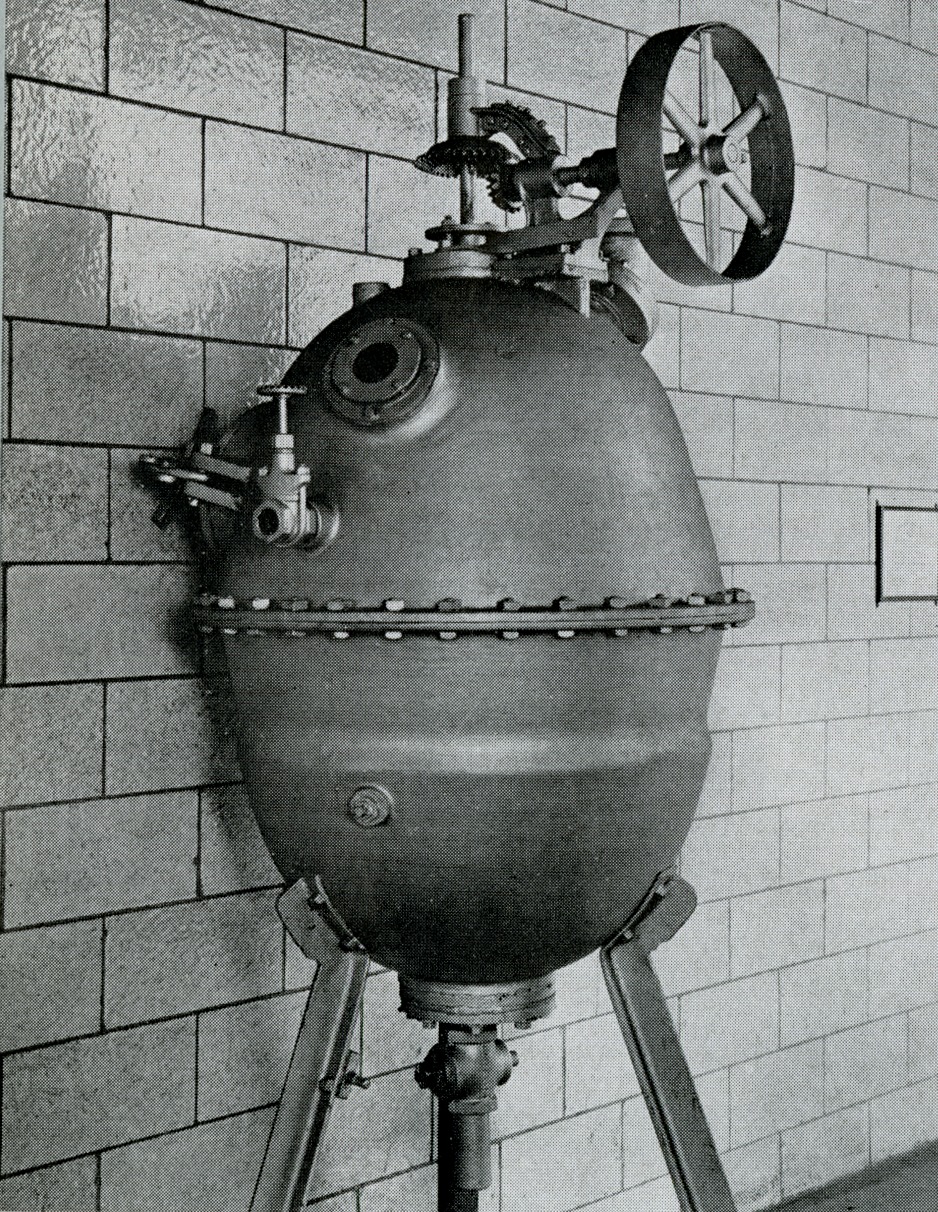
The Bakelizer looks like it would fit quite well in an alchemy lab
Estimated reading time: 6 minutes
When you imagine a fantasy setting plastic is probably among the least likely things you have in your mind. Often based on Medieval, Ancient or Victorian Earth, fantasy settings tend to keep away from such modern inventions as plastics. On the other hand many authors gladly fill their creations with lots of other anachronisms.
It’s understandable – who would want their their dwarven barbarian to drink ale from a PET bottle? This is disgusting even in real life. Or have their elven warlock wield a molded PVC staff? For many this would break the immersion they seek from a fantasy novel or game, be it tabletop or videogame. Yet there are plastics in our world that can seamlessly enter your fantasy setting. Especially if you avoid calling them “plastics”.
Real world plastics
The beginnings of plastics in our world sound like the exploits of alchemists discovering new formulas in pursuit of superior substances. Early polymers were quite different from the plastics of today, and are coveted as collectibles by some. You can read about the history of plastics in the Sources at the end of the article. To keep it short, chemists strove to create new materials for various reasons, often economical. Many of the early plastics were supposed to substitute expensive and rare resources such as ivory. Some can be made at home using quite basic ingredients and equipment.
Then there are modern plastics we all know. They make up a huge amount of the world we live in. Stuff like PVC and HDPE need no introductions, and it can be guessed that Kevlar also rings a bell. These plastics require a complex understanding of chemistry. They also need access to rather advanced equipment and non-basic resources, and are made in large scale. Many are made of petroleum, another thing not commonly used in fantasy settings.
Fantasy plastics
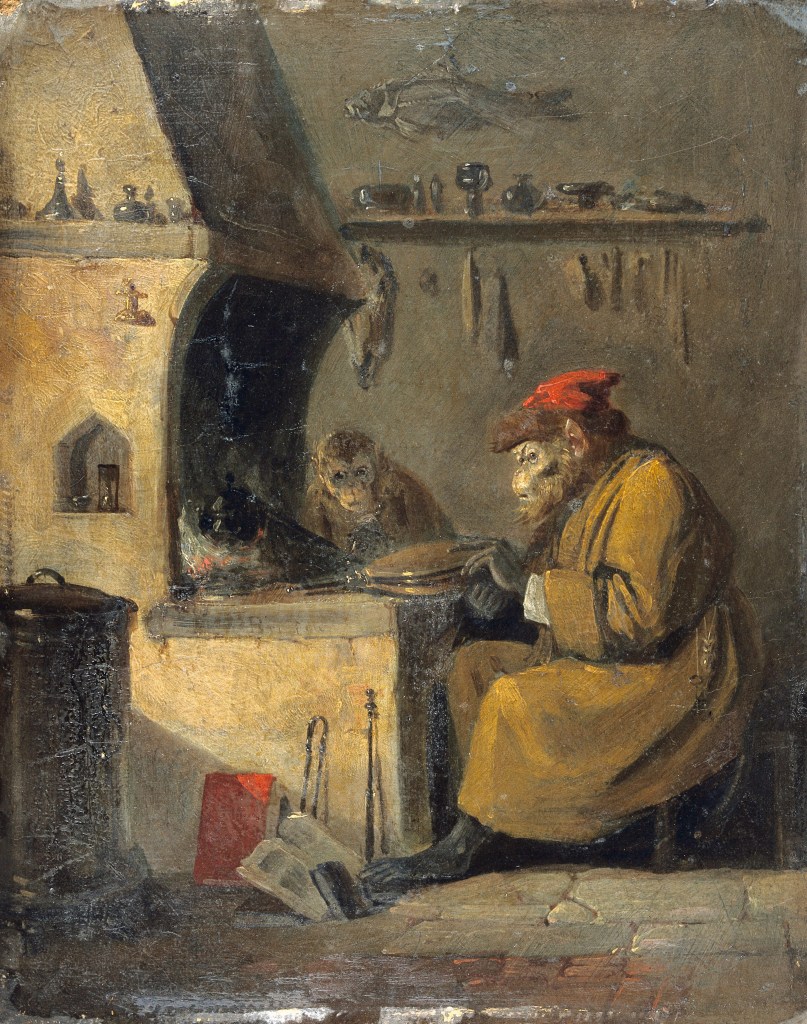
A monkeyman alchemist heating the mold he’s making his new polymer in! Oil by Edmund Bristow (1787–1876) via lookandlearn.com (CC BY 4.0)
Now let’s take a look at our fantasy settings. Why would you introduce plastics into a world where there are other interesting materials, often magical? Think about who’s going to be the creator of the newly introduced plastics. Yes, the alchemists! Some will be conservative and stick to a dozen essential creations that they spam all over. But I believe in most settings the alchemists constantly look for new ways to power, knowledge, and destruction. It’s a matter of time before they start stumbling on plastics. It’s also a matter of availability. Sure you can use mammoth ivory, but it would cost you an arm and a leg. Dairying cows are grazing under your window at this very moment, and for a few coppers you can get all the milk you need to make that new component out of casein plastic!
Now you might say that mammoth ivory has certain magical properties that make it not only more valuable but also desirable for certain applications. Why couldn’t your not-Galalith also have properties that would make it stand out in its own way? It could provide different magical advantages, or dampen negative effects. When made from a special milk, let’s say unicorn milk, unique properties could develop. Even with cow milk maybe the new material is the only one that is non-reactive in combination with another. Or perhaps plastics aren’t new but instead old, the remnants of an ancient civilization, and can be found as artifacts from a bygone era. Either these are usable as they are, or the plastics could be only collected and remade into new items. Roman glass was reused in Medieval period in this way, to the extent of scholars writing explicitly that you should dig in old Roman ruins for shards of quality glass to recycle!
Plastics in other settings
It’s not an easy task finding plastics being used in fantasy. Authors or game designers prefer more “fantasy” materials than something that surrounds us everywhere in real life. There are few exceptions I found and would like to introduce shortly.
Dungeons of Dredmor
The light-hearted 2011 rogue-like introduced plastics as “plastic ore” that can be melted into “plastic ingots”. Most of the craftable items like “pleather armor” or “plastic bolts”are near-useless . There are some high-level weapons though that are crafted using plastic ingots. This is something that can be pointed out as rather useful. Plastics in your scenario don’t have to be common or available. There can instead be specific conditions under which they become a valuable resource.
The Elder Scrolls
One of Morrowind’s most iconic materials is bonemold. It is a composite material made from bonemeal (ground bones) and resin. It is similar to real world bakelite, with bonemeal serving as the filling material, and the resin unsurprisingly as the resin. Both components are natural in origin, so easily explained in a fantasy setting. Being used mostly for making armour by the Dunmer armoursmiths, it has nevertheless other uses. In TES: Morrowind we see bonemold longbows, arrows, and crossbow bolts. Later games in the series offer only armour that can be crafted from bonemeal, leather and some iron.
Different sets of bonemold armour from TES: Morrowind. All rights reserved to Bethesda Softworks, UESP and/or other respective owners (CC BY-SA 2.5 DEED)
The use of bonemold in The Elder Scrolls (Morrowind in particular) shows how you can get unique and interesting results if you don’t think only in terms of traditional fantasy options. Bonemold feels anything but immersion-breaking. It’s never called a plastic, and fits the strangeness of the Dunmer culture very well.
Conclusion
Only two examples of plastics in fantasy settings? Well, the reason for this article is the scarcity of plastics in fantasy. So yes, it’s quite hard to find some media where it’s been used. Outside of settings where plastics are by default common, naturally. The examples show two different approaches. One using outright “modern” plastics for comic relief (Dungeons of Dredmor), the other deals with “archaic” plastics in a less conspicuous way (The Elder Scrolls). Both have their pros and cons. It depends on the setting and tone of your game which is better suited. It’s quite possible to use both “modern” and “archaic” plastics in a single setting. Just avoid using real world names and descriptions such as PVC, or plastic.
What are your thoughts on plastics outside modern or sci-fi settings? Hate it or love it? Do you recall seeing any sort of plastic in a fantasy setting? In a video game, a novel, a movie? Please feel free to share your views and experiences in the comments section. As always, thanks for reading and sharing!
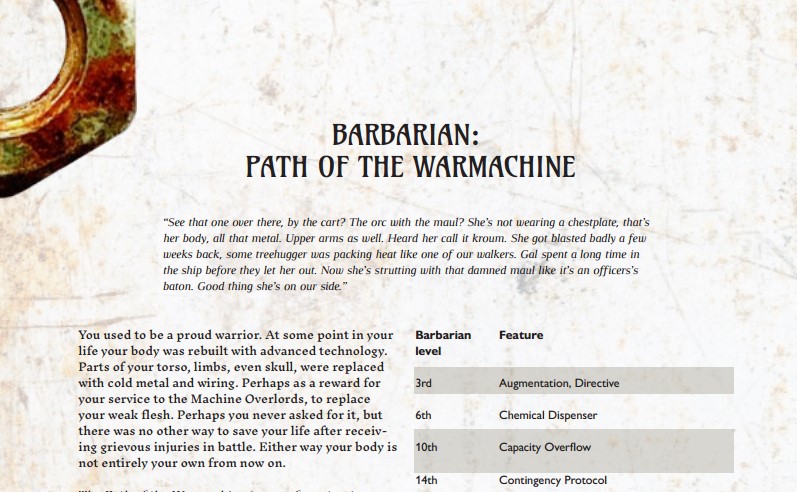
A while ago I started working on a barbarian subclass, one to go with my ranger Conclave of the Monkey Wrench. The Path of the Warmachine was to be its antithesis. Where one was supposed to pose resistance to a technologically advanced threat, the other was supposed to embrace the new technology. Or be embraced by it. It was all about enhancing the frail natural body with superior technology.
The resulting Path of the Warmachine offers survivability above all, with an immediate bonus to AC, and several situational options fueled by rage. The Directive is a built-in role-playing prompt. While the subclass is mostly combat-oriented, as one would expect from a barbarian path, there’s a lot of potential for RP.
Click the picture above or this link to get the full PDF.
The Path of the Warmachine is not part of any particular setting. “Canonically” a warmachine receives their chrome from an invading or at least encroaching foreign force. Either from a far away country, or a different planet/plane/dimension, whatever suits your needs. They might be a foreigner, or a local that has been turned and augmented.
There’s room for all kinds of backstories and events leading to becoming augmented, and also thereafter. You might struggle with the machine parts of your body, maybe it’s against some cultural or religios taboos. You are possibly a traitor to your country or planet.
My take on an augmented individual is far from modular or customizable. The feature options are different, but in the same vein. You don’t have the freedom you would have with Shadowrun cyberware. But that never was the goal. Fifth edition D&D puts simplicity over complexity and modularity, and I wanted to stay in that line. There are surely other supplements that give you much more freedom and don’t limit the enhancements to a particular type of character. But for a novel twist on the barbarian, that fits a certain type of setting, the Path of the Warmachine is yours to use.
That being said, I’m working on a new class with much more options and versatility. I won’t be giving any release dates, but it’s in the works. I’m intending it to be usable both as a class on its own, and a multi-class candidate.
If you read this far thank you for your interest. Would you play a Warmachine barbarian? Let me know in the comments, and please share if you can, so I can get as much feedback as possible. Cheers!




 Rashundai Games
