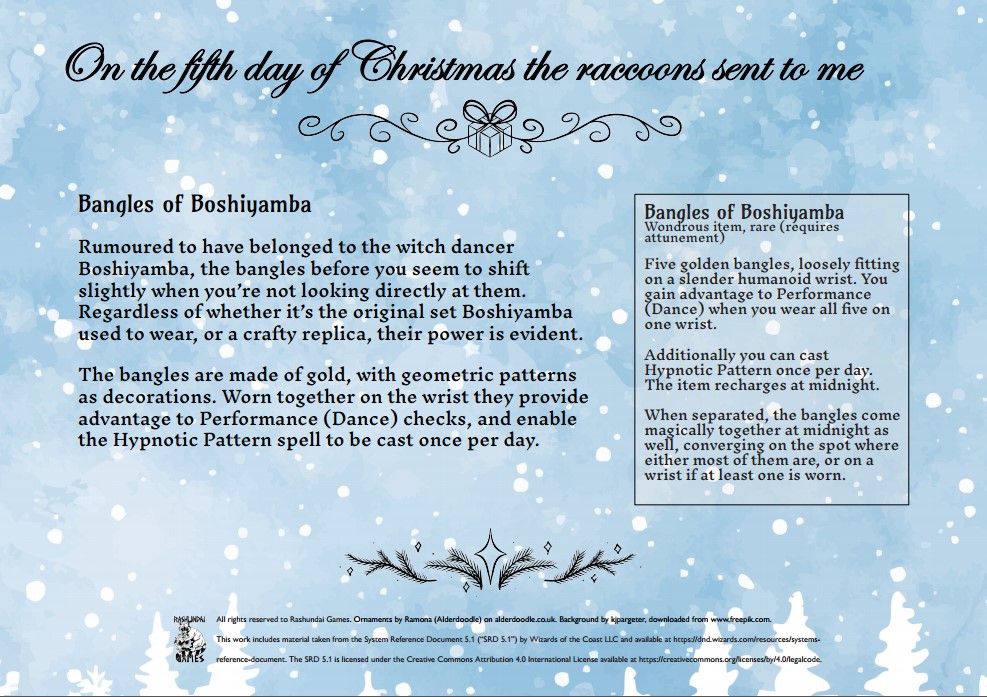
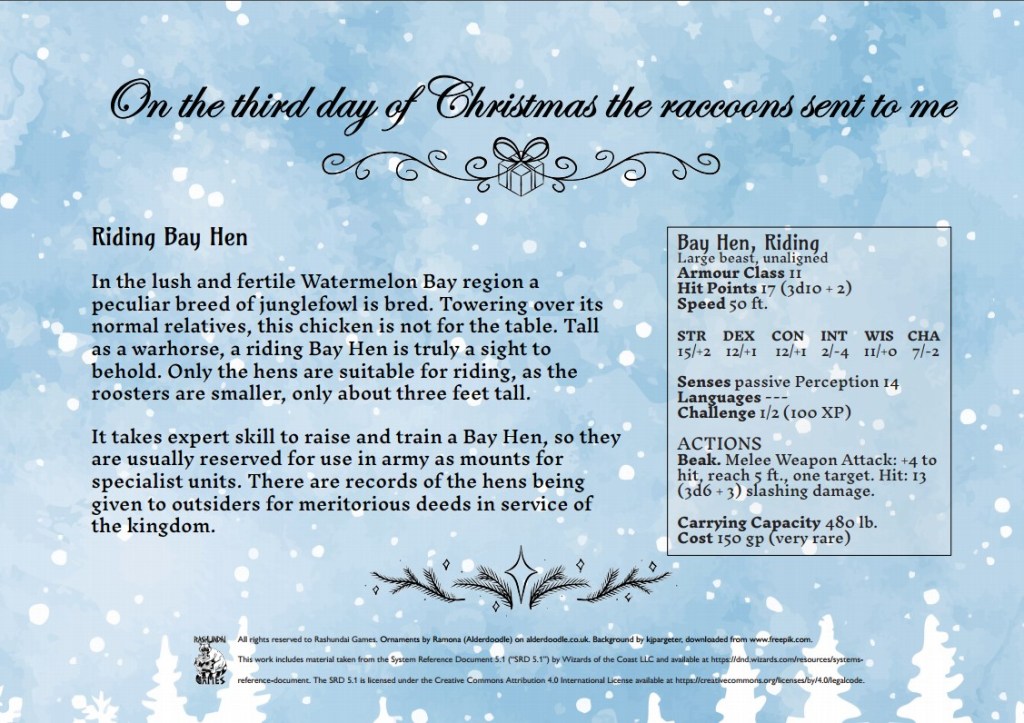
The raccoons have been playing with some cheap golden bangles. We let them, but today instead of three pieces they have five of them! Better let someone have a closer look.
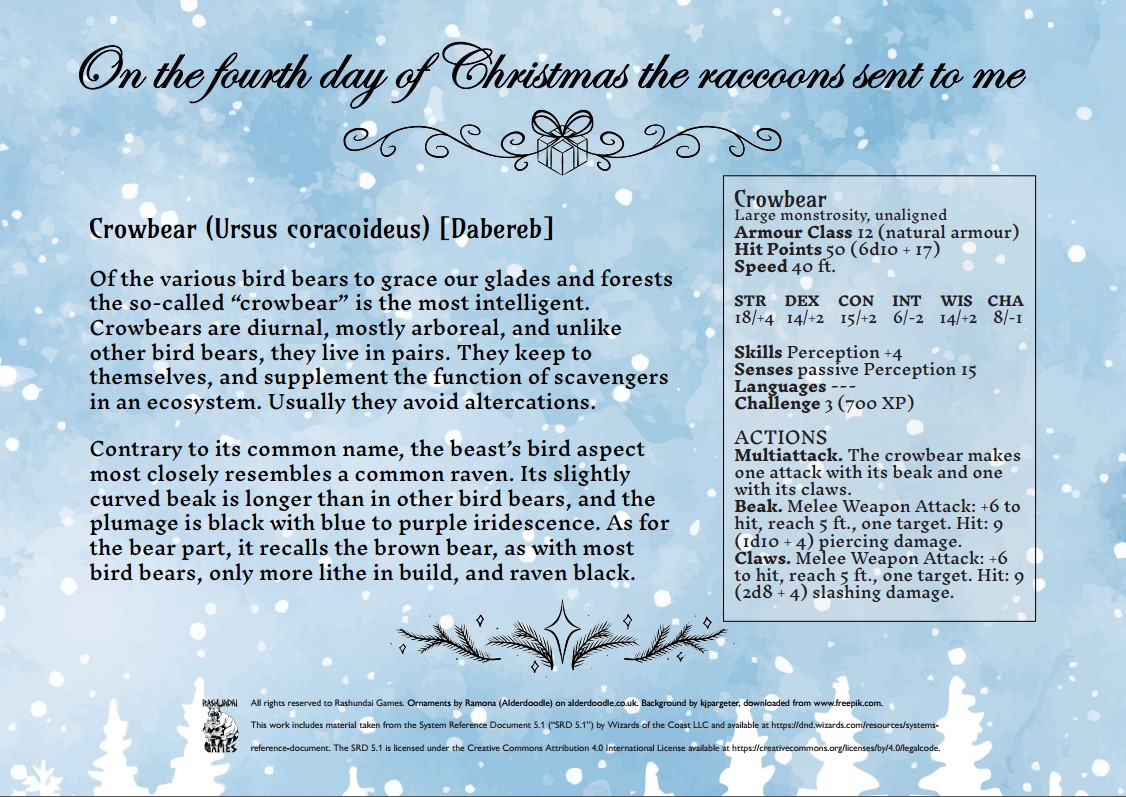
After some chaotic chattering and exclamations the raccoons manage to get across the message. There have been sightings of a healthy mother with three cubs at the edge of the estate. The groundskeeper is overjoyed!
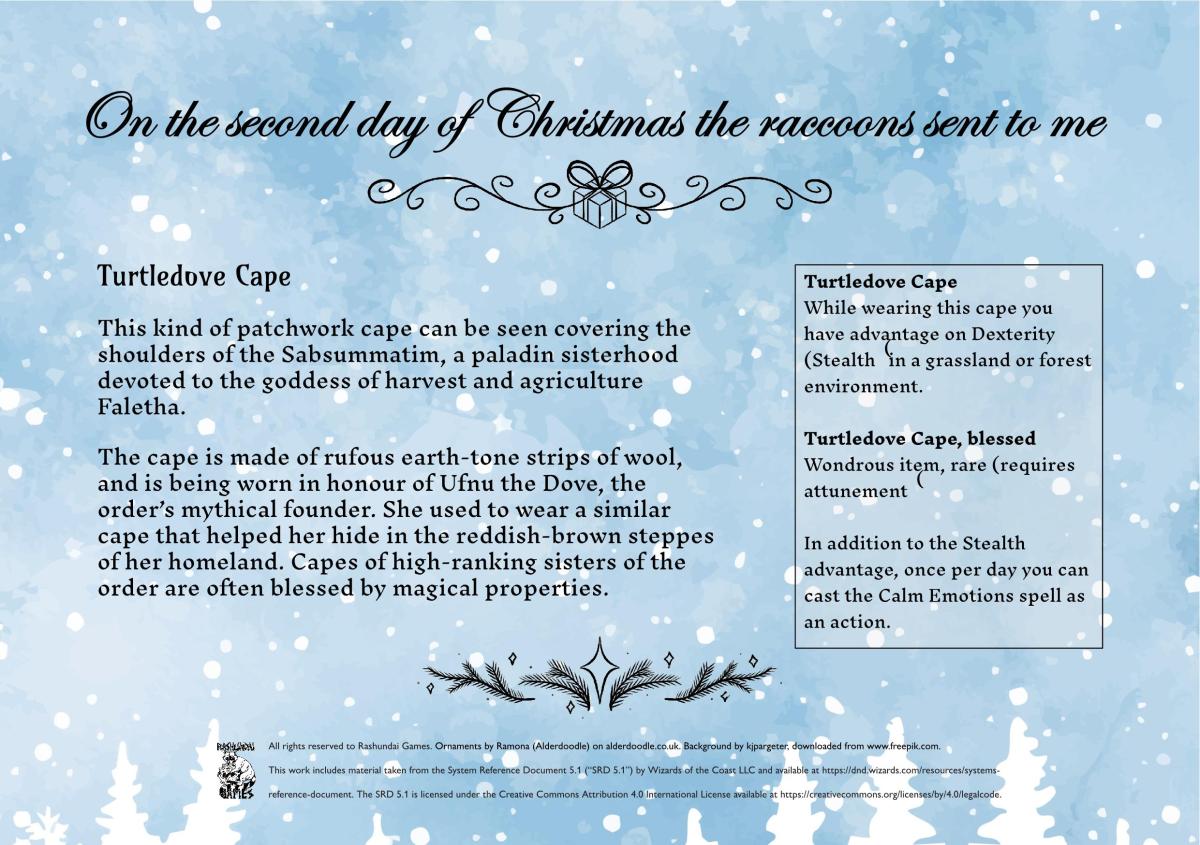
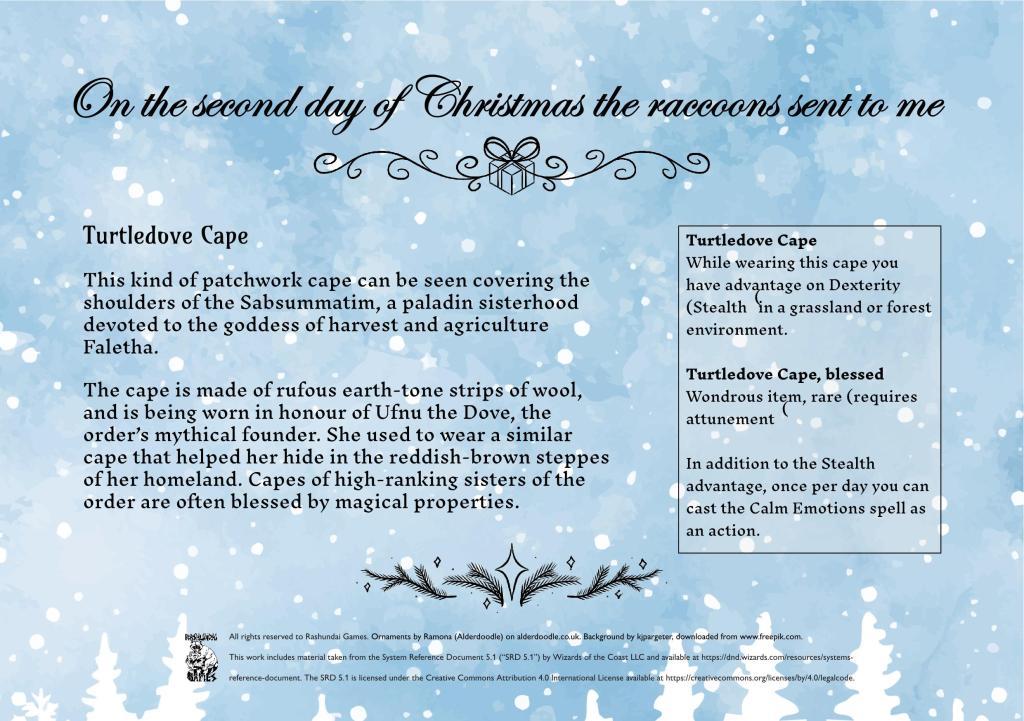
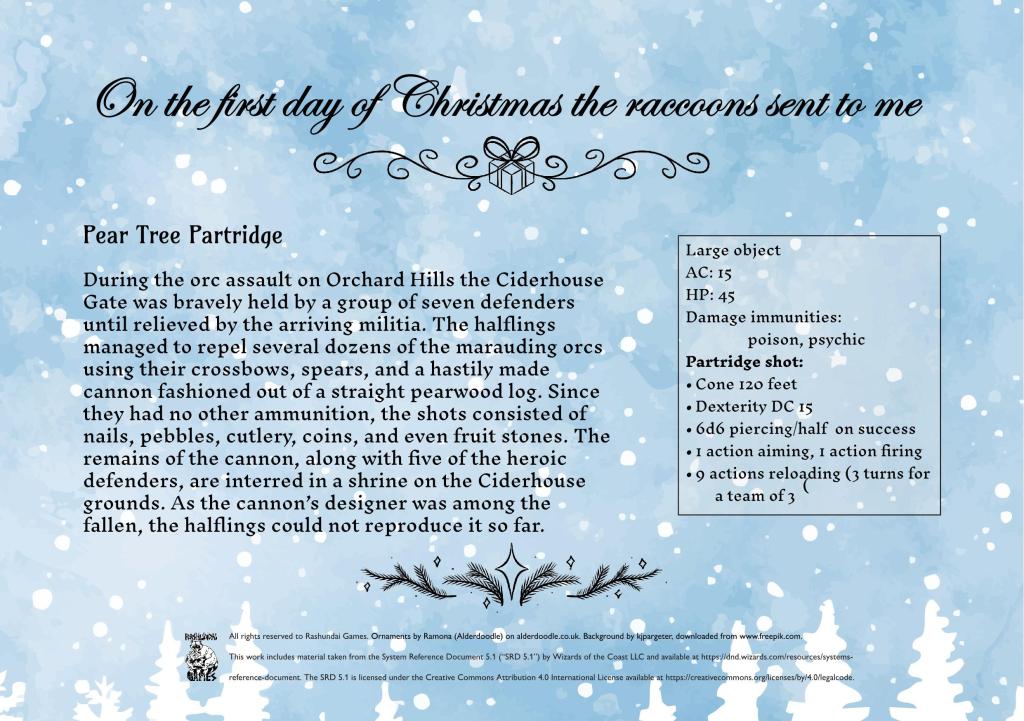
Hello again and welcome to another entry in my D12 Days of Christmas series.
On today’s card you’ll find something you’d expect in the possession of a ranger rather than a paladin. Not all paladins are armour-clad crusaders, and not all wear capes. The Sabsummatim do, and you can read a bit about those here:
I’ve been wanting to do this the last two years, and finally got to work. This will be a short series of short playable TTRPG stuff. Every day you’ll get a card with an item, monster, spell, or whatever else I come up with. It will show snippets of my “default” setting that you can easily adapt to yours.
Without further delays, here’s the first one, click the image to download:
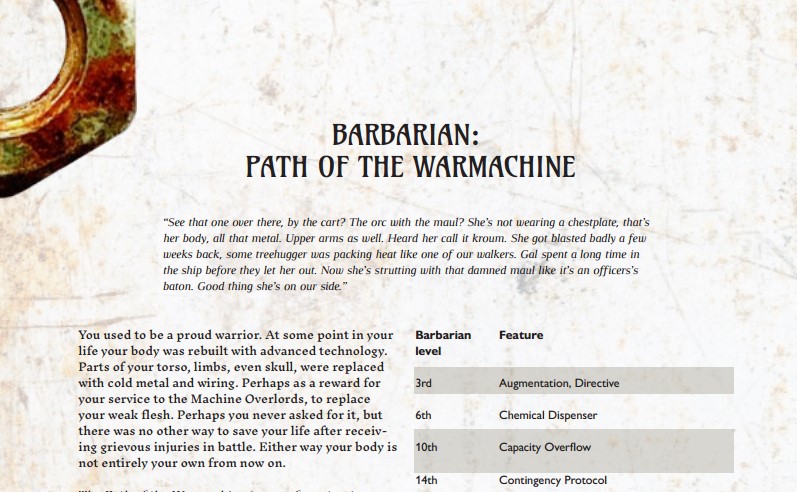
A while ago I started working on a barbarian subclass, one to go with my ranger Conclave of the Monkey Wrench. The Path of the Warmachine was to be its antithesis. Where one was supposed to pose resistance to a technologically advanced threat, the other was supposed to embrace the new technology. Or be embraced by it. It was all about enhancing the frail natural body with superior technology.
The resulting Path of the Warmachine offers survivability above all, with an immediate bonus to AC, and several situational options fueled by rage. The Directive is a built-in role-playing prompt. While the subclass is mostly combat-oriented, as one would expect from a barbarian path, there’s a lot of potential for RP.
Click the picture above or this link to get the full PDF.
The Path of the Warmachine is not part of any particular setting. “Canonically” a warmachine receives their chrome from an invading or at least encroaching foreign force. Either from a far away country, or a different planet/plane/dimension, whatever suits your needs. They might be a foreigner, or a local that has been turned and augmented.
There’s room for all kinds of backstories and events leading to becoming augmented, and also thereafter. You might struggle with the machine parts of your body, maybe it’s against some cultural or religios taboos. You are possibly a traitor to your country or planet.
My take on an augmented individual is far from modular or customizable. The feature options are different, but in the same vein. You don’t have the freedom you would have with Shadowrun cyberware. But that never was the goal. Fifth edition D&D puts simplicity over complexity and modularity, and I wanted to stay in that line. There are surely other supplements that give you much more freedom and don’t limit the enhancements to a particular type of character. But for a novel twist on the barbarian, that fits a certain type of setting, the Path of the Warmachine is yours to use.
That being said, I’m working on a new class with much more options and versatility. I won’t be giving any release dates, but it’s in the works. I’m intending it to be usable both as a class on its own, and a multi-class candidate.
If you read this far thank you for your interest. Would you play a Warmachine barbarian? Let me know in the comments, and please share if you can, so I can get as much feedback as possible. Cheers!
A longer article exploring the idea of monstrous vegetables. Free sample near the end!
Estimated reading time: 16 minutes
Sometimes you need a change from all the orcs, goblins, or undead. Maybe you want to surprise your players, the plot might require different foes, or you just want to have some lighthearted fun. Wherever your need comes from, we’ve got your back with Monster Produce!
I’m talking about monsters based on fruits and vegetables. While you can find plenty of plant-based enemies in the rulebooks, produce is generally not as well represented. Maybe the notion really is silly, and has a place only in parody games. That is up to you to decide after you’ve finished your veggies, I mean this post. There’s also a little treat waiting for you at the end!
The How and Why?
As with all monsters you probably want to know a little more about them than just the stat block. Why would there be vegetables attacking people, and how they came to be? Let’s look at some possibilities.
Your killer tomatoes can be natural or artificial. Maybe spontaneous is a better term than natural. Anyway it means that no deity, magic user, or scientist created them. A magical field, some kind of mutagen, or even plain fantasy evolution, might have created monsters out of these plants. They are probably tied to a place with precise conditions. Like a magical spring or the impact site of a meteorite. These conditions might not be replicable, or they might be (and this might be of interest to certain parties). There might be a “Plane of Produce” where every fruit and vegetable has its monstrous counterpart. These can either be summoned, or maybe they appear when certain conditions are met.
On the other hand we have artificial veggie monsters. They have been engineered by an alchemist of some sort, probably with botanical leaning. They might also be the result of a spell gone wrong (or right), creating dependable (or not) minions from household supplies. A deity might have sent them as a punishment, or as a boon to the faithful.
And what are the pros and cons of vegetable and fruit monsters? It’s hard to generalize, as they can vary widely. Being essentially plants they have different anatomy than animals. They might lack weak spots, though this might also differ across produce types. Slashing damage might be fine, but piercing and/or blunt damage might not work as well on most. Imagine stabbing a raw potato with a fork. Or hitting a celeriac bulb with a stick. On the other hand they might have unique weaknesses. Salt comes to mind, anyone who ever cooked vegetables knows that they release water and soften when salted.
Depending on their origin, these animated greens might still be edible, or at least usable in some manner. I remember fondly the amazement I experienced as a kid when screamers in Dungeon Master yielded edible slices. Woody tissue might be a rare material for crafting. And of course whatever toxic, hallucinogenic, or healing substances found in the original plant might be present. Possibly even more potent in these enhanced specimens.
Veggie Varieties and Fruit Forms
After deciding their origin, we need to choose the shapes and forms of our Horticultural Horrors. The configuration will determine their stats and roles, and might be linked to their origin. I imagine it’s more likely a mutagenic serum would create a massive onion crawling on its roots spreading poison clouds, than little onion people with arms and legs and smiling faces. The latter might be the work of magic, or a deity.
The first type of our typology (type I) is an animated version of the base fruit or vegetable, possibly weaponized by transformed leaves, vines, husks, shell, whatever applies. Fangs, claws, and other animal parts might also be present. It may or may not have a face, often it will have no eyes. Size might differ from one normal for the fruit or veggie to monstrously enlarged specimens. Animated pumpkins lashing vines around, or man-eater plant proxies (giant bell peppers sitting on their plant waiting for suitable prey to come along) fall into this type. Killer tomatoes would fit here as well.
Then there is the aggregate type (type II). Here a bunch of type I specimens become fused or form a reversible colony. This not only increases the mass, but could also lead to the development of new abilities, an increase in intelligence, or even sentience.
The next type (type III) is roughly humanoid (IIIa) or animal-shaped (IIIb). The base fruit or vegetable will get arms and legs, and at least a face if not a whole separate head. They might easily range from cute to creepy. Type IIIa will include mandrake, various fruit and vegetable sprites, Oddish, or Mr. Potato Head. Type IIIb would resemble an animal or a broader animal group (e.g. dog, turtle, lizard).
Type IV is fully humanoid to the extent that the original fruit or vegetable is not readily identifiable at first glance. It’s not an apple with arms, legs, and head stuck to it, but a delicious person made of apple-flesh.
Putrid Potatoes
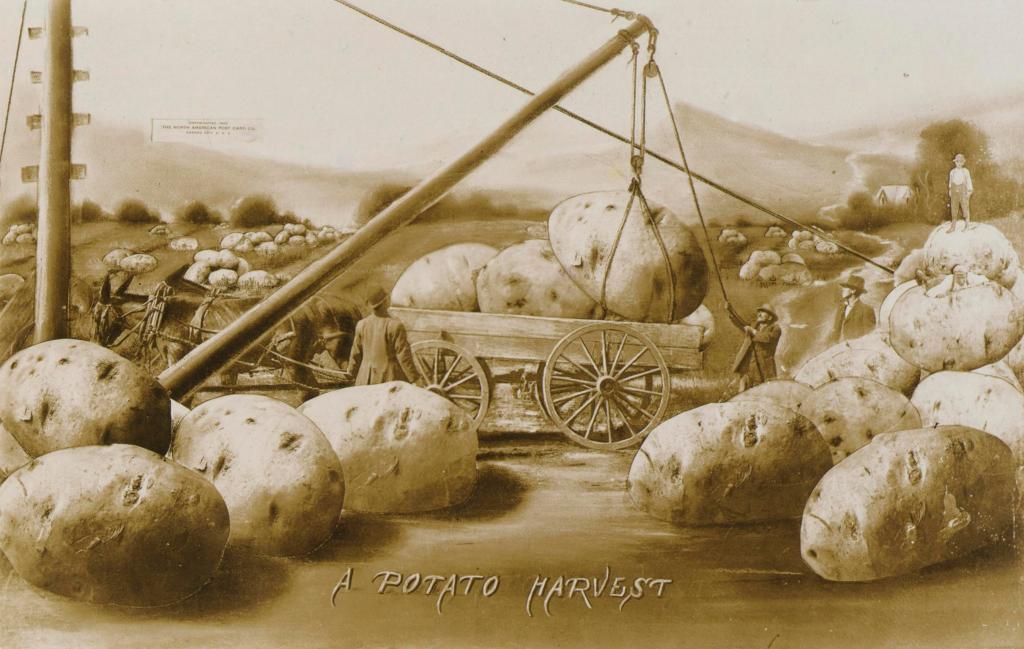
Have you seen those memes with potatoes that have spent way too long in the cupboard and started reaching out for soil and your soul? Look them up if you haven’t. Add to that the often misshapen forms of the tubers and you’ve got a set of attributes ready for monstrification. And what if those potatoes were the size of a man or larger, as in the collage below?
A potato harvest, collage by W.H. Martin (ca. 1910s) via lookandlearn.com (CC0 1.0).
The potato idea was used in the 2011 roguelike Dungeons of Dredmor by Gaslamp Games. Large levitating potatoes with sprouts and eyes (type I) bearing names such as Evil Magic Potato or Enchanted Plaguetato plague your steps from the beginning. They can cast magic missiles or other spells, depending on the tier. It’s certainly a nice execution, one of the best Produce Monsters I’ve seen, actually.
Another game in which you can fight animated potatoes is Void Tyrant by Quite Fresh, a 2019 roguelite for smartphones. There you face Potators, humanoid potato figures (type IIIa) who look like, surprise, potatoes with arms and legs. Apart from trying to bash in your skull they hand you potatoes that clutter your card deck. Not the greatest of concepts, but it fits the not too serious tone of the game.
Callous Carrots
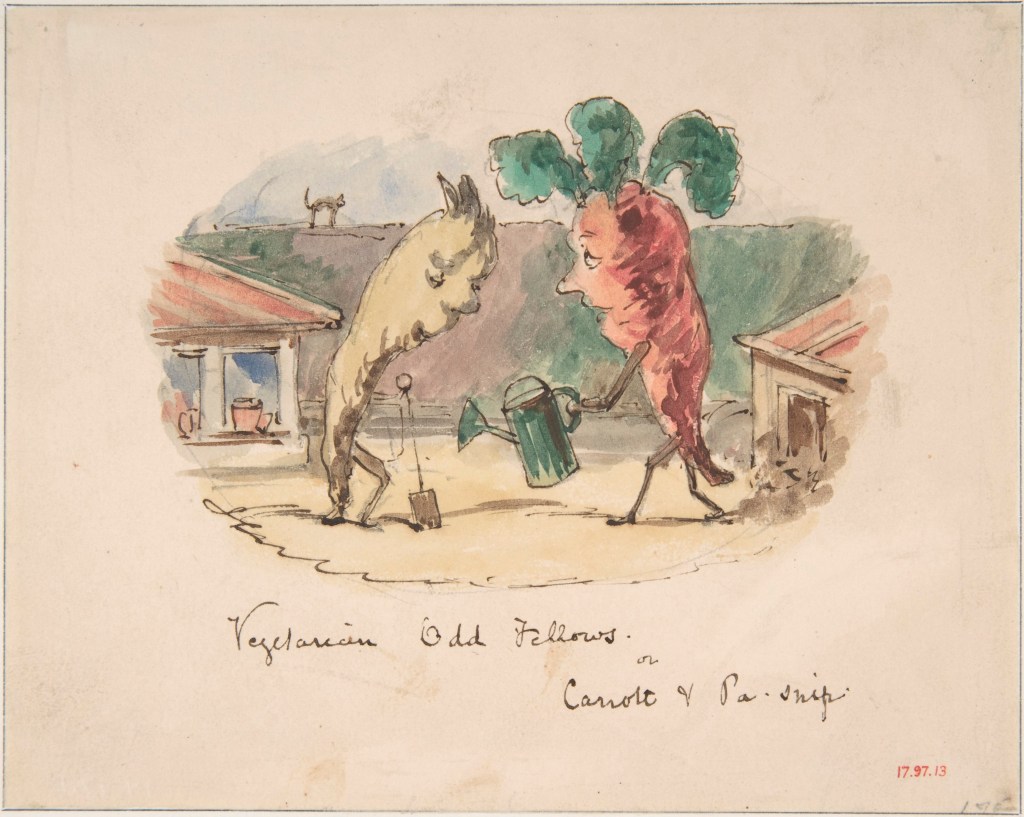
“Vegetarian Odd Fellows: or, Carrolt and Pa-Snip” by John Leech (1817–1864) via lookandlearn.com (CC0 1.0).
They don’t look especially menacing, do they? What if they’re two metres long with centipede-like legs and mandibles? And we can extend this category to other Apiaceae to include parsley and parsnip. If you’ve ever grown parsnip you might know that it contains furanocoumarins. These are compounds that react with your skin under sunlight and cause inflammation. See the potential there?
Carrots have also been utilized in Dungeons of Dredmor, taking form of an upturned carrot walking on its leaves (type I). They appear later than the potatoes, so presumably they are more powerful, but I haven’t met them yet.
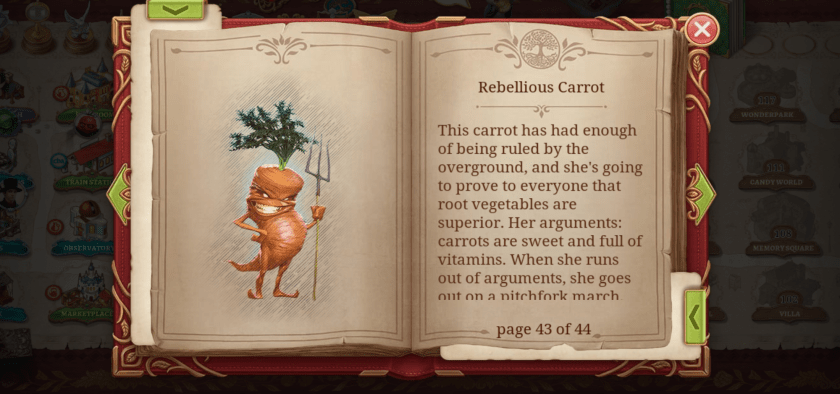
A carrot monster from Seekers Notes. All rights reserved to Mytona.
There’s a secret object and puzzle game called Seekers Notes, mainly for phones. It’s not combat oriented, but there are enemies you have to beat to advance the story and grind items. There are changed seasonally, and in Spring of 2025, the theme was apparently Vegetable Uprising. One of the enemies is Rebellious Carrot, a type IIIa carrot with humanoid features, holding a pitchfork. You need a special peeler to dispose of it in the game. Although cartoonish, this is a solid example of what this article is about.
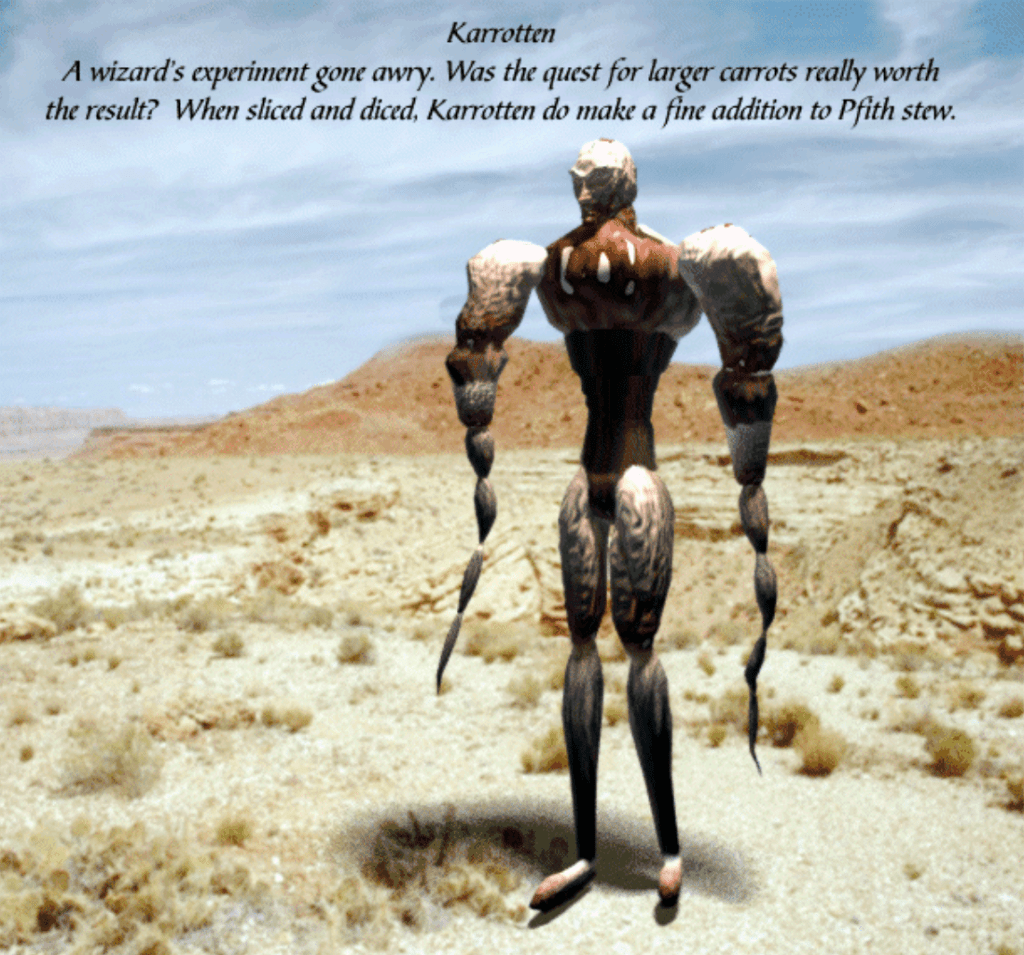
Karrotten as seen in the in-game Encyclopedia of Seven Kingdoms. All rights reserved to Enlight Software and Interactive Magic.
A different take can be seen in Seven Kingdoms, an RTS by Enlight Software. In this 1997 game we find the Fryhtans, a collection of monster races. One of these are the Karrotten, a type IV species of magically created carrot-people. Not much background is provided, but it shows that even in an otherwise mostly serious setting there can be place for monster veggies.
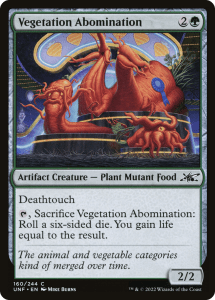
Several mutated specimens of carrot. All rights reserved to Mike Burns and Wizards of the Coast.
There’s also a nice example of what are presumably mutated carrots in Magic: the Gathering set Unfinity. We see what looks like a worm or naga, a tentacular beast, and a sort of hydra. So two of type IIIa and one type I. The card says they have Deathtouch, which is an ability that makes damage lethal no matter the amount and the toughness of the defender. This could mean they are venomous, so we get once again to the produce monsters’ potential toxicity.
Terrible Tomatoes
The main stars of several parody B movies, killer tomatoes are one of the less usable produce-based monsters. It would be very hard to use them as they featured in the movies (or at least the first one, of which I have seen a few minutes) in any kind of at least partly-serious campaign. Even in parody games you could do better. In Attack of the Killer Tomatoes they are just enlarged tomatoes that beat people to death. A better way to use tomatoes would be to treat them as any other fruit or vegetable mentioned in this article – even type I could be done better than that.
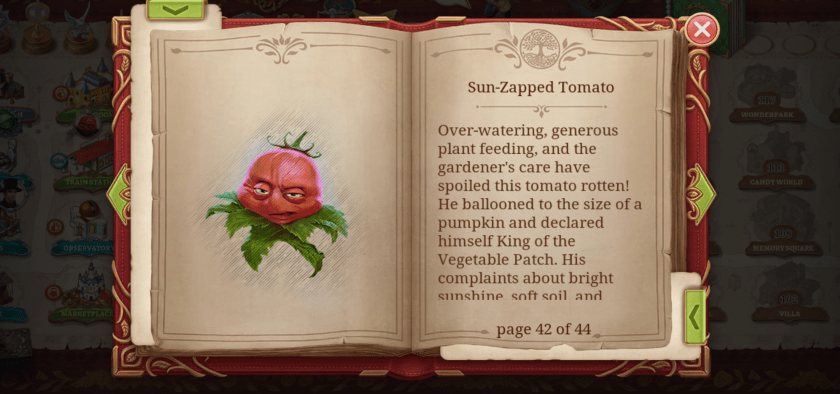
The Sun-Zapped Tomato from Seeker’s Notes (see above) is a better example. It’s a levitating giant tomato with an annoyed look. Due to the nature of the game we don’t have any stats. It is described as an ever-complaining bore declaring itself king of the patch. Maybe this one could be an NPC instead of a monster? To banish it you need a special Tomato Salt, so there we have a weakness as well (salt!).
A tomato monster from Seekers Notes. All rights reserved to Mytona.
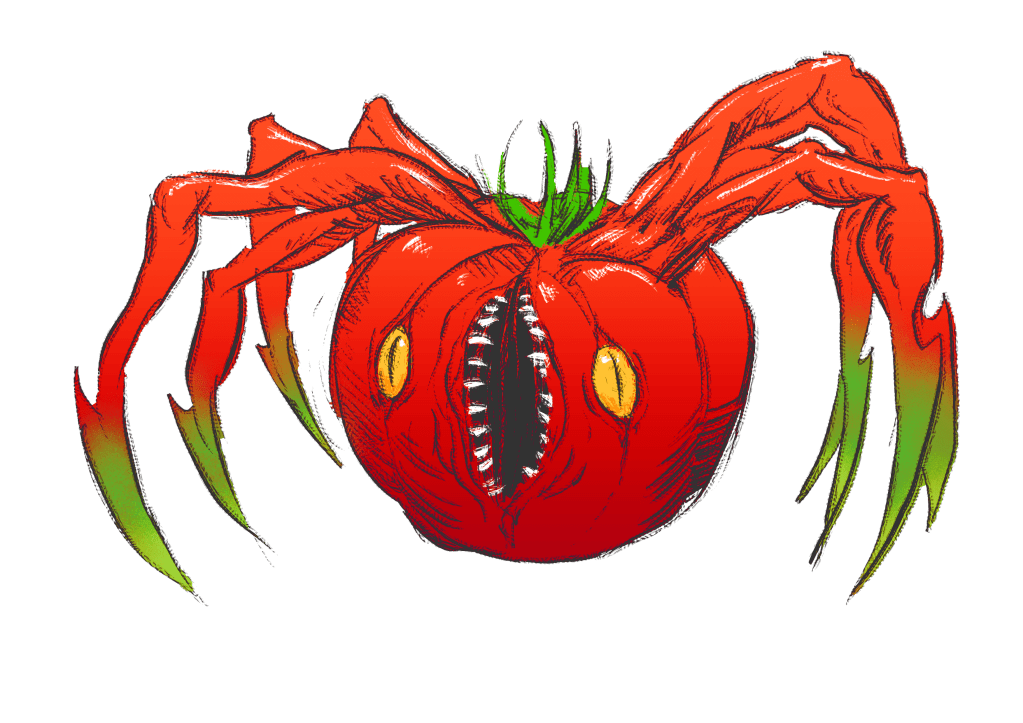
Below is nice type IIIb tomato monster found in an art asset pack I bought. It resembles a spider, or the spider-head things (from The Thing). The image doesn’t indicate scale, but I think it would make a nice monster whether tomato-sized or larger. I would lean towards it being quite large, with the tomato part being perhaps 5-6 feet in diameter.
Tomato spider by Chaoclypse from a pay-what-you-want art pack. It’s a nice design and I gladly paid the suggested price for the pack. I’ll use the other artworks elsewhere, I guess.
Pitiless Pumpkins
A classic, animated pumpkins and pumpkin-based monsters are a staple of Halloween-themed content. Pumpkins come in many shapes, enabling a lot of variety, but the most iconic Connecticut field pumpkin is probably the one that comes to your mind right now. It’s not uncommon for pumpkins to be “enemy-sized” even when they aren’t enlarged somehow. Pumpkins also grow on vines, so you don’t have to worry about having to explain why they possess limbs – they’re modified vines, of course. I’ve seen examples of types I and IIIa, but it’s not hard to imagine a type II as well. Type IV, or pumpkin people, are quite common in fiction, though they are usually some other sort of monster, such as fey or undead. I won’t give pumpkins any more space, because although I like the idea very much, it’s very ubiquitous across genres and media.
Perilous patissons
Patissons or pattypans or are a sort of summer squash that used to be quite popular in Central and Eastern Europe. They have a curious shape resembling a pie or a flying saucer, and there are also “fingered” cultivars. Belonging to the Cucurbita family they offer pretty much similar option as pumpkins.
Until recently I believe there were no patissons used as a base for a creature. That changed with this blog post by Paizo, so kudos to them and a memo to myself not to loiter when I write (I started writing this in January 2024). The Pattypan of Gold Bits is presumably a gourd leshy by Pathfinder 2e taxonomy, i.e. a plant creature summoned by a fey or a druid. Or type IIIa when keeping to the categories of this article. Gourd leshys are actually a fine solution to this type of monster produce. You just have to change a few bits if you want a different vegetable. Maybe borrow fungus leshy’s Spore Cloud for a onion-based leshy.
Obnoxious Onions
If you cry while cutting onions, you might want to avoid these. All well known irritants, the Allium family offers several different candidates for new monsters. Onion, shallot, and garlic have large bulbs and long leaves, while leek, scallion, chives, and wild relatives such as ramsons, are mostly leaves.
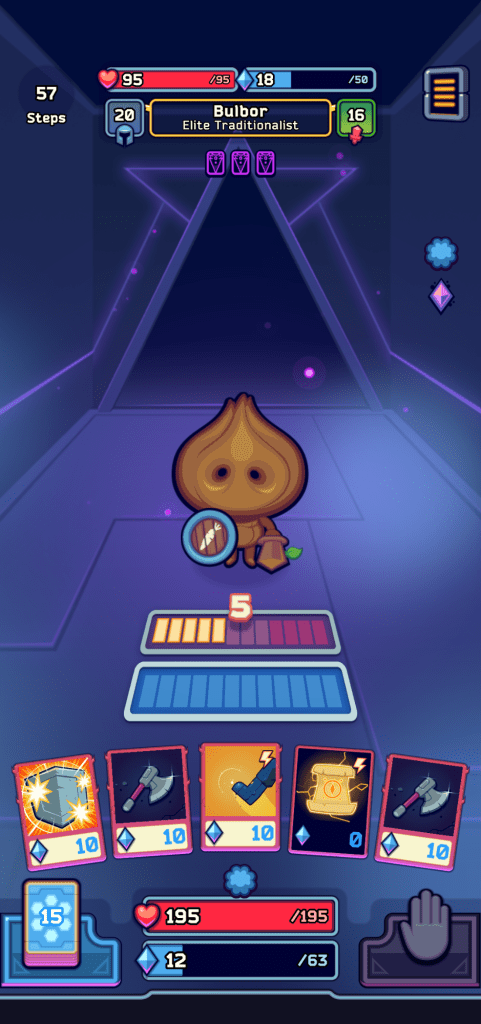
Bulbor from Void Tyrant. All rights reserved to Quite Fresh.
There’s quite a few option with the onion family that can build on their irritating volatile compounds, whether in the form of a skin acting poison or noxious vapours. These can be released on demand or perhaps on being hit.
Onions have been used in Void Tyrant as well, in the form of Bulbors, a type IIIa monster. As with Potators, these little smelly fellows hand out vegetables while trying to kill you.
Apparently, there is a Malaysian animated series for kids called BoBoiBoy from 2011, where there’s a villain aptly named Onion Monster. Its powers include noxious gas.
Tormenting Turnips
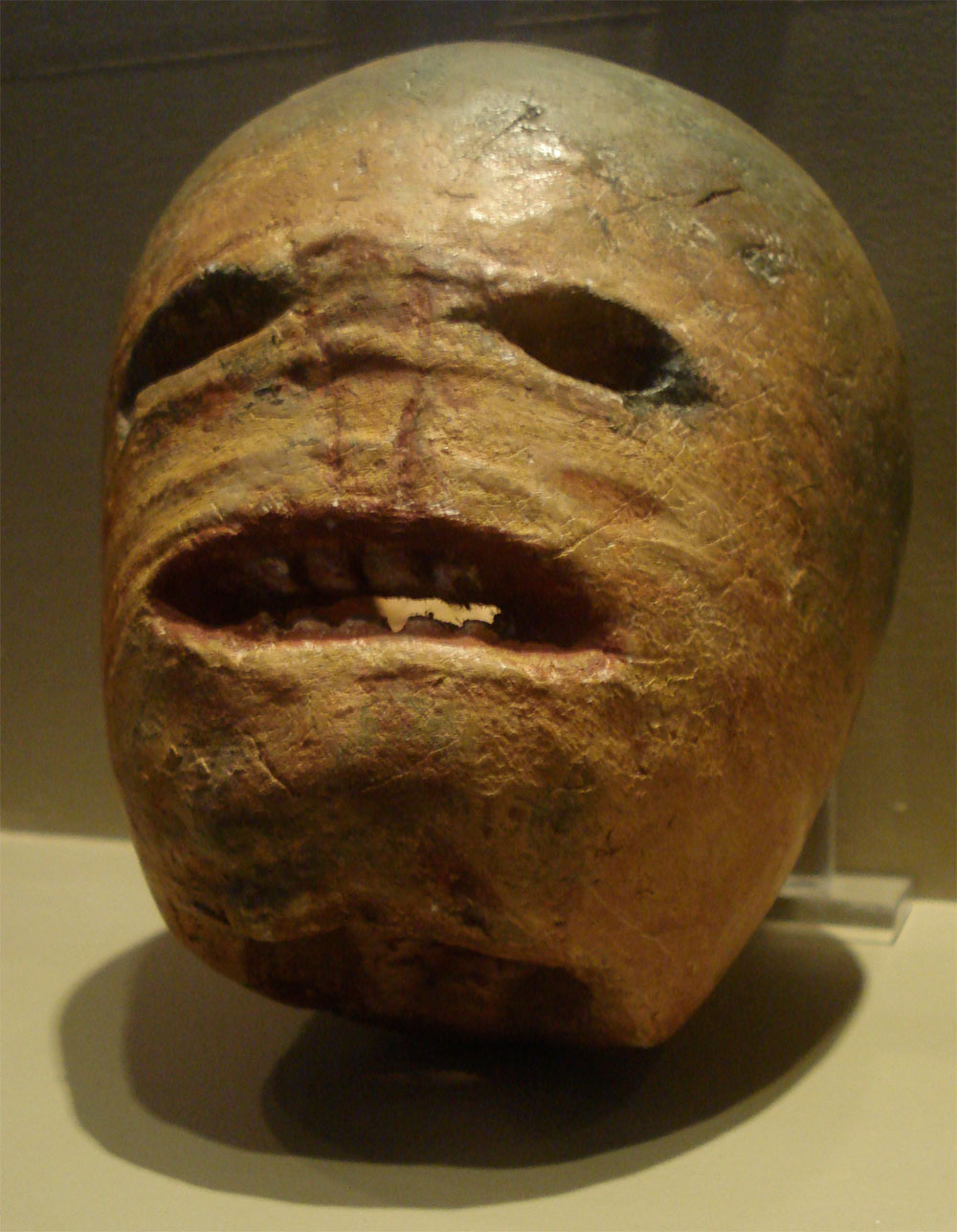
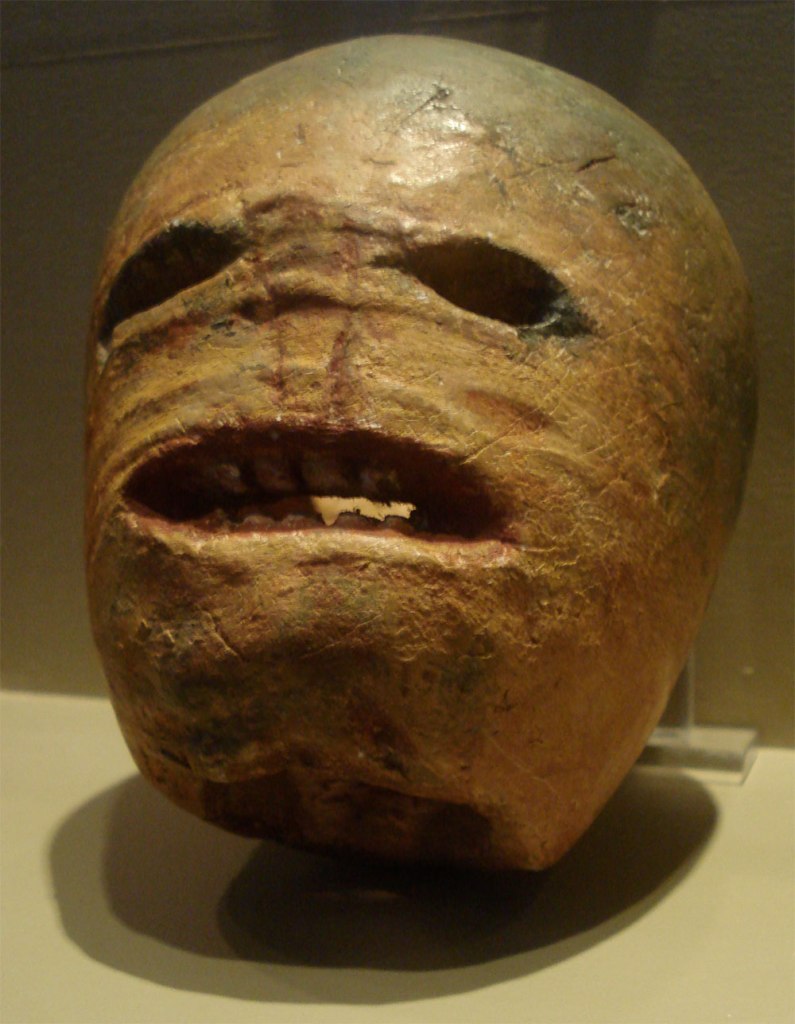
Do you know what people used to carve Jack-o’-lanterns before pumpkins? That’s right, turnips or rutabagas. You might have seen photos of sweet little faces such as the one below. Imagine it with a little torso, arms, and legs, wielding improvised weaponry such as kitchen knives, meat tenderizers, or a good old shillelagh – a band of turnip goblins terrorizing the countryside makes for a nice low-level threat. They would fall under type IIIa.
An early 20th century turnip Jack-o’-lantern from the Museum of country life, Ireland. All rights reserved to rannṗáirtí anaiṫnid.
Used in Dungeons of Dredmor their turnip-based monsters come with names such as Murderous Rutabaga or Ancient Rutabaga. They have some toxic properties that would perhaps fit better with radishes than rutabagas, but otherwise fit quite well into the overall theme of the game and its vegetable foes as a type I.
Swede is another name for rutabaga, and it’s been made into a monster by Czepeku for one of their battlemaps here. It looks like a man-sized type IIIa that’s been cut in half on a kitchen table. Hopefully it wasn’t friendly. While this is a very simple form of monster produce, it can be very effective as a foe. And also as an NPC, if you take inspiration from similar looking radishes (see below).
Ravenous Radishes
Radishes come in many forms – the small European red ones that are called summer or spring radishes, and the winter radishes comprising the larger varieties such as black radishes, daikon, and other Asian radishes. All of them are pungent and to some degree spicy, with European radishes being usually milder than the likes of daikon or black radishes. I believe we can bundle their relative, the horseradish, with the radishes, and let it take the first place in sharpness.
Sharpness is the key when we’re talking about radish monsters, so we have a similar arsenal as with onions. Radishes could however be sturdier built, and more earthy than leafy.
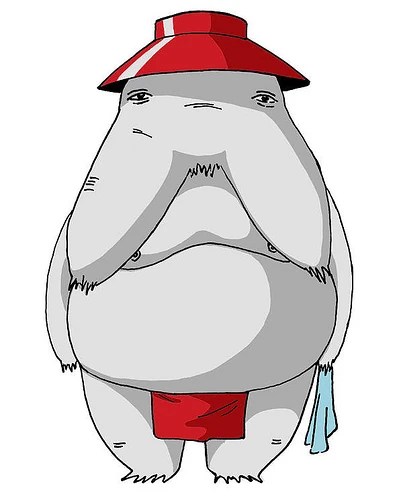
There are several examples from media where radish is used as a base for a creature. In the excellent Spirited Away by Studio Ghibli there’s the Radish Spirit, appearing as a large and benevolent bipedal daikon. Though it was a presumably unique spirit and not there to fight anyone, one can see the appeal of a hulking humanoid-shaped root vegetable. Either used as an NPC, or as a monster to be fought in a vegetable dungeon.
Radish Spirit from Spirited Away. All rights reserved to Studio Ghibli, image taken from the Ghibli Wiki.
Lethal Lettuce
Lettuce, what a bland vegetable in itself. Add a bit of salt and vinegar and it’s more appetizing. Add some magic or mutagens and it’s a murderous organic drapery waiting for some unlucky soul to get too close. The leaves suggest engulfing foes, or flying, possibly both at the same time. Imagine a giant romaine lettuce flying through the night sky, dropping unsuspected on its prey, killing it by suffocation within the folds of its leaves. Or perhaps using some toxin or digestive acid, why not? Or the same lettuce hanging in the forest canopy above a path, waiting for solitary travelers.
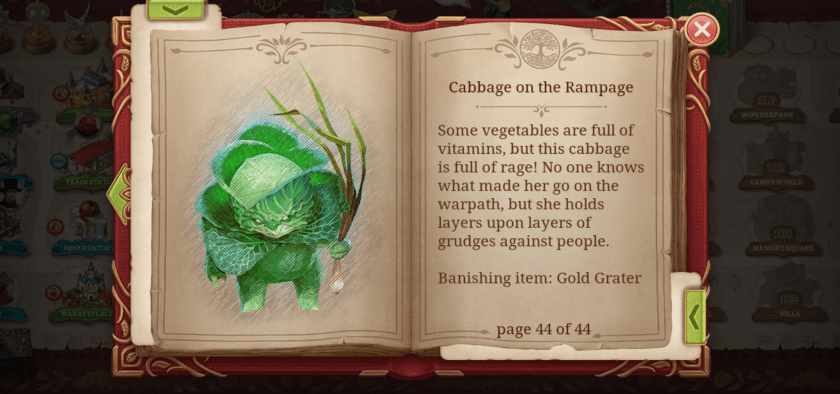
Finally, a cabbage monster from Seekers Notes. All rights reserved to Mytona.
The screen above is once again from Seekers Notes. The highest tier of vegetable monsters in the game is this type IIIa raging cabbage. It’s using an onion as a weapon, and to banish it you need a Gold Grater. It seems quite bulky, built like a golem. Usable as both an enemy and an NPC.
End of part I
There’s a lot you can do with produce as a base for your monsters, or even sentient species. While some players might dismiss them as too nonsensical, I believe when done right they can be an interesting way to liven up your bestiaries. As a DM you know your players (or at least you should), so you probably know what they will like.
These creatures, whether you’re using them only as fireball fodder, or as important NPCs, will broaden your options. You can base them on existing features of real plants, or add new traits that they have evolved or received. Make your party wade through ketchup for once instead of gore!
I would also like to announce that I am working on a produce-themed supplement, part of which will be a bestiary! CLICK HERE to get a free WIP sample!
So that’s it for part I! This article has been on my table for more than a year, and it was starting to get a bit stale. I also feel it would be better to put fruits in a separate article. Get ready for some fruity foes in part II!
Finally some playable content! Below you can find the download link for a new class option for rangers, the Conclave of the Monkey Wrench. It is quite setting-specific, but I believe universal classes are not the way. After releasing its antithesis, the Path of the Warmachine for barbarian, I came back to finish this post.
Click the image to download the full PDF!
The Conclave of the Monkey Wrench was made with a specific scenario in mind. A more or less pre-industrial setting gets visited or outright invaded by a technologically advanced party. It might be an advanced nation from another continent (think Europeans in Earth’s modern period), aliens from another planet, or beings from other plane or dimension. The outsiders covet the local natural resources and start probing or exploiting them. Among the locals are those who would resist. Many of those would come from the nature-focused groups such as druid circles, rangers, and servants of nature deities.
The ranger of the Monkey Wrench conclave is your D&D equivalent of a noble ecoterrorist. Tree spiking, machine sabotage, escaping from pursuers. Ranger is a class that suits this role well thanks to their versatility. It only needed some anti-tech flavour.
The Conclave of the Monkey Wrench has several points of focus. First of all it aims to confront machinery. Whether in the form of various constructs or installations used for resource mining, you have advantages on dealing with them. At higher levels you also embody the reduce-reuse-recycle philosophy by creating weapons out of destroyed constructs. They should not be too powerful for a 11th level character, but might provide some needed damage variety. And the 15th level feature, Short Circuit, expands your sabotage options in multiple ways – range, scale, magnitude.
Next there is the mobility aspect. The 7th level feature lets you pull off hit and run stunts in the environment where you need it the most. Combined with spells like Jump, that are already at your ranger’s disposal, this makes for a very mobile character.
Last but not least I wanted to build this subclass a bit differently than the official ones. I didn’t want the generic combination of conclave spells and three features. The theme lends itself quite well to having a signature tool, the Monkey Wrench. The exact shape and stats can vary, you can make it into a sonic screwdriver for all I care. Just use the stats for a dagger if you need to hit something with it. The Monkey Wrench should in any case be a tool first and a weapon second. Ideally with ties to the technology you’re up against.
You can write in the comments what are your thoughts about this subclass. Would you play it? Is it playable? Let me know, and please share if you liked it!



 Rashundai Games
