Lorwyn: First Light review

A review of the new Lorwyn: First Light D&D supplement based on the Magic: the Gathering blocks Lorwyn, Shadowmoor, and the upcoming set Lorwyn Eclipsed.

Estimated reading time: 20 minutes

The long awaited D&D supplement is finally out as of November 18. Since its latest announcement in September I’ve been a bit skeptical, so I waited a day before buying it. But being the Lorwyn fanboy I am, I couldn’t really let is pass.
Since the first announcement during MagicCon: Chicago in February I’ve been working on a series of articles about Lorwyn-Shadowmoor. Mostly they’ve been filled with my predictions and thoughts about how will certain things get handled by the creators.

We will be getting a supplement with lots of lore, stats for various monsters, place descriptions, etc. done by professionals with access to the original notes (hopefully). In the meantime I can offer my take on the already published stuff, and speculations about what will be in the sourcebook. – quote from my first article on D&D Lorwyn

I managed to finish a huge bundle of four (!) articles to this day, with the Shadowmoor Merrows still in the WIP phase. Blame my job, which is completely unrelated, and the oppressive need to provide sustenance and shelter for my family.

With Lorwyn: First Light finished I can compare my speculations with the finished product. This will be a complex review of both form and contents. I’ll take a good look at what First Light provides and what it doesn’t. Can you play a campaign in Lorwyn using the new supplement? How much work is left for the DM after reading it? Let’s get to it!

Form and Format

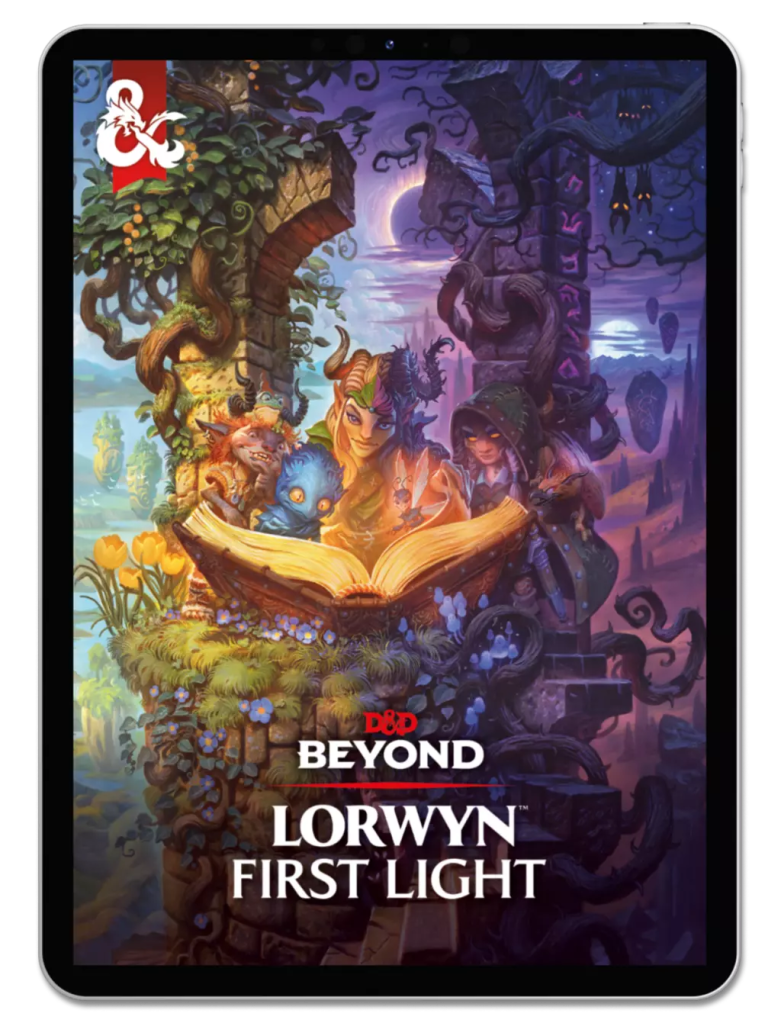
Lorwyn: First Light is a digital-only release available on the D&D Beyond Marketplace. When bought, you’re not given a download link for a PDF, but instead you can browse the contents on the site. This is probably normal for D&D Beyond, and it shows that I don’t have experience with the site. I have my rulebooks in hardback, and all the 3rd-party stuff as PDFs.

The supplement is divided into four chapters and an introduction. The introduction gives a short, well, introduction to the plane. It provides the basics of geography, cosmology, and history. Chapter 1 lists the character options, while in the second chapter we return to the geography of the plane. Following is the third chapter, the Bestiary, and the last one is called Lorwyn Adventures. We’ll get to each of them in a while.

An advantage of the D&D Beyond treatment is that there are keywords that either link to a relevant source (also on Beyond), or show a pop-up card with a spell description for example. I’m inventing the wheel here, but since I don’t use Beyond, this is our first encounter. It goes without saying that you need access to the linked source on D&D Beyond first, otherwise you’re redirected towards the Marketplace.

Introduction

The introduction gives a short summary of the Lorwyn-Shadowmoor plane, and it does its job quite well, actually. I can imagine someone unfamiliar with the setting getting a nice overview that can be expanded upon in later chapters. It mostly isn’t, but we’ll get to the other chapters later. The basic cosmology of the dual plane is explained, and there’s also a very brief history.

We learn where we are in the timeline, and that the supplement deals with one period only. We’re dealing with a post-Oona, post-Phyrexian period, with no guidelines how to play in different eras. Which makes sense, as it’s intended to be a companion to the upcoming Lorwyn Eclipsed MtG set.

The introduction also states one should receive what’s needed for playing D&D in Lorwyn. That’s quite a statement, it makes one expect a complex guide to the denizens and locales of the plane with all the rules necessary. I should be able to make a character using only this supplement. And get a good enough picture of the plane to run an adventure or campaign, right? We’ll see how it goes in the next chapters.

As a side note, there’s one thing that struck me as intriguing. It is the emphasis on light conditions in the plane and its aspects, Lorwyn and Shadowmoor. This is probably due to the workings of D&D Beyond and its tooltips, but it makes the light conditions really stand out in the text. It’s good to know how much light there is in the environment, but it’s not something I needed from an official supplement. Such things are well within the capabilities of most DMs. Plane specific lore and mechanics are what we expect.

We’re given some of those in the introduction, to be fair. There are short descriptions of the two elemental gods, Eirdu and Isilu. Not much is said about them, but we’re given stats. Sadly in the worst possible way, so we’re to use dragon stats for both of them. And while the Eirdu proxy seems passable, the one supposed to stand for Isilu feels wrong. I’m not going into more detail, as this is a paid product we’re talking about. It just looks as if the team worked on this in the last minutes before deadline and just picked something based on colours.

And another side note, the Marketplace pitch for Lorwyn: First Light mentions “2 new unique magic items”. They are both right there in the introduction, but probably aren’t what you imagine when you see “unique magic item”.

Character options

The first regular chapter is dedicated to character options such as backgrounds, feats, and playable species. According to the Marketplace we should be given 2 backgrounds, 2 feats, 2 new species, and guidelines for playing (sic!) 8 other species. Eight species, that sounds like we’re getting almost all Lorwyn-Shadowmoor tribes, right? One didn’t make it, maybe one of those you couldn’t really play as a PC, like giants or merrow.

backgrounds and Feats

For some reason this chapter starts with backgrounds. We are given two of them, one for Lorwyn, one for Shadowmoor. While the idea is not terrible, they’re extremely bland and generic. They say nothing about your character beyond “you’re at home in Lorwyn/Shadowmoor”. There are so many backgrounds one could fit in here just by looking at some cards.

The feats are not much better. It’s not that they are bad in themselves, it’s just the way they’re presented. Both come with the new backgrounds. We could assume that every Lorwyn-Shadowmoor native has one or the other background (an incredibly boring idea), and therefore one or the other feat. So every Lorwyn denizen could cast Faerie Fire and every being from Shadowmoor can cast Hex. It would be better if those feats were exclusive to the elemental gods’ chosen or something along those lines. And if there were additional backgrounds and feats to choose from.

Species adaptations

What we’re actually given are short descriptions of boggarts, elves, faeries, flamekin, and kithkin. Each tribe is treated differently, some have instructions on how to play them, some only a few terse sentences. Boggarts and elves get the most attention, though their entries are still rather brief. But out of the five (not eight, as advertised) species three actually require you to buy another supplement, because you’re sent to Mordekainen Presents: Monsters of the Multiverse for the stats. It’s okay for an expansion to require the core rules, i.e. Player’s Handbook, Dungeon Master’s Guide, or Monster Manual. It’s not okay to take my money and then tell me to pay more so I can get what I paid for in the first place.

Elves are actually the only adapted species that is different in Lorwyn-Shadowmoor from other settings. I don’t count slapping Darkvision on everything as making it different. There are two lineages, the Lorwyn Elf and the Shadowmoor Elf, that you can choose from. Why the other tribes didn’t get at least this much is beyond me.
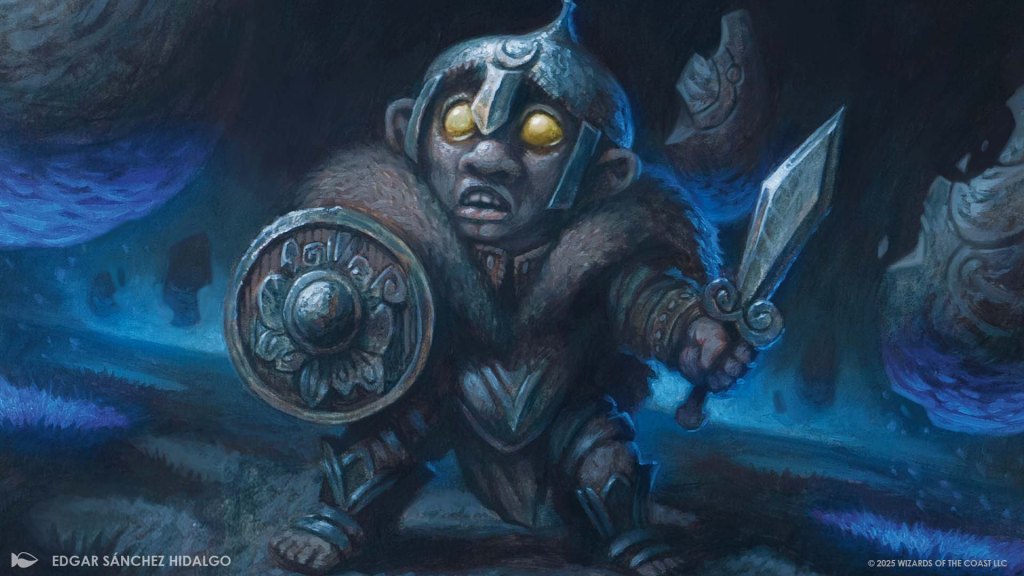
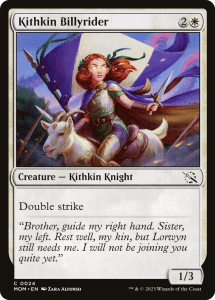
To play a kithkin you just create a plain old halfling from the Player’s Handbook. Add Darkvision, if you want a Shadowmoor kithkin. Thoughtweft is mentioned, but never by name (why?), and it has absolutely no in-game effect. There’s even mention of the nomadic kithkin who severed their connection to the thoughtweft after the Phyrexian invasion. You have potentially three subspecies waiting just to be named and described in the laconic manner of First Light. More if you take clachan/doun differences into account. Why was this possible with the elves but not with the kithkin?

Faeries and flamekin are mostly just glorified hyperlinks to Monsters of the Multiverse. Their descriptions are short, both almost exactly a whopping one hundred words. You have no reason to stop there, because you won’t learn much about them.

As I said before, three species are missing. The merrow are found in the third chapter, as unplayable monsters. That was expected, I predicted it in my merrow article, the merrows would be hard to use in a normal campaign. Treefolk and giants are also creatures that would have difficulties fitting in a party, so it’s understandable they are only to be found in the Bestiary. But somehow we were offered 8 playable species adaptations plus 2 new ones. And we received only 5 adaptations.

New Species

The two new species are Changelings and Rimekin. Changelings are a staple of the old Lorwyn block, and while I never took them for something playable, why not? As with everything in First Light the description is terse, but you get the stats and basic idea.

Rimekin are a newcomer from Lorwyn Eclipsed, and it makes sense to see them among the new options. Though they are very much but a recolor of the flamekin, they nevertheless seem playable. One wonders why there’s no option for a cinder. They are mentioned next to the flamekin adaptation, but neither there nor in the new species we are given something to work with should one want to play a cinder.

Geography

The second chapter is called the Lorwyn-Shadowmoor Gazetteer, and provides the descriptions of some of the Lorwyn and Shadowmoor locales. It is one of the better chapters, because it actually delivers what it’s meant to, despite the ever-present brevity.
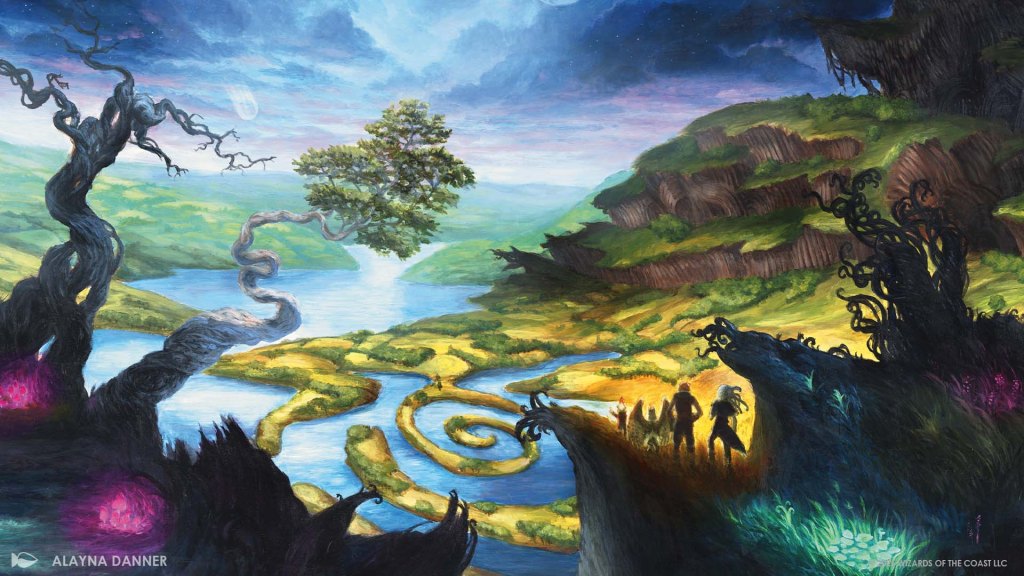
The settlements each have an overall description with a few prominent characters. There are some issues of scale. We are given rough inhabitant counts for each, but the descriptions evoke much larger settlements. Each location entry also offers three reasons to visit. These serve as adventure hooks mostly, which vary in their quality. Some are good on their own, and I can imagine a nice adventure coming out of them. Some are just curiosities you can add to a real adventure to spice things up a bit.

There are some contradictions between the Gazetteer and older lore, even the Planeswalker’s Guide. These are not critical, but it makes one wonder, what should be canon? Since we’re dealing with a MtG setting, I believe their lore has precedence.

In the Mudbutton Warren entry there’s Auntie Gobgot. And it’s a he. The aunties have always been, well, aunties, i.e. females. They’re supposed to be matrons of the boggarts, old crones smart and mean enough they didn’t randomly die to some example of boggart carelessness. The Planeswalker’s Guide explicitly states the aunties are matrons. Why would anyone need a male auntie is a mystery to me. That’s not even gender equality, that’s uncalled-for disregard.

All in all there are 5 major and 10 minor locations for Lorwyn. Shadowmoor has 4 major ones and 7 minor locales. The “minor” locations get only a few sentences, though we could argue whether they are minor to the setting. The likes of Glen Elendra, Velis Vel, Dark Meanders, or Wanderwine River could play rather important roles in a campaign. It’s not like Lorwyn-Shadowmoor is a huge setting such as the Forgotten Realms. There are exactly 6 known clachans/douns, why not describe all of them? It could take maybe another thousand words to describe all the known locations from the Lorwyn and Shadowmoor blocks. Possibly even less.

Bestiary

In this chapter we should find the various denizens of Lorwyn-Shadowmoor, that don’t belong to one of the playable tribes. Right from the start we are given a short description of faeries, and how we should just use stat blocks from Monster Manual. As in the previous chapter, I have nothing to add, faeries are simply not welcome in this supplement. They’re not my favourite either, but I would expect more space dedicated to one of the pivotal species in the setting. Other than that we are given guidelines on how to adapt scarecrows and treefolk, and the advertised 8 new monsters.

Scarecrows

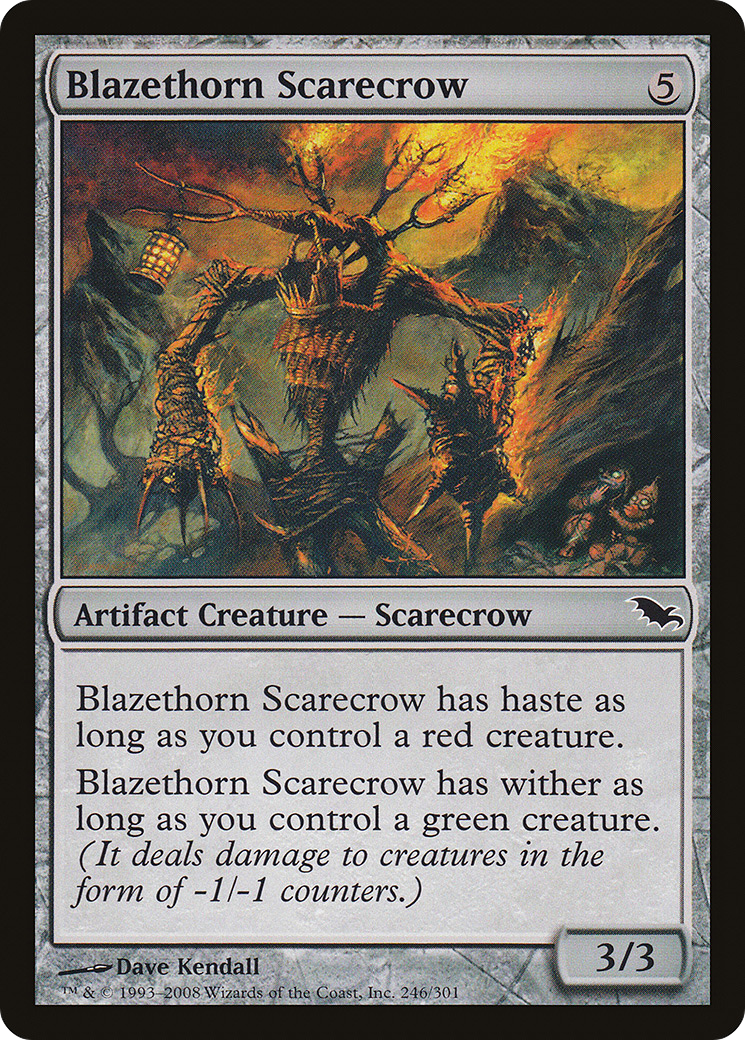
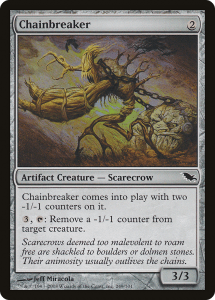
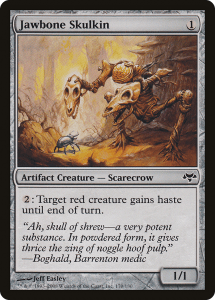
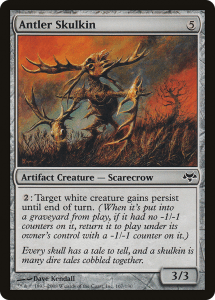
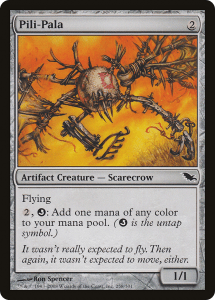
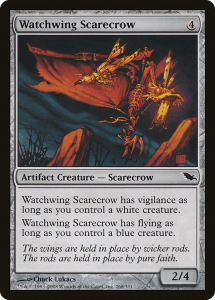
In my article about Shadowmoor Kithkin I praised the block for the huge amount of scarecrows, and their variety. There were “classic” stick scarecrows, but also several flying types, scarecrows made of body parts (skulkin), and even a giant scarecrow spider. There was ample potential in the 23 scarecrow cards from Shadowmoor and Eventide.

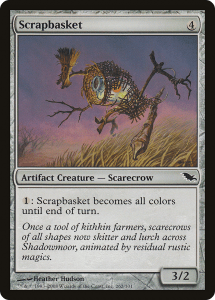
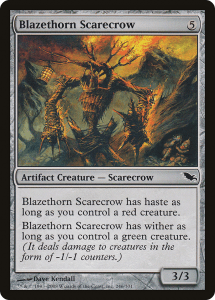
By now you have probably realized that Lorwyn: First Light isn’t too generous with what it offers. How much effort was dedicated to this unique Shadowmoor feature? About 90 words of description, 13 of which make up the sentence telling us to use the scarecrow stat block from Monster Manual. There the description of a scarecrow is twice as long, not counting the stat block itself.

Treefolk

Treefolk suffer the same mistreatment as scarecrows. There are 32 treefolk cards in the Lorwyn and Shadowmoor blocks of yore. First Light managed to give us a condensed description of two sentences per aspect. A total of 156 words, again counting the advice to use a stat block from Monster Manual. This paragraph is more than a third of what we get in the supplement lengthwise.
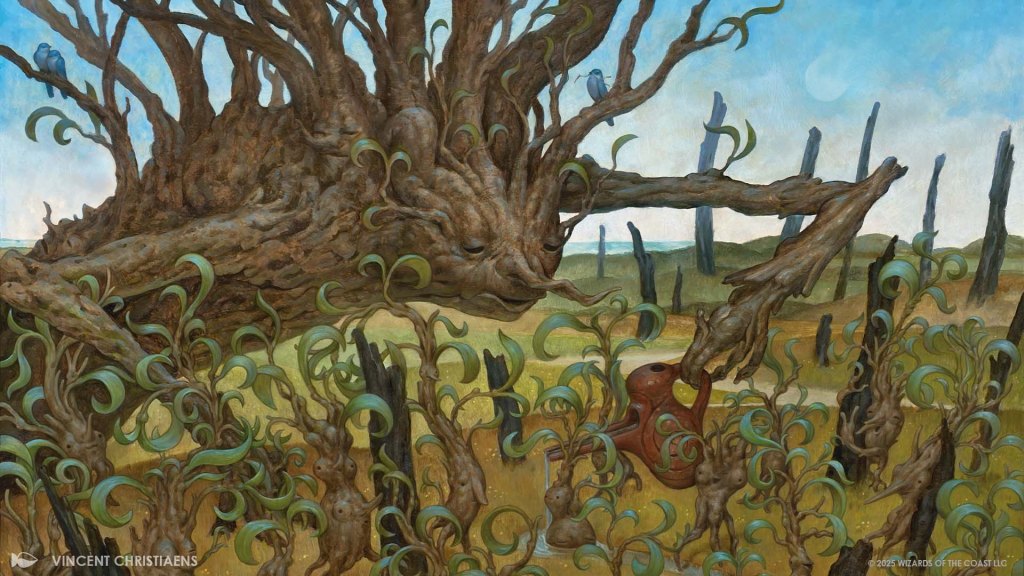
With treefolk some variety is recognized even in Lorwyn: First Light. To spice things up you get to roll a dice (d4!) and obtain a very short description of the individual. The types are the same as in the Planeswalker’s Guide, but the descriptions even shorter. Perhaps making a table with stat changes depending on the type of tree and aspect of the plane would be more useful?

New monsters

The Marketplace promises 8 new monsters “drawn from Celtic-inspired myth”. The “Celtic-inspired myth” thing is quite unnecessary at this point, but whatever, it’s marketing stuff. They promise giants, faeries, and incarnations of nature. First Light mostly delivers on this promise, as we indeed receive 8 monsters. This time with their own stat blocks, so no more redirection!

We get two giants, one for each aspect. Once again the descriptions look as if the creators had to pay a hundred dollars for every letter. And the 34 giants in the MtG blocks got condensed into two. But no one said we’ll be getting more of them. Both giants are usable and fit into their aspects.

The supplement also provides us with elemental incarnations in the grand total of two. Again, we weren’t supposed to get more, so it’s fair. Here I have to praise Lorwyn: First Light, as the design of the two incarnations is good. Though I suspect the art came first and creatures intended for cards were just given stat blocks. That is fine, even expected. And I understand WotC couldn’t have spoiled too many of the new cards. But still, the Lorwyn and Shadowmoor blocks have 55 greater elementals or elemental incarnations. It’s a bit unsatisfying to get only two. They are something unique to the plane, with wonderfully weird designs. That’s something you could emphasize, not sideline.

Merrows almost get the faerie treatment (we are told to use the Monster Manual stat block), but then we’re given two unique stat blocks. That’s something, though once again I have to question the decisions made. The Lorwyn merrow is given a scepter and a longbow, while the Shadowmoor one doesn’t use weapons. It’s fine to be creative, but why not give them a blade, spear, or staff? The weapons we see merrows most often with? And a blowgun or spinebow instead of a longbow? Spinebows could easily be a new item unique to the supplement. Missed opportunities.

Finally we get two noggles! These charming creatures native to Shadowmoor are depicted on only four cards, and we get two in the adaptation! That’s much more like what I expected. I can’t say anything against these, by now I’m even used to the tight-lipped descriptions. And since we’re not losing unnecessary bandwidth on descriptions, what prevented the creative team from doing the same with bogles, ouphes, duergars, hags, imps, and trolls? You know, the actual creatures “drawn from Celtic-inspired myth”. All of those are mentioned in the Planeswalker’s Guide, so they weren’t forgotten. I hope we’ll see them in Lorwyn Eclipsed at least, along with kelpies, selkies, and pucas.

Adventures

With a bitter feeling I got to the last chapter of Lorwyn: First Light. We were supposed to get two ready-to-run adventures, according to the Beyond Marketplace. When I thought about it, even though the supplement itself is quite subpar, we’re probably paying for the two adventures. Fifteen bucks isn’t bad for two adventures and some fluff and stat blocks on top of that.

Well I don’t know what’s the standard for adventures these days, even one-session ones. But in First Light they amount to one location and two short “adventures” taking place there. I think each of them gives you maybe 2 hours of play, and I’m both being generous and counting all the unrelated banter that’s impossible to keep out of a session.

The “adventures” itself are incredibly simple, essentially just short strings of several combat encounters. There are no decisions to be made, nothing to discover, no opportunities to test the players’ creativity. Just a few fights, that’s all. I could flesh both “adventures” into proper adventures, even stretch them over a few sessions and make them make sense. But I already paid for someone else to do it for me. The stuff presented as adventures in Lorwyn: First Light is akin to something you scribble in your notes a few hours before an unexpected session starts.

The adventures were also meant to fit into the setting of Lorwyn-Shadowmoor. You know, the fabled fairy tale realm full of “Celtic-inspired myth”. Why is there an “expo” in Lorwyn? Did the kithkin get that idea from a memo? Did they also plan a live-stream on Teams for those who couldn’t attend because of scheduling conflicts? And what’s with the “refurbishment company”? Will there be an Extreme Makeover: Clachan Edition? I’ve been doing my best (and often failing) not to sound too dismissive in this review, but this shows either total disregard for the setting, or serious ineptitude. You have the entire Lorwyn-Shadowmoor at your disposal, probably even unreleased lore for Lorwyn Eclipsed, and the best you can do is an expo and refurbishment company troubles?

Conclusion

To conclude I would like to crunch some numbers and do some comparisons. Let’s take a look at Plane Shift. I randomly chose Plane Shift: Zendikar. Released in 2016 it is a nice 38-page PDF of about 12 thousand words. Written by one person and available for free! There are also instances where the author suggests using Monster Manual stat blocks. But each time he provides a lot of Zendikar-specific lore.

The Planeswalker’s Guide to Lorwyn Eclipsed came out in September this year. It was written by a team of three, is full of lore and a little over 12 thousand words. Since it’s an article on the MtG website, it’s also free. There are no rules or stat blocks, of course, but it does what you expect it to do.

Lorwyn: First Light, the product for which you pay 15 dollars is a bit short of 14 thousand words. Made by a team of four designers, one rules developer, four editors, five producers, an art director, a graphic designer, and four consultants. That’s twenty not counting the artists. I suspect most if not all of the art is repurposed from the upcoming Lorwyn Eclipsed set. Not made for First Light exclusively. Save for the one map made by the great Mike Schley. Unfortunately it was used for “adventures” that certainly don’t do it justice.

Make of that what you will. I sincerely hope this was caused by executive meddling and not by laziness or incompetence. Lorwyn: First Light would be fine as a free teaser distributed before the full release of a normal setting book. The missing parts would presumably be remedied by the finished product. Or if it was just another Plane Shift download. Sure, it’s not exhaustive and it often leaves much unfinished, the Plane Shift books are often this way. But they’re all nice gestures from the publisher. This feels like a sloppy cash grab, a weak marketing move to promote the new MtG set among D&D players. There are some chapters that are better than others, namely the new monsters and the Gazetteer, but it’s not enough.

I have been harsh in this review, but I believe my points are clear and sound. If I seem to be nitpicking sometimes, it’s not self-serving. That’s just the thing with every sequel and remake, be it a movie, video game, or setting. There will be fans who have high expectations based on the source material. You can see in my articles that I’ve been hyped for the Lorwyn supplement from the beginning. When I had doubts, it was out of concern for a loved setting, not out of criticism. I am very much looking forward to Lorwyn Eclipsed, and I believe the money I will spend on the pieces of cardboard will bring me much more joy than Lorwyn: First Light. And more resources one could use to run a D&D game on the plane Lorwyn-Shadowmoor.

Finally a disclaimer, as it probably should be present in a review like this. The author is an independent person not affiliated with Wizards of the Coast, or any other figure in the industry. The reviewed product was bought with his own funds and he’s reviewing it in his spare time on his own. All art used in this article belongs to Wizards of the Coast and other respective owners, and was taken from D&D Beyond Marketplace or the Planeswalker’s Guide to Lorwyn Eclipsed.

Feel free to let me know in the comments what do you think about Lorwyn: First Light, or my review. Do you agree with my harsh views, or do you think I’m being too mean, and Lorwyn: First Light is well worth the money?
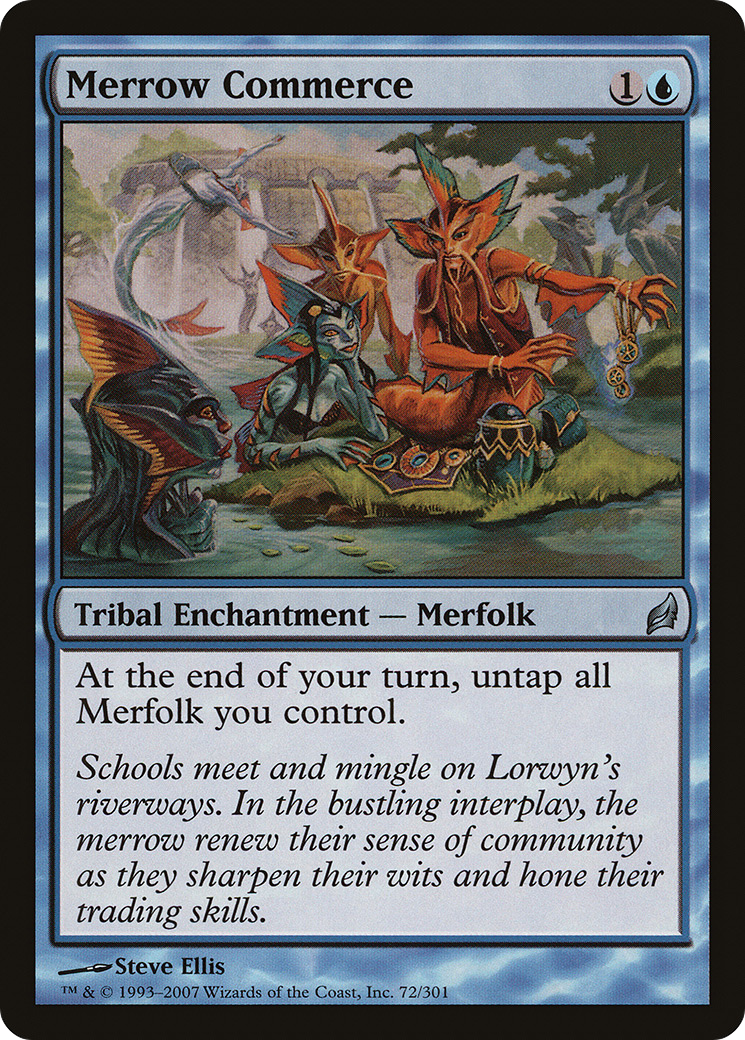
D&D: Lorwyn Merrows

Estimated reading time: 10 minutes

In this episode of my Lorwyn-Shadowmoor series I will take a look at the merrows of Lorwyn. As you probably know, Wizards of the Coast announced a new D&D supplement for 2026. In this series of articles I present my predictions and anticipations. I wanted to finish this before June, in time for a Mermay contribution, but I worked on other things instead. Then vacation came, more work, and you know the rest. But the series is back on and this time we take a dive into the waters of Lorwyn.

Merrows, as Lorwyn merfolk are called, differ from those of some other MtG planes. On planes such as Zendikar or Ixalan the merfolk are bipedal. Lorwyn (and Shadowmoor) merrows resemble those of Dominaria, with fish tails and without legs. While not a problem for a card game, in a TTRPG where things should make at least some sense, having a party member unable to walk might prove challenging. I’m quite curious how the team at Wizards is going to handle this. So let’s dive into the Merrows of Lorwyn.

Merrow Lanes and Dark Meanders

I start these articles with an overview of the tribes’ society, but this time some geographical context is in place. As I said before, the merrows of Lorwyn are bound to bodies of water due to their morphology. This is fine for a non-player species, but could prove difficult in a traditional D&D game. On Lorwyn the merrows make use of rivers (called “merrow lanes”), the largest of which is called Wanderwine; and Dark Meanders, a series of underground rivers crisscrossing the plane. These connect all the water bodies on the plane, including wells.

When the waterways don’t lead to where the merrows need to be, there’s another solution – flooding. To this end they employ aquitects, mages potent in creating new waterways where they’re needed. This is something that quite exceeds the power levels of low to mid D&D campaigns in many settings. If accounted for in a suitable setting, it might be possible to pull it off. Though again probably better to have aquitects as NPCs than the player characters.

Society

The merrows of Lorwyn value knowledge and learning, and so their society is centered around the wisest of their scholars. Merrows gravitate towards these mentors called “reejerey”, and form loose but recognized schools. These have different interests and values. In Lorwyn there are five known merrow schools: Inkfathom, Paperfin, Silvergill, Stonybrook, and Weirwinder. New ones could be invented for the D&D supplement. The schools obviously have their specializations. Inkfathom school for examples delves into the Dark Meanders. Paperfin seems to focus on black ops, Silvergill merrow safeguard travel along the lanes.

Being mostly blue-aspected, the merrows embody the usual scholarly traits of blue mana in Magic. They covet secrets of all kinds, revere the knowledge of the past, and make no qualms about revising the past. Stealing and even destroying sources of knowledge is fair play for the merrows. In this sense they are quite a meddling bunch, though generally they are among the good guys of Lorwyn.

Trade of goods and ideas is another area which the merrows consider their forte. They use the rivers to transport passengers as well. Ideal as NPCs that offer services to the party. I can imagine a lot of boons the adventurers could get from the merrows this way. For example fast and (mostly) safe travel through the Dark Meanders, or arcade-style pop-up merchants.

The merrows are probably on good terms with at least the kithkin and the elves. Probably less so with the others, but then again the others are less “sociable” in general. To the kithkin and elves the merrows provide transport services, and they also share their healing powers. And their policing of the waterways is also a service that’s probably well received by most.

You can see there’s more to the merrows than their morphology that makes them ideal for NPCs instead of player characters. They are bound to water features, yet can travel from one to another easily. As keepers of lore and history they have much to offer, and much to possibly request, making them natural quest-givers. Their water-based limitation nicely overcomes the age-old problem o powerful characters sending weaker ones on quests they could do better themselves. Not everything is accessible from water. A merrow can provide healing, transport, knowledge, or rare commodities from far away. It just makes more sense to have them as non-player characters.

Equipment

As with the kithkin I will analyze the various arms, armour, and other implements we can connect with the merrows. In D&D equipment and loot plays a large role, so it’s important to know what to expect. Some of these might be rare and sought after by the other tribes.

Scholars and wizards first and foremost, the merrows don’t use much hardware. Half of the times they are depicted holding nothing. Sometimes they are casting a spell. When they hold anything in their hands, often it’s not a weapon, but a scroll, staff, poultice, lantern, or even a branch. This of course corresponds with their general theme.

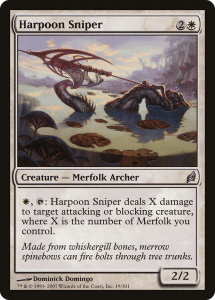
There are of course merrows who are more conventionally armed. We can see spears and serrated blades for close combat. Some have a knife or dagger on them, but these are probably for utility purposes. There are also some ranged weapons in the form of a blowgun, and a heavy-duty spine bow. Nice idea for an exotic weapon that’s still easy to understand and imagine.

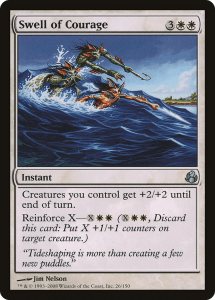
If all that’s too tame, there’s the card Swell of Courage. One merrow wields what looks like an enlarged fishing hook, another has a magical spear, the third some kind of axe. Two of them wear turtle shell pauldrons and the axe-merrow has a turtle shell shield. This one’s a bit of an outlier, but there’s no reason to discard it. Maybe the fish hook’s taking it a bit too far, what do you think?

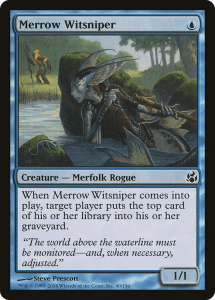
The turtle shell armour pieces above are the only armour pieces we can see on Lorwyn merrows. The Merrow Witsniper is wearing some kind of tight, presumably leather, harness, but it’s probably not armour. Others wear swimwear or light clothing, sometimes a robe. It makes sense not to put too much fabric on yourself when you spend most of your life underwater. We also see various charms and baubles, as well as pouches. But mostly the merrows do what you would if you went swimming. They wear as little as possible.

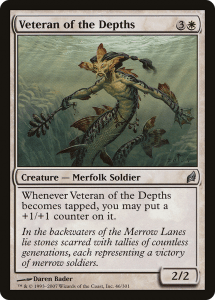
What about other stuff? There’s a pearl, that probably has some magic properties. A staff that makes sense for a wizard. What about the branch in the hands of Veteran of the Depths? A status symbol, charm, or just something they picked up while swimming? You can probably see the potential. There are also lots of options for various water travel related utility charms.

Magic

Merrows are one of the more magical tribes in Lorwyn. There are however not that many spells we could count as “theirs”. They share the blue aspect with the fae, and so while there is a lot of blue spells, many don’t feel like what merrows would use outside of MtG.

Those sorceries and enchantments that can be linked to the merrows give us a fairly uniform picture. Their magic is usually not one of direct violence. Instead they use their art for gaining knowledge and negation. This is hardly surprising to any Magic: The Gathering players, but I’m assuming my readers are primarily D&D players. In terms of D&D schools of magic we are dealing with divination, abjuration, and transmutation mostly. Some illusion and enchantment make sense as well.

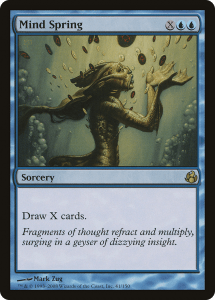
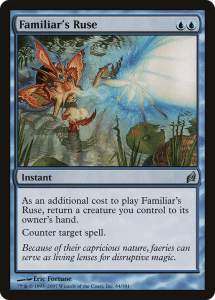
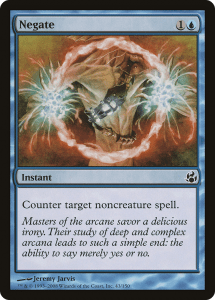
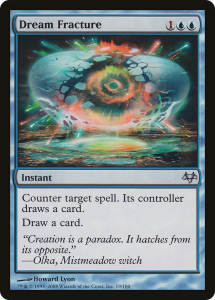
Effects that make you draw cards would fall under divination. They mostly deal with gleaning insights, searching, and other similar stuff. A staple of blue players in MtG is counterspell. In D&D there’s a single spell called unassumingly Counterspell. MtG has tons of counterspell flavours, and perhaps the same could be done here. Different situations, requirements, and other parameters could make each an interesting variation on the common principle of negating a spell. Look at Familiar’s Ruse below, which canonically uses a fairy as a catalyst.

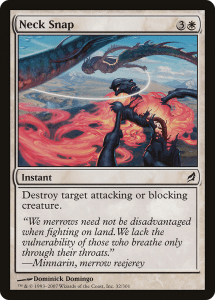
And we mustn’t forget the few out-of-place spells, that clearly should be from the school of evocation. It makes sense to have some at your disposal, even if you prefer indirect means. Especially in D&D environment casters are expected to have at least some offensive spells. We are shown a few of those in Lorwyn at the merrow disposal. The Neck Snap would work either as a spell, or as a magical item. Scattering Stroke, though a spell counter, looks on the card art as a jet of heated water or something similar.

Summary

The merrows of Lorwyn are one of the “good guys” by most standards. They seem to have mostly good relations with other tribes. Trade of things and ideas, and recording, collecting, and adjusting knowledge, are their two main interests. Their unique morphology would make them quite difficult to fit in a normal D&D campaign. Normal in the sense that there’s a group of characters traveling mostly on dry land. It would require quite some work to prepare the campaign in a way that enables merrow players to do what others can. And after such treatment it might be too merrowcentric for the other to enjoy fully.

Therefore I find the merrows to be ideally suited to being NPCs. Wise mentors, guides, almost omnipresent traders, even assassins. The merrows are an important part of Lorwyn, but you better leave them out of your party.

This is where I usually list the subspecies based on the Lorwyn-Shadowmoor lore for the tribe. Since I’m advocating the NPC treatment, I won’t go into stats. Have a quick recap of what the various merrow schools seem to be focused on instead:

  • Silvergill – maintaining and guarding the lanes, trade?
  • Inkfathom – exploring and navigating the Dark Meanders
  • Paperfin – hard to say from the one card, but since it’s a rogue, I would say black ops – assassinations, espionage, procurement of guarded knowledge
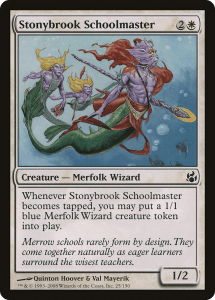
  • Stonybrook – let’s say diplomacy and teaching? They have the banneret and schoolmaster cards

What do you think? Do you agree merrows should be NPC-only? Or would you go to the great lengths needed and do your best to implement them as a playable species? Leave a comment and stay tuned for the Shadowmoor counterpart!
Final remarks

While there is lore available on Lorwyn-Shadowmoor and its denizens, a large part of my analysis is based on card art and flavour text. Therefore a lot might be a matter of artist license rather than conscious worldbuilding decisions. Sometimes that is preferable. We’ll see in the official supplement how the specific issues will be resolved.

The cards used as illustrations were obtained on Scryfall and all rights to them are reserved to Wizards of the Coast and/or other respective owners.

The author is not affiliated with Wizards of the Coast or any other party mentioned in the text.

D&D: Shadowmoor Kithkin

Estimated reading time: 12 minutes

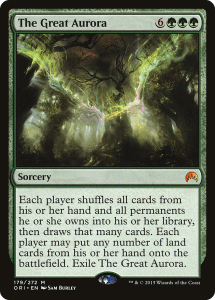
Welcome back to my series dedicated to Lorwyn-Shadowmoor, a dual plane from Magic: the Gathering. An official supplement by Wizards of the Coast has been announced and I have taken up the very unofficial quest to speculate and predict the outcome. Last time I summarized the kithkin of Lorwyn. New let us move past the Great Aurora and see how the kithkin changed. Shadowmoor, the darker aspect of the dual plane, is a place of constant dusk and gloom. The tribes’ negative characteristics are amplified and positive ones are muted.

For kithkin this means a transformation from a proud and honourable folk to paranoid sadistic xenophobes. Certainly not pleasant to be around, unless you are one of them. They fear the other tribes (not entirely unreasonably) and counter by doing their best to make others fear them. Let’s take a closer look at these little evil darlings.

Society

Shadowmoor kithkin society is still a very close-knit one, probably even more than before the Aurora. They benefit from the thoughtweft, which is even stronger in Shadowmoor than before. Along with guidance from their leaders this fills the kithkin with zealous hatred and fear for all outsiders.

Gone is the image of heroic little folk in a world of weirdos. Now the kithkin are the weirdos, as former weirdos shifted into true monsters. And the kithkin have no restraint in following them.

The clachans are now called “douns”, and instead of cozy rustic villages they resemble fortresses. It’s one of the dual plane’s most interesting traits, that there are counterparts to most places, beings, and features. The doun names reflect this nicely. Goldmeadow became Mistmeadow, Kinsbaile is Kinscaer, Burrenton changed into Barrenton, Ballyrush into Ballynock. The change is sometimes semantic (Mistmeadow) or just meant to sound darker, as with Kinscaer. Cloverdell changing into Thistledown is the most significant name transformation.

The clachan Dundoolin from Lorwyn apparently has no Shadowmoor counterpart. This opens some space for speculation. Maybe Dundoolin in Shadowmoor is… Dundoolin. The name is gloomy enough as it is, with “dun” supposedly meaning the dull grey-brown colour, and “doolin” possibly meaning “dark pool”, if the inspiration is from Irish. It could mean that Dundoolin is not as much affected by the Great Auroras. Or it could be just an oversight that I’m reading too much into. Either way it will be interesting to see how this will get handled in the release.

Traps

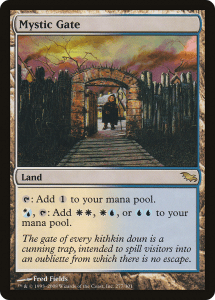
As you have probably seen on the Mystic Gate card above, Shadowmoor kithkin lay traps. They have in this sense channeled their inner kobolds, because it seems they really love setting traps of all kinds. This is again a shift from their Lorwyn counterparts, who stand up to their foes in a fair fight. In Shadowmoor the kithkin avoid direct confrontation as much as possible.

This fondness for traps can of course be used nicely in a D&D game. Shadowmoor kithkin might have a trait centered on setting traps, and maybe bonuses on finding and disarming them. Entering a doun undetected could also make a fine challenge. Taking their paranoid nature into account, any place in kithkin reach could be trapped up to eleven.

On the cards we see simple snare traps, and the doun entrances are protected by pitfall traps. Certainly other trap types could be found in the kithkin arsenal. Various log traps, dart traps, and even traps spewing the various powders and concoctions of the kithkin come to mind.

Equipment

The equipment used mirrors the tactics of the user. In Lorwyn we have seen mostly soldiers and knights with regular infantry or cavalry weapons and armour. In Shadowmoor we see an increase in the number of clerics and wizards. There are fewer soldiers and knights (only one knight!), but they still seem to be ready for heavy close combat. There are swords and shields, various types of armour.

What we also see, though, is an increased use of axes and even halberds. Regular spears are swapped for harpoons, or spears with wicked-looking blades. The overall feel you get from armed kithkin is that they either skulk around, or wait until the enemy gets past the traps and finish the rest.

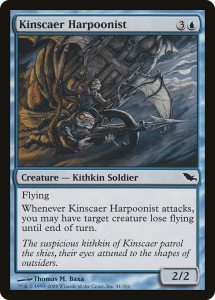
The kithkin of Shadowmoor still have air forces at their disposal, though presumably minus the plovers. What they have though are balloons that either drop their powdery payload, or carry a rather nasty looking oversized crossbow with harpoon bolts. It wouldn’t be a stretch to expect those crossbows (scorpios?) used on the ramparts of a doun, either.

Scarecrows

Another thing the Lorwyn kithkin presumably don’t use, while their darker counterparts do, are the scarecrows. At least there are no scarecrow cards in the Lorwyn block. In Shadowmoor there are 23 different scarecrows. They can perhaps be classified into three distinct groups: a) proper scarecrows made of wood, wicker, straw, and cloth; b) skulkin, made of wood and hard animal remains, such as bones, antlers, and hooves; and c) flying scarecrows.

They are all supposedly made by kithkin specialists called cobblesmiths. Some might have been made by the gwyllion hags, or even other scarecrows. But mostly they’re constructs the kithkin make to help with their chores, twisted either on purpose or by the powers of Shadowmoor into nightmarish contraptions. Actually, I would make them appear in Lorwyn as well in the D&D supplement, as obedient if quirky servants. And have their twisted versions roam the mists of Shadowmoor.

The scarecrows, although made by the kithkin, aren’t exactly obedient. It seems they tend to go off rampaging on their own, fueled by the malevolent energies of the plane. This means several things in a D&D sense. It provides a steady supply of enemies of various forms and power level, that are not “sentient”. You don’t have to come up with explanations, it’s just a roaming scarecrow. Not exactly my kind of thing, but it would be a gold mine to some. You can find enough low level plot hooks just by starting at “rogue scarecrow”. And you could make cobblesmith into a class option, with some variant of “turn undead” tailored to scarecrows, and of course the means to create your own. That sounds like a lot of fun and I should put it together before someone else does.

The skulkin are a nice variation on the “common” scarecrows. Using body parts they have a fetish or totemic feel to them, and it seems the parts used influence the properties of the finished construct. They might or might not be made by someone other than the kithkin, the gwyllions seem most likely, as some of the flavour texts are by one of their kind.

And finally, the flying kind. It’s quite a neat idea, have you ever fought a flying figurine made of wood, wicker and cloth scraps? Lucky you never did! There are four of them in the Shadowmoor block, so flying scarecrows are definitely a real threat.

It’s probably easy to tell how much I like the scarecrows in Shadowmoor (scarecrows in general, actually). I think they’re great with tons of uses in a D&D campaign. Not only as enemies, but as quest givers, quest objectives, random NPCs, or just parts of the scenery. There is really a lot you can do with them, thanks to their customisability.

Magic

Kithkin magic is never one of direct destruction, and the same applies in Shadowmoor. D&D-wise their magic is all enchantment and abjuration, with some divination and transmutation thrown in. Especially in Shadowmoor the kithkin seem to avoid direct confrontation as much as possible, but when it’s necessary, they have some buffing capacity through their spells.

Dispelling seems also quite prominent in kithkin spell arsenal. Since many of the foes kithkin might face use various forms of enchantments and illusions, this is also something worth having at your disposal. You don’t really have to come up with new spells for this, just give some flavour to existing ones.

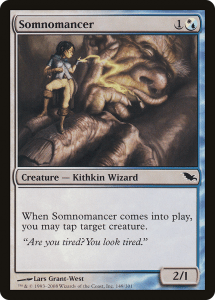
Kithkin apparently like to put others to sleep. To this end they employ their somnomancers. In D&D it would be a very narrow specialization, as there are not many sleep spells to choose from. Perhaps if there were several kinds with different range, radius, saves. Maybe we’ll get that in the supplement. Either way a somnomancer would probably work well together with the fairies, putting things to sleep so the fairies can harvest its dreams.

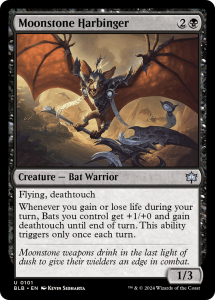
Divination is also a favourite pastime of the kithkin. Their wizards use a substance known as moonstone to bolster their auguries. Not much is known about moonstone, other than it’s rare and doesn’t occur in the Lorwyn aspect of the plane. It would make a fine quest item, and you could create various artifacts using moonstone as their base. The only other moonstone occurence in MtG is Bloomburrow, where it’s used by the bats. There might not be any link between the two, but it would be interesting to see what will Wizards come up with.

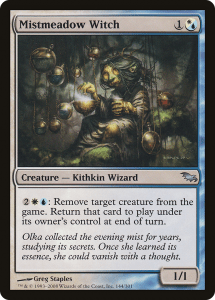
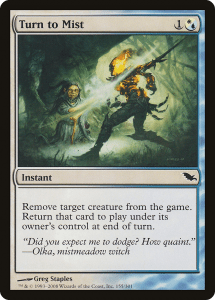
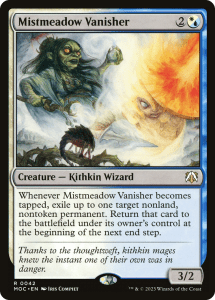
Another interesting flavour of kithkin magic users would be the mistmeadow witches. Masters of vanishing into mist, they are an elusive quarry. Perhaps the mists could have other uses as well? And the witches have other talents as well, such as summoning spirits.

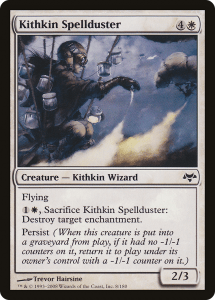
We can see other forms of kithkin magic, from levitating shields to capturing spells in bottles. As in Lorwyn, kithkin love various powders and concoctions. I have already shown the spelldusters, and on the skulkin cards flavour text speaks of powdered bones potency. Powders are generally a nice alternative to potions, and you could easily replace some of the potions in your game with them.

Summary

Even in Shadowmoor the kithkin are probably the most relatable. Minus the xenophobic paranoid sadist part, I hope. However wicked their minds might be, they’re the least alien. That makes them a good choice for beginner players. Unlike in Lorwyn they can’t really be a majority party species, because they would probably murder the minority. I can imagine all-kithkin parties, or perhaps parties where the kithkin are a minority and have to work together with others, even against their nature and nurture.

There needn’t be many stat changes from their Lorwyn cousins. I suggested Dexterity as their main Ability Score Increase of +2, and then one other based on clachan. Or, in the case of Shadowmoor, doun. Thoughtweft and ambidexterity as traits, with thoughtweft stronger than the one Lorwyn kithkin have. Probably the whole species could have some stealth-related trait. The subspecies based on douns could remain mostly the same, but some changes would be logical. Check out my suggestions below:

  • Mistmeadow – +1 WIS, proficiency in stealth and perception, vanishing
  • Barrenton – +1 STR, proficiency with smith’s tools, fire resistance, mountaineering
  • Ballynock – +1 CON, traps and ambushes
  • Dundoolin – +1 INT, bonus language, proficiency in 2 INT skills
  • Kinscaer- +1 CHA, bravery and leadership related traits
  • Thistledown – +1 WIS, proficiency in nature, animal handling

Mistmeadow remains the one for stealth, mainly thanks to mistmeadow witches and their vanishing tactics. Barrenton probably still is the one closest to red mana, and could be left as is. Maybe with some mountain affinity. Ballynock loses its affinity for animals, and instead focuses on laying traps and ambushes alike. Kinscaer is no longer the heroic clachan Kinsbaile seemed to be, but still places a lot of importance on leadership and purpose. Thistledown is hard to read from the two cards that are there, but it might have replaced Ballyrush in their animal affinity. You can see I left Dundoolin there, even though there are no mentions of it in Shadowmoor. I’m going with my pet theory that Dundoolin doesn’t change that much during Great Auroras. The name stays the same, as does their scholarly inclination. Only they’re little horrors now instead of friendly little guys.

And that could be it for now. I spent more time on Shadowmoor kithkin than on their Lorwyn counterpart. I’m still working things out with each new article. So what do you think? Would you make more changes to the doun-based subspecies? Do you think it possible to have these kithkin as player characters, or rather as NPCs? Leave a comment and don’t forget to subscribe!

Final remarks

While there is lore available on Lorwyn-Shadowmoor and its denizens, a large part of my analysis is based on card art and flavour text. Therefore a lot might be a matter of artist license rather than conscious worldbuilding decisions. Sometimes that is preferable. We’ll see in the official supplement how the specific issues will be resolved.

The cards used as illustrations were obtained on Scryfall and all rights to them are reserved to Wizards of the Coast and/or other respective owners.

The author is not affiliated with Wizards of the Coast or any other party mentioned in the text.

D&D Lorwyn: Cosmology and Timeline

In case you haven’t heard, Wizards of the Coast have announced in late February that a new sourcebook is in works. It will resurrect the dual plane Lorwyn-Shadowmoor from Magic: The Gathering, released back in 2007-2008. There was the Lorwyn block, comprised of Lorwyn and Morningtide, and the Shadowmoor block, consisting of Shadowmoor proper and Eventide.

I wanted to dedicate a series of articles to MtG with focus on those two blocks, but Wizards beat me to it with their announcement. There’s no release date so far, so I’ll go for it anyway and write my thoughts, expectations and speculations. I am really looking forward to the end product and wish the team behind it luck. Lorwyn-Shadowmoor is a great setting and should not be left to rot.

Lorwyn-Shadowmoor is clearly inspired by British Isle folklore. It shows in the language, themes, and aesthetic, but it was never marketed in this manner. The creators probably wanted to create a setting influenced by folklore and fairy tales, not build a setting around folklore.

In this article, hopefully first of many, I will describe some of the cosmological aspects of Lorwyn-Shadowmoor in regard to Dungeons and Dragons. There are my speculations on the place of the plane in the multiverse(s), and inevitably a quite large part on the timeline. I wanted to get these out of the way before I start writing about more specific topics, such as the various denizens of the plane.

Dual plane

Lorwyn and Shadowmoor are unique in that they’re two sides of one setting. A dual plane changing periodically because of the Great Aurora. Originally a recurring event orchestrated every few centuries by Oona, queen of the fairies.

Many such events have happened apparently, until the last one (the one we see in the MtG blocks). That one was not caused by Oona, to her great unease and discomfort, but rather brought by the Great Mending. The Great Mending is an important event in the Magic multiverse that I will not describe here. Concerning Lorwyn and Shadowmoor the fact that it happened should be enough.

Due to the dualistic nature of the setting, almost everything in Lorwyn has its darker counterpart in Shadowmoor. Lorwyn is a cozy rural fairy tale fantasy inspired by the British Isle folklore. The sun always shines there and even the storms are a made of light instead of pouring rain.

Shadowmoor is the opposite, it is always dark and hostile. It still retains the fairy tale tone, but warm and cozy is replaced with harsh and gloomy. The denizens of Shadowmoor are mostly bereft of their good sides, with their flaws amplified.

The duality of the plane is best seen when the change is part of the equation. Without the Great Aurora the plane is either an idyllic rural haven, or a folk horror darkland. Both have their merits, but a large part of the potential is lost when only one aspect is experienced.

Cosmology

What I am quite interested in is the way Wizards will handle the plane in relation to D&D cosmology. Both multiverses feature planes, but they are not connected.

MtG Multiverse

Based on the Planeshift series my guess is there will be no overlap with Lorwyn either. Rules will be given for playing D&D set in the plane, but you will be expected to act within the MtG multiverse. That’s fine in my book, it makes more sense to travel from Lorwyn to Innistrad, than jump between Lorwyn and Sigil, or one of the many worlds of the Prime Material plane.

In the Magic multiverse one thing you have to consider is that travel between the planes is not easy. Usually the power called “planeswalker’s spark” is required, and the individuals in possession of the spark are known as “planeswalkers”. It takes time and effort to master the spark, so the planeswalkers that could travel to Lorwyn should be fairly high-level.

This changes after another large event in the MtG universe, the Phyrexian Invasion of the Multiverse. One of the the results is that many planeswalkers lost their planeswalking powers. Instead, newly created portals called “omenpaths” now exist, enabling even non-planeswalkers to travel from plane to plane. So the accessibility of interplanar travel depends on your timeline, but more on that later.

D&D Multiverse

Suppose you only wanted to use Lorwyn-Shadowmoor in your campaign. You are using the “default” D&D cosmology, also known as the Great Wheel. From the outside in there are several layers of planes. The Positive and Negative planes are the outermost, then there’s the Astral plane wrapped around the Outer planes, with all the alignment-based fun stuff.

The Inner planes are encased in the Elemental chaos, then there’s the Ethereal plane, and nestled safely in the middle is the (Prime) Material plane. That’s where most of the adventures usually happen, whether it’s on Toril, Krynn, Greyhawk or what have you. Somewhere near the Prime there are the Feywild and Shadowfell, and those are the ones whose relation to Lorwyn-Shadowmoor would need to be resolved.

The Great Wheel as depicted in the Dungeons & Dragons 5th edition Player’s Handbook. All rights reserved to Wizards of the Coast and/or other respective owners.

Personally I would handle Lorwyn as a crystal sphere similar to Realmspace, or Greyspace. One heavily influenced by Feywild in the past, but perhaps cut off since then. Maybe Oona, the queen of fairies is the culprit, seeking dominion and independence in her own plane without intervention from home. That would explain both the influence and isolation, and go well with Oona’s theme of manipulative schemer. But all this depends on another detail of the D&D adaptation, and that is the timeline.

Timeline

The aspect of the plane would dictate much of the tone and play style of any prospective game. There’s actually quite a lot of possible scenarios depending on the timeline the creative team chooses. I believe it makes most sense to present readers with all of the options. They’re making a setting supplement, not a short zine, so there should be plenty of space for that. Everything depends on whether they want to set a particular scenario forth as “canon for D&D play”, or whether they want to give as much freedom as possible.

Before the blocks

The earliest and possibly largest period imaginable would be the one before the Lorwyn block. A time when the aspects were being flipped every couple of centuries by queen Oona and nothing out of the ordinary happened. Or did it?

Prequels are often used and abused by creators to fluff out already established franchises. When done right it can add depth and explain some things that were left unexplained in the original story. When overdone it can lead to the past being more crowded than the main story, and that is not always desirable.

In this scenario we would find some of the more long-lived characters from the blocks, but there would also be plenty of space for new ones. It would give the creators a lot of freedom, and they have the luxury of the Great Aurora effectively resetting almost everything. That gives a lot of leeway for even quite deep plots as long as it’s something Oona can kill with the Aurora.

Lorwyn block

The first two sets of the Lorwyn-Shadowmoor cycle are Lorwyn and Morningtide. The plane is in its bright and sunny aspect, and there is an overall playful mood throughout. The elves are the public villains, and Oona and her fairies the villains in the shadows.

I will not recount the whole story here, you can read it on the MTG Wiki if you like. Just a few remarks. Since there already is a “main story” for the Lorwyn block, there remains less of the freedom for the team working on the new D&D book.

It’s not easy to fit new stories alongside a strong existing main story. In Star Wars such things are possible thanks to the breadth of the universe. In Harry Potter or Lord of the Rings this would be more difficult. In the case of the latter there’s an amazing achievement in the form of the War in the North video game, but such feats are rare.

Shadowmoor block

Shadowmoor was introduced in the eponymous set along with Eventide. The plane has now been shifted by the Great Aurora, and it’s not for the better. Not only almost everyone lost their memories and their good sides. Oona herself is perplexed by the Aurora, as this one wasn’t her doing. In the end Oona’s chokehold on the plane was broken and a new era begins.

A lot of what was applicable to the Lorwyn block story is the same with the Shadowmoor block. There is a story and it might be difficult to squeeze in other worthwhile content without it coming off as secondary. But it can be managed and surely some groups would be able to pull off a nice campaign.

post-Shadowmoor / pre-Phyrexia

The events of the Shadowmoor block leave the plane in a new state, without the constant shifts of aspect. There are no more Great Auroras and a normal daily cycle is restored. The plane should be more or less in its Lorwyn aspect with a few remnants of Shadowmoor. That sounds like a fun mix that’s not all gloomy but still has some darker elements.

After the events of Shadowmoor and Eventide Oona has been dethroned and supplanted by Maralen, though still alive. The elf Maralen is now queen of the fairies and supposedly is going to rule differently. The fairies will probably remain mostly as they were, but we can presume the other tribes will exist in both aspects in this scenario. So we get both kind and xenophobic kithkin, playful and monstrous boggarts, despotic and virtuous elves. The extra Shadowmoor smaller tribes might also stay. It could really mean many cool options for your tabletop campaign.

If there’s only one “canon” scenario, this one would make the most sense to me. Being a sequel there’s a lot to go forth from, and no danger of retroactively stripping logic from already published materials. The only established event concerning the plane of Lorwyn is the one in the next paragraph, and that one should not cause any problems.

Phyrexian invasion

Phyrexia is MtG’s version of hell, a world of machine-and-flesh monstrosities lusting for the whole multiverse to devour and turn, or “compleat” in their own wording. There was an original Phyrexia in the older blocks, that was defeated, but not wholly eradicated. It took hold of Mirrodin (another great plane with a bunch of blocks and lots of great ideas) and transformed it into New Phyrexia, unleashing an invasion into every plane in the multiverse.

Lorwyn was not an exception, though the focus of the whole story arc was on other, more prominent planes. Lorwyn received only some fleeting mentions. Such is the fate of planes fifteen years dead to the franchise (at the time of Phyrexia: All Will Be One).

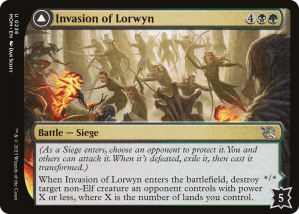
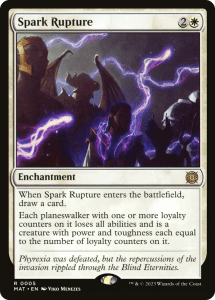
The few bits of information that we have tell us that Lorwyn was indeed invaded. There were those who fell to the lure of the Phyrexians, as we can see on the card above. Ultimately the tribes of the plane joined forces to fight back and resist the machine would-be-overlords. The invasion card art shows only elves, but we can see kithkin and presumably others joining in as well, including the wildlife.

The invasion of Lorwyn by the Phyrexians is another scenario well-suited for your D&D game. A whole campaign could be devised, starting with some early pre-invasion reconnaissance being responsible for trouble on the plane. Followed by full-scale invasion, during which perhaps the party would have some vital quest to help turn the tide. The possibilities here are again quite broad, both for the creative team and for the players.

post-invasion

After the invasion most of the planes invaded were destroyed to various extents. We know nothing of the casualties Lorwyn suffered, but since the Lorwyn invasion wasn’t mentioned too much, we could expect a fairly good result. Maybe we’ll get more information in the prepared supplement. It’s also a direction in which a lot of creative work could be done.

There is an opportunity to come up with some interesting worldbuilding, but it seems wasteful to me to set your game after the invasion. Sure, the rebuilding also has its charm, but from a D&D point of view, the Phyrexian invasion is something you want to be part of, when you’re not setting up your game in Lorwyn’s past.

One outcome of the Phyrexian defeat should be pointed out, however. During what’s called the “Desparking” many Planeswalkers lost their spark. At the same time omenpaths have opened, essentially the means of interplanar travel for non-planeswalkers. This opens the possibilities for parties of non-planeswalkers to visit Lorwyn. For example start playing on Zendikar and then travel to Lorwyn. Again, this is something that broadens your options significantly, but comes only after New Phyrexia is dealt with.

Conclusion

Well, the conclusion is obviously that it’s great Wizards are working on a Lorwyn-Shadowmoor supplement for Dungeons and Dragons. The plane has been neglected for too long, and making it available also for people like me, who are more into TTRPGs than TCGs, is a nice gesture.

I posited various questions and their possible solutions for the future supplement. It will be to interesting to see how the team handles them, or even if they do. Maybe what I’m considering isn’t really what’s important here?

Let me know in the comments what are your thoughts, and how would you handle the issues of possible scenarios and cosmology. Also, it’s entirely possible I’ve got some things wrong, as I’m by no means a MtG buff. Corrections are welcome, as well as suggestions, and any constructive discussion. What are your thoughts on the matters I described?

If you liked the article, your comments and sharing would mean a lot, and give me the necessary feedback. The article is quite long, at roughly 12 minutes reading time. Would you prefer articles of this length, or should I strive for more shorter ones in the future?

Last but not least, some disclaimers: Magic: the Gathering (and Dungeons & Dragons, for that matter) are property of the Wizards of the Coast. The cards embedded in the article are obtained via Scryfall with no foul intent. The content of this article benefits a great deal from the MTG Wiki. I am not affiliated with any of the above mentioned entities in any way.

February of Magic and Wonders

Estimated reading time: 6 minutes

Gathering Magic

Over the past few months I have come to realize that my relation with Fantasy has been shaped by Magic: The Gathering more than I would think. Possibly more than by Dungeons & Dragons. It makes sense, Magic influenced other works for decades as well. Nothing exists in isolation and everything is influenced by something.

While not a TTRPG itself, Magic: The Gathering is a game into which tremendous creative effort has been poured over the years. You may not like every set, particularly the newer ones are questionable at times, but there’s a lot worth it about Magic. It took quite long before Wizards realized they could cross-over with Dungeons & Dragons, but now we have supplements for whole nine planes! Ravnica, Theros, and Strixhaven have their own physical sourcebooks you can buy. You can find older stuff for Ixalan, Kaladesh, Innistrad, Zendikar, Dominaria, and Amonkhet in the Planeshift series available on DM’s Guild for free.

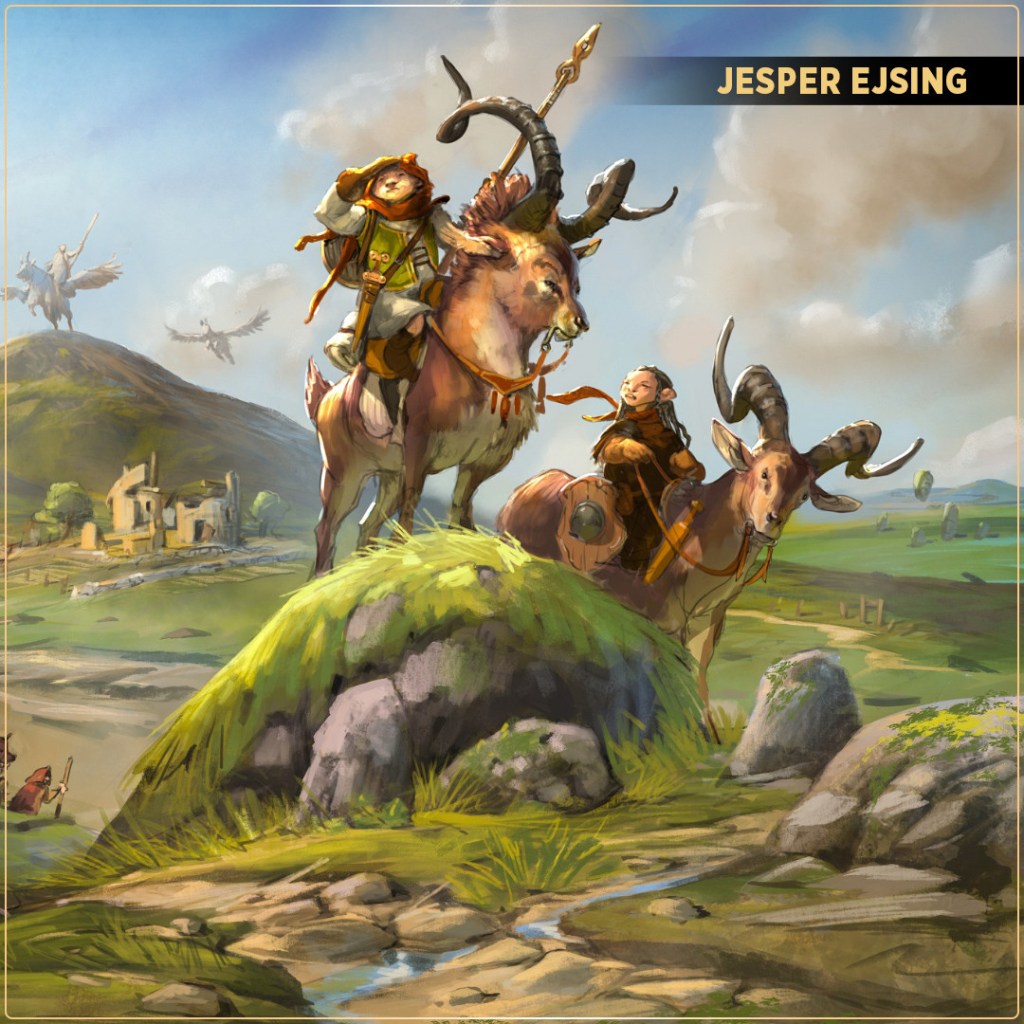
Jesper Ejsing’s art from the upcoming Lorwyn-Shadowmoor D&D Supplement! All rights reserved to Jesper Ejsing, Wizards of the Coast, and/or other respective owners.

Now we’ve been promised another supplement taking place in the Lorwyn-Shadowmoor dual plane! I am both excited and frustrated. The Lorwyn and Shadowmoor blocks were the first ones that got caught my attention for real when they came out. I didn’t collect Magic back then, and only read the lore and oggled the art, but I was captivated by the setting. It’s a fey setting that doesn’t scream “FOLKLORE” in every sentence. Many settings I see being advertised these days are trying real hard to convince us they are full of folklore. I believe they are, and that they will be great when they’re finished. I just don’t need it so explicitly stated, subtlety works wonders sometimes. Lorwyn did this well in my opinion. You can see the British Isles folklore clearly, but nobody is forcing it onto you.

A Shadowmoor elf shaman. All rights reserved to Wizards of the Coast and/or other respective owners.

But as I said I am also frustrated. Remember my last post, where I advertised an exciting new series? I meant to start writing commentaries on various Magic: The Gathering cards, and their potential for your TTRPG needs. With an emphasis on the plane I liked the most. You already guessed which one it is, didn’t you?

The cinders of Shadowmoor should not be messed with. All rights reserved to Wizards of the Coast and/or other respective owners.

So what I’m going to do is probably go for it anyway. We will be getting a supplement with lots of lore, stats for various monsters, place descriptions, etc. done by professionals with access to the original notes (hopefully). In the meantime I can offer my take on the already published stuff, and speculations about what will be in the sourcebook. That should not be seen as anything wrong by Wizards; if anything, it would be a warm up before the release. There’s no date, yet, so I might be able to put out a few articles before then. We’ll see.

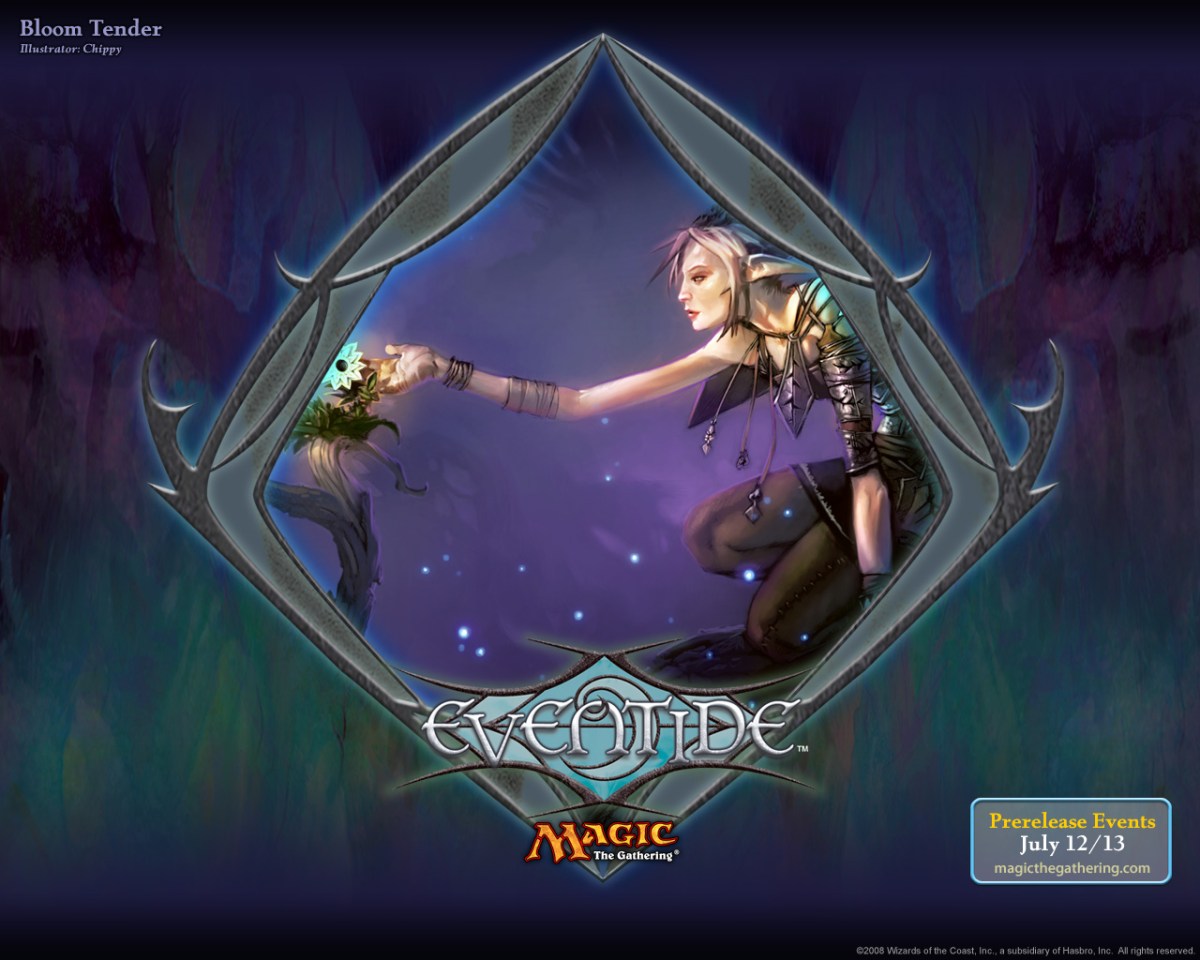
A beauty-obsessed elf tending to a bloom. All rights reserved to Wizards of the Coast and/or other respective owners.

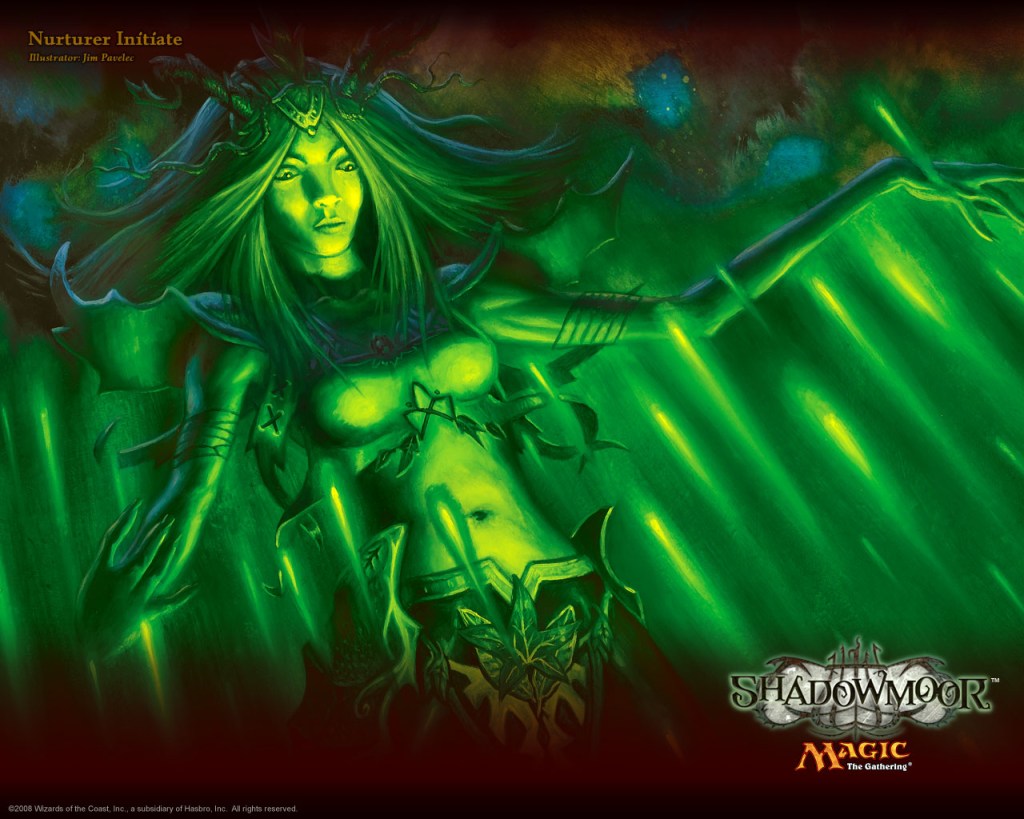
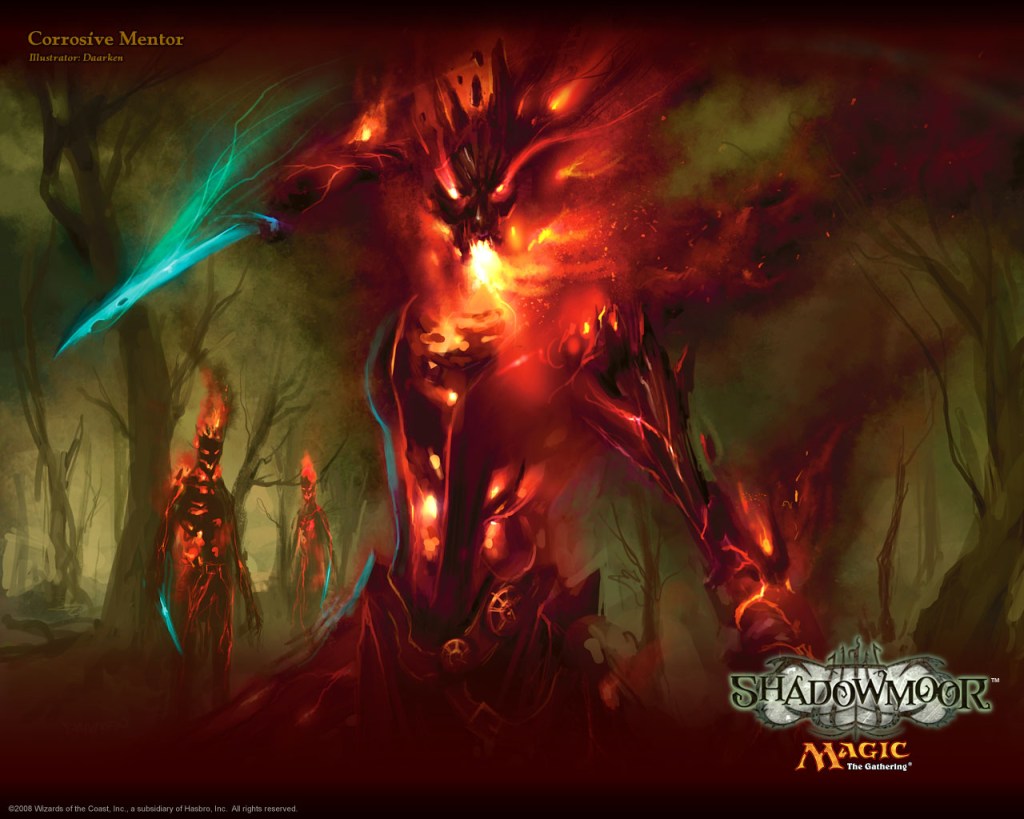
Hope you enjoyed those original wallpapers I saved from the Shadowmoor and Eventide releases back in 2008. Are you excited for the new Lorwyn/Shadowmoor sourcebook? Leave a comment and don’t forget to subscribe so you don’t miss the upcoming articles!

JAGS Wonderland

While writing about Lynchian gaming in the last month’s post I found out about JAGS Wonderland by Marco Chacon. It’s a free TTRPG about descending into madness and transcending reality. Or at least so it seems after some fifty pages. I have to say the book is wild. Though I consider myself not easily shaken, Wonderland made me quite uneasy. Well done. The rulebook references Lewis Carrol’s works heavily and combines it with secret agencies, aliens, cults, and conspiracies.

The cover for JAGS Wonderland. All rights reserved to Marco Chacon and/or other respective owners.

There’s a lot of thought behind the rulebook. It’s a game more suited for experienced players wanting a different sort of game than dungeoneering and monster slaying. It should be possible to do that in JAGS Wonderland as well, if anyone was so inclined. And vice versa you could probably use some worldbuilding elements and game mechanics from Wonderland in your game regardless of the system. Imagine Dungeons and Dragons with the “traditional” cosmology of planes replaced with that of Wonderland. Would you be interested in a setting like that?

I still have over a half of the first book and then the Book of Knots sourcebook to go through.There’s a lot of interesting stuff in this game and I will probably mention it from time to time in these summaries. And if there’s anyone with experience with JAGS Wonderland (or JAGS in general), leave a comment below!

Kickstarter

There are some new campaigns on Kickstarter that caught my eye. I will have to think some more before I pledge, but the least I can do is spread the word.

Firstly there’s the Blades of Gixa campaign by Quadra. It is the result of #Dungeon23 challenge by a person who actually managed to finish it. Those are quite rare, and from what I’ve seen on social media, Quadra’s work both looks great and is captivating to explore. The product should be system agnostic with some stats etc. provided by the author. Definitely worth a look.

Another campaign I am watching is the Heavy Metal Monster Manual by Greedy Gorgon Press. You might recall their earlier works, all of them with catchy names showing heavy influence by rock and metal bands and songs. What I’ve seen so far was funny and with lot of appeal to rock and metal fans, so don’t forget to check it our, if you’re so inclined. 

Miscellanea

I’m still working on the class options mentioned earlier, and the Arco review. Regrettably I’ve been neglecting both due to life and recently the spur to action caused by the Lorwyn announcement.

One thing I should not forget to state – I am in no way affiliated with any creators mentioned in this article. I am simply sharing my enthusiasm and there’s no compensation I get for this. That being said, I am waiting for your move, Wizards, I want in on Lorwyn!

As always, thanks for reading this far, and I’ll be glad for your thoughts in the comments section. Also please share this post on your favourite social media if you liked it, it means a lot!