Monster Produce part I

A longer article exploring the idea of monstrous vegetables. Free sample near the end!

Estimated reading time: 16 minutes

Sometimes you need a change from all the orcs, goblins, or undead. Maybe you want to surprise your players, the plot might require different foes, or you just want to have some lighthearted fun. Wherever your need comes from, we’ve got your back with Monster Produce!

I’m talking about monsters based on fruits and vegetables. While you can find plenty of plant-based enemies in the rulebooks, produce is generally not as well represented. Maybe the notion really is silly, and has a place only in parody games. That is up to you to decide after you’ve finished your veggies, I mean this post. There’s also a little treat waiting for you at the end!

The How and Why?

As with all monsters you probably want to know a little more about them than just the stat block. Why would there be vegetables attacking people, and how they came to be? Let’s look at some possibilities.

Your killer tomatoes can be natural or artificial. Maybe spontaneous is a better term than natural. Anyway it means that no deity, magic user, or scientist created them. A magical field, some kind of mutagen, or even plain fantasy evolution, might have created monsters out of these plants. They are probably tied to a place with precise conditions. Like a magical spring or the impact site of a meteorite. These conditions might not be replicable, or they might be (and this might be of interest to certain parties). There might be a “Plane of Produce” where every fruit and vegetable has its monstrous counterpart. These can either be summoned, or maybe they appear when certain conditions are met.

On the other hand we have artificial veggie monsters. They have been engineered by an alchemist of some sort, probably with botanical leaning. They might also be the result of a spell gone wrong (or right), creating dependable (or not) minions from household supplies. A deity might have sent them as a punishment, or as a boon to the faithful.

And what are the pros and cons of vegetable and fruit monsters? It’s hard to generalize, as they can vary widely. Being essentially plants they have different anatomy than animals. They might lack weak spots, though this might also differ across produce types. Slashing damage might be fine, but piercing and/or blunt damage might not work as well on most. Imagine stabbing a raw potato with a fork. Or hitting a celeriac bulb with a stick. On the other hand they might have unique weaknesses. Salt comes to mind, anyone who ever cooked vegetables knows that they release water and soften when salted.

Depending on their origin, these animated greens might still be edible, or at least usable in some manner. I remember fondly the amazement I experienced as a kid when screamers in Dungeon Master yielded edible slices. Woody tissue might be a rare material for crafting. And of course whatever toxic, hallucinogenic, or healing substances found in the original plant might be present. Possibly even more potent in these enhanced specimens.

Veggie Varieties and Fruit Forms

After deciding their origin, we need to choose the shapes and forms of our Horticultural Horrors. The configuration will determine their stats and roles, and might be linked to their origin. I imagine it’s more likely a mutagenic serum would create a massive onion crawling on its roots spreading poison clouds, than little onion people with arms and legs and smiling faces. The latter might be the work of magic, or a deity.

The first type of our typology (type I) is an animated version of the base fruit or vegetable, possibly weaponized by transformed leaves, vines, husks, shell, whatever applies. Fangs, claws, and other animal parts might also be present. It may or may not have a face, often it will have no eyes. Size might differ from one normal for the fruit or veggie to monstrously enlarged specimens. Animated pumpkins lashing vines around, or man-eater plant proxies (giant bell peppers sitting on their plant waiting for suitable prey to come along) fall into this type. Killer tomatoes would fit here as well.

Then there is the aggregate type (type II). Here a bunch of type I specimens become fused or form a reversible colony. This not only increases the mass, but could also lead to the development of new abilities, an increase in intelligence, or even sentience.

The next type (type III) is roughly humanoid (IIIa) or animal-shaped (IIIb). The base fruit or vegetable will get arms and legs, and at least a face if not a whole separate head. They might easily range from cute to creepy. Type IIIa will include mandrake, various fruit and vegetable sprites, Oddish, or Mr. Potato Head. Type IIIb would resemble an animal or a broader animal group (e.g. dog, turtle, lizard).

Type IV is fully humanoid to the extent that the original fruit or vegetable is not readily identifiable at first glance. It’s not an apple with arms, legs, and head stuck to it, but a delicious person made of apple-flesh.

Putrid Potatoes

Have you seen those memes with potatoes that have spent way too long in the cupboard and started reaching out for soil and your soul? Look them up if you haven’t. Add to that the often misshapen forms of the tubers and you’ve got a set of attributes ready for monstrification. And what if those potatoes were the size of a man or larger, as in the collage below?
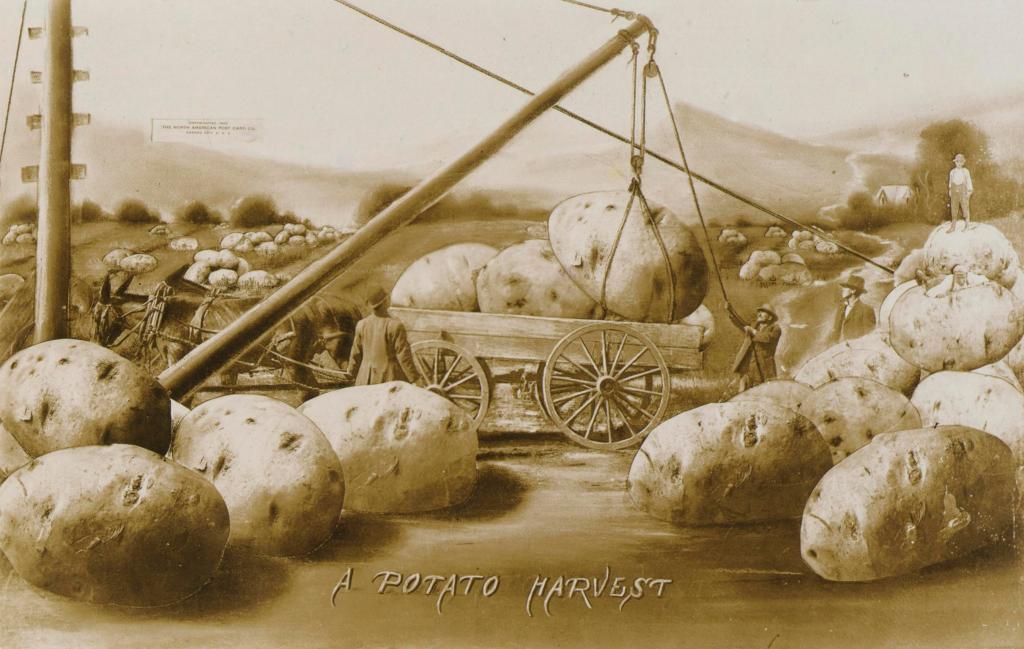
A potato harvest, collage by W.H. Martin (ca. 1910s) via lookandlearn.com (CC0 1.0).

The potato idea was used in the 2011 roguelike Dungeons of Dredmor by Gaslamp Games. Large levitating potatoes with sprouts and eyes (type I) bearing names such as Evil Magic Potato or Enchanted Plaguetato plague your steps from the beginning. They can cast magic missiles or other spells, depending on the tier. It’s certainly a nice execution, one of the best Produce Monsters I’ve seen, actually.

Another game in which you can fight animated potatoes is Void Tyrant by Quite Fresh, a 2019 roguelite for smartphones. There you face Potators, humanoid potato figures (type IIIa) who look like, surprise, potatoes with arms and legs. Apart from trying to bash in your skull they hand you potatoes that clutter your card deck. Not the greatest of concepts, but it fits the not too serious tone of the game.

Callous Carrots
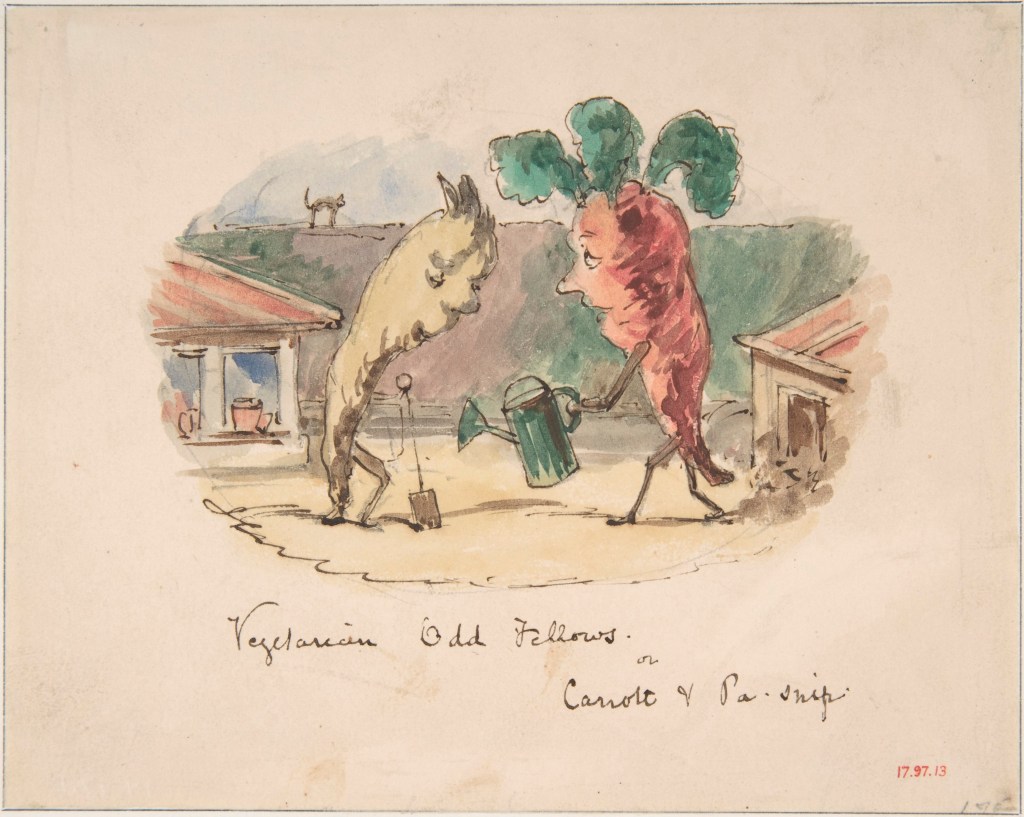
“Vegetarian Odd Fellows: or, Carrolt and Pa-Snip” by John Leech (1817–1864) via lookandlearn.com (CC0 1.0).

They don’t look especially menacing, do they? What if they’re two metres long with centipede-like legs and mandibles? And we can extend this category to other Apiaceae to include parsley and parsnip. If you’ve ever grown parsnip you might know that it contains furanocoumarins. These are compounds that react with your skin under sunlight and cause inflammation. See the potential there?

Carrots have also been utilized in Dungeons of Dredmor, taking form of an upturned carrot walking on its leaves (type I). They appear later than the potatoes, so presumably they are more powerful, but I haven’t met them yet.
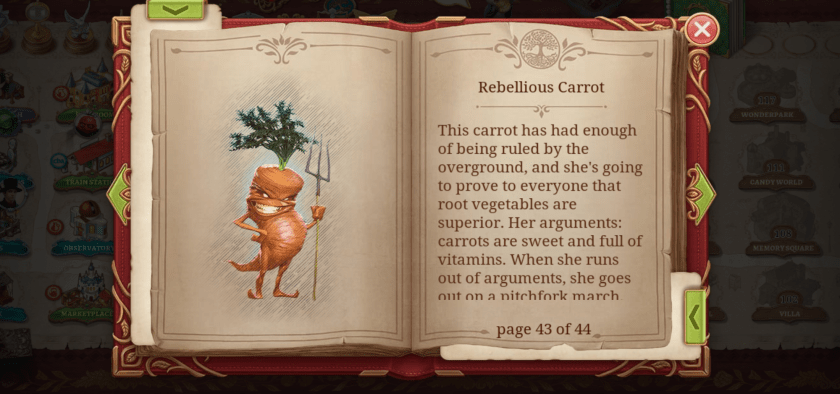
A carrot monster from Seekers Notes. All rights reserved to Mytona.

There’s a secret object and puzzle game called Seekers Notes, mainly for phones. It’s not combat oriented, but there are enemies you have to beat to advance the story and grind items. There are changed seasonally, and in Spring of 2025, the theme was apparently Vegetable Uprising. One of the enemies is Rebellious Carrot, a type IIIa carrot with humanoid features, holding a pitchfork. You need a special peeler to dispose of it in the game. Although cartoonish, this is a solid example of what this article is about.
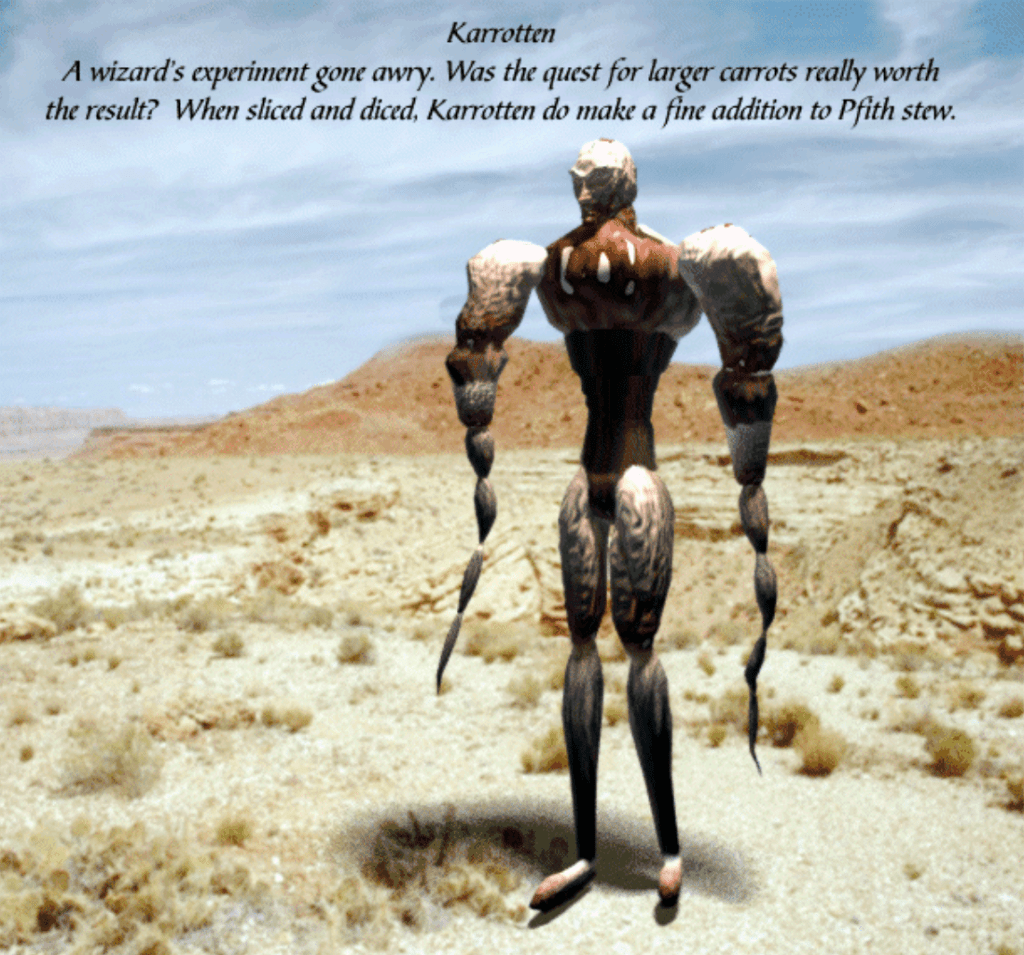
Karrotten as seen in the in-game Encyclopedia of Seven Kingdoms. All rights reserved to Enlight Software and Interactive Magic.

A different take can be seen in Seven Kingdoms, an RTS by Enlight Software. In this 1997 game we find the Fryhtans, a collection of monster races. One of these are the Karrotten, a type IV species of magically created carrot-people. Not much background is provided, but it shows that even in an otherwise mostly serious setting there can be place for monster veggies.
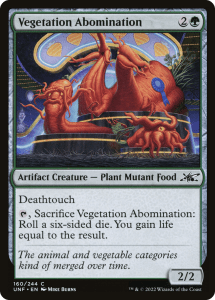
Several mutated specimens of carrot. All rights reserved to Mike Burns and Wizards of the Coast.

There’s also a nice example of what are presumably mutated carrots in Magic: the Gathering set Unfinity. We see what looks like a worm or naga, a tentacular beast, and a sort of hydra. So two of type IIIa and one type I. The card says they have Deathtouch, which is an ability that makes damage lethal no matter the amount and the toughness of the defender. This could mean they are venomous, so we get once again to the produce monsters’ potential toxicity.

Terrible Tomatoes

The main stars of several parody B movies, killer tomatoes are one of the less usable produce-based monsters. It would be very hard to use them as they featured in the movies (or at least the first one, of which I have seen a few minutes) in any kind of at least partly-serious campaign. Even in parody games you could do better. In Attack of the Killer Tomatoes they are just enlarged tomatoes that beat people to death. A better way to use tomatoes would be to treat them as any other fruit or vegetable mentioned in this article – even type I could be done better than that.

The Sun-Zapped Tomato from Seeker’s Notes (see above) is a better example. It’s a levitating giant tomato with an annoyed look. Due to the nature of the game we don’t have any stats. It is described as an ever-complaining bore declaring itself king of the patch. Maybe this one could be an NPC instead of a monster? To banish it you need a special Tomato Salt, so there we have a weakness as well (salt!).
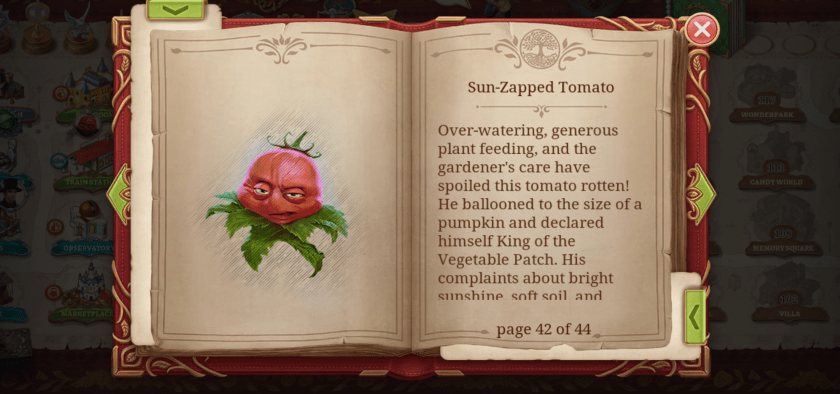
A tomato monster from Seekers Notes. All rights reserved to Mytona.

Below is nice type IIIb tomato monster found in an art asset pack I bought. It resembles a spider, or the spider-head things (from The Thing). The image doesn’t indicate scale, but I think it would make a nice monster whether tomato-sized or larger. I would lean towards it being quite large, with the tomato part being perhaps 5-6 feet in diameter.
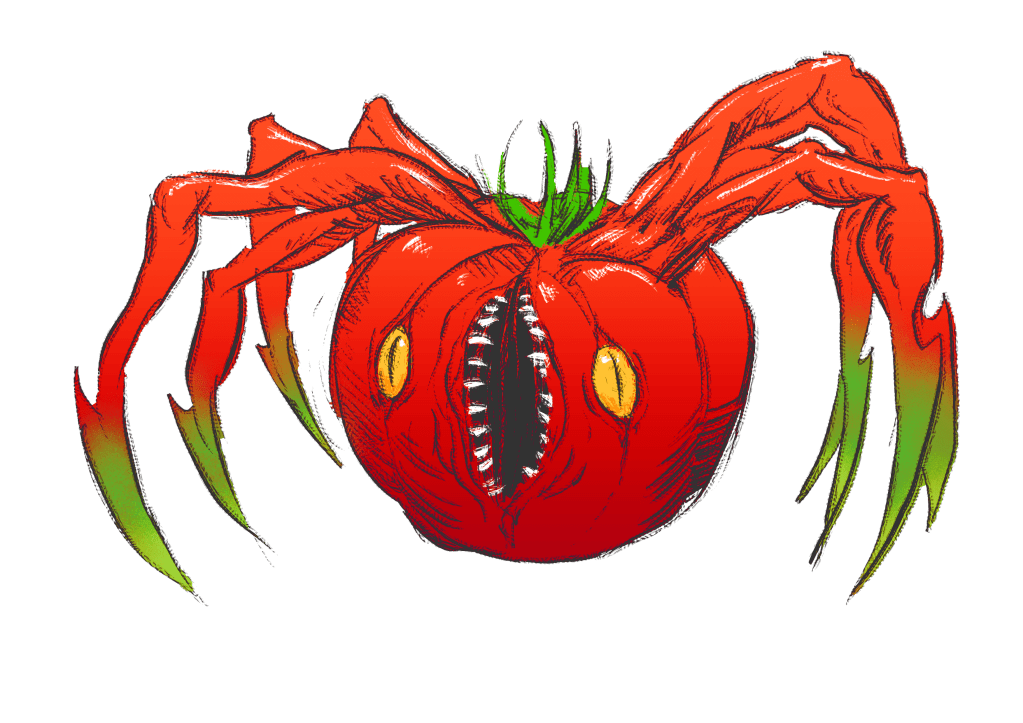
Tomato spider by Chaoclypse from a pay-what-you-want art pack. It’s a nice design and I gladly paid the suggested price for the pack. I’ll use the other artworks elsewhere, I guess.

Pitiless Pumpkins

A classic, animated pumpkins and pumpkin-based monsters are a staple of Halloween-themed content. Pumpkins come in many shapes, enabling a lot of variety, but the most iconic Connecticut field pumpkin is probably the one that comes to your mind right now. It’s not uncommon for pumpkins to be “enemy-sized” even when they aren’t enlarged somehow. Pumpkins also grow on vines, so you don’t have to worry about having to explain why they possess limbs – they’re modified vines, of course. I’ve seen examples of types I and IIIa, but it’s not hard to imagine a type II as well. Type IV, or pumpkin people, are quite common in fiction, though they are usually some other sort of monster, such as fey or undead. I won’t give pumpkins any more space, because although I like the idea very much, it’s very ubiquitous across genres and media.

Perilous patissons

Patissons or pattypans or are a sort of summer squash that used to be quite popular in Central and Eastern Europe. They have a curious shape resembling a pie or a flying saucer, and there are also “fingered” cultivars. Belonging to the Cucurbita family they offer pretty much similar option as pumpkins.

Until recently I believe there were no patissons used as a base for a creature. That changed with this blog post by Paizo, so kudos to them and a memo to myself not to loiter when I write (I started writing this in January 2024). The Pattypan of Gold Bits is presumably a gourd leshy by Pathfinder 2e taxonomy, i.e. a plant creature summoned by a fey or a druid. Or type IIIa when keeping to the categories of this article. Gourd leshys are actually a fine solution to this type of monster produce. You just have to change a few bits if you want a different vegetable. Maybe borrow fungus leshy’s Spore Cloud for a onion-based leshy.

Obnoxious Onions

If you cry while cutting onions, you might want to avoid these. All well known irritants, the Allium family offers several different candidates for new monsters. Onion, shallot, and garlic have large bulbs and long leaves, while leek, scallion, chives, and wild relatives such as ramsons, are mostly leaves.
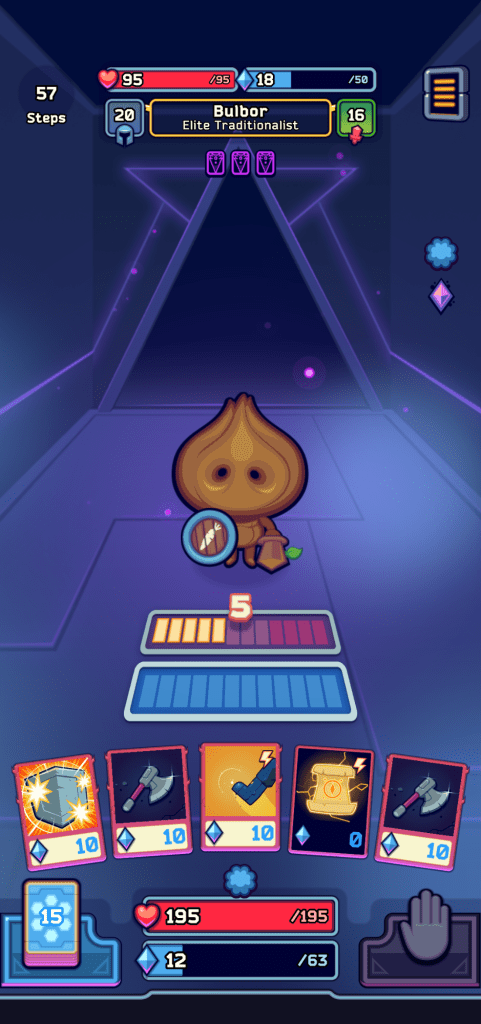
Onion shaped monster
Bulbor from Void Tyrant. All rights reserved to Quite Fresh.

There’s quite a few option with the onion family that can build on their irritating volatile compounds, whether in the form of a skin acting poison or noxious vapours. These can be released on demand or perhaps on being hit.

Onions have been used in Void Tyrant as well, in the form of Bulbors, a type IIIa monster. As with Potators, these little smelly fellows hand out vegetables while trying to kill you.

Apparently, there is a Malaysian animated series for kids called BoBoiBoy from 2011, where there’s a villain aptly named Onion Monster. Its powers include noxious gas.

Tormenting Turnips

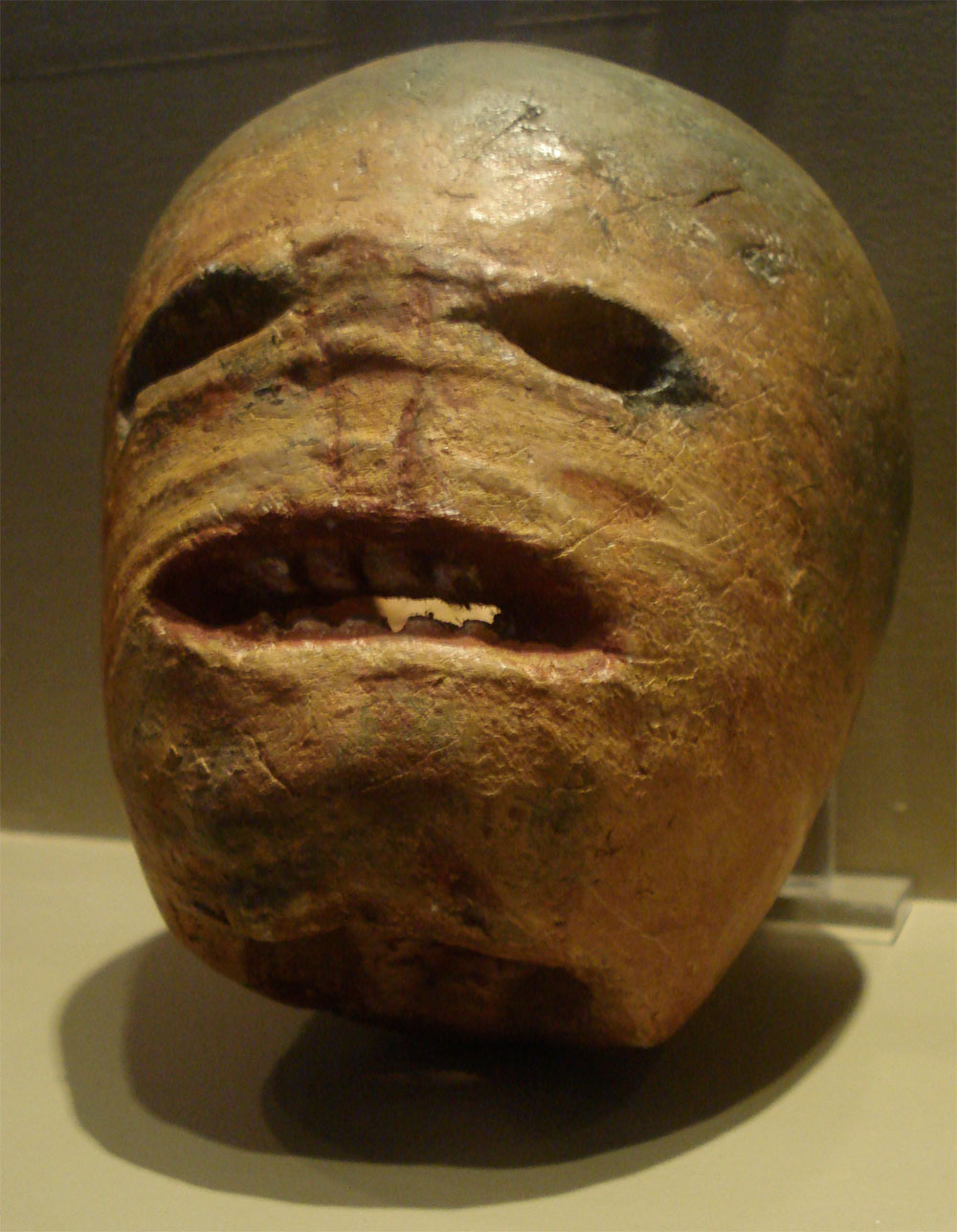
Do you know what people used to carve Jack-o’-lanterns before pumpkins? That’s right, turnips or rutabagas. You might have seen photos of sweet little faces such as the one below. Imagine it with a little torso, arms, and legs, wielding improvised weaponry such as kitchen knives, meat tenderizers, or a good old shillelagh – a band of turnip goblins terrorizing the countryside makes for a nice low-level threat. They would fall under type IIIa.
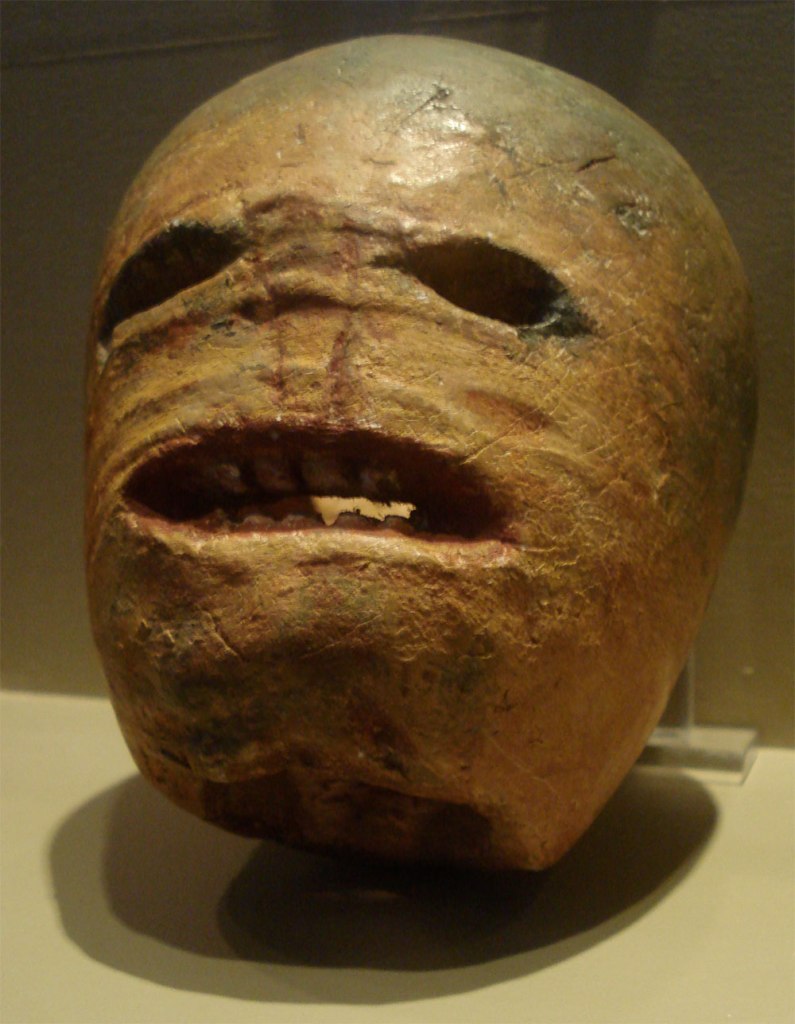
Turnip with carved out eyes and mouth
An early 20th century turnip Jack-o’-lantern from the Museum of country life, Ireland. All rights reserved to rannṗáirtí anaiṫnid.

Used in Dungeons of Dredmor their turnip-based monsters come with names such as Murderous Rutabaga or Ancient Rutabaga. They have some toxic properties that would perhaps fit better with radishes than rutabagas, but otherwise fit quite well into the overall theme of the game and its vegetable foes as a type I.

Swede is another name for rutabaga, and it’s been made into a monster by Czepeku for one of their battlemaps here. It looks like a man-sized type IIIa that’s been cut in half on a kitchen table. Hopefully it wasn’t friendly. While this is a very simple form of monster produce, it can be very effective as a foe. And also as an NPC, if you take inspiration from similar looking radishes (see below).

Ravenous Radishes

Radishes come in many forms – the small European red ones that are called summer or spring radishes, and the winter radishes comprising the larger varieties such as black radishes, daikon, and other Asian radishes. All of them are pungent and to some degree spicy, with European radishes being usually milder than the likes of daikon or black radishes. I believe we can bundle their relative, the horseradish, with the radishes, and let it take the first place in sharpness.

Sharpness is the key when we’re talking about radish monsters, so we have a similar arsenal as with onions. Radishes could however be sturdier built, and more earthy than leafy.

There are several examples from media where radish is used as a base for a creature. In the excellent Spirited Away by Studio Ghibli there’s the Radish Spirit, appearing as a large and benevolent bipedal daikon. Though it was a presumably unique spirit and not there to fight anyone, one can see the appeal of a hulking humanoid-shaped root vegetable. Either used as an NPC, or as a monster to be fought in a vegetable dungeon.
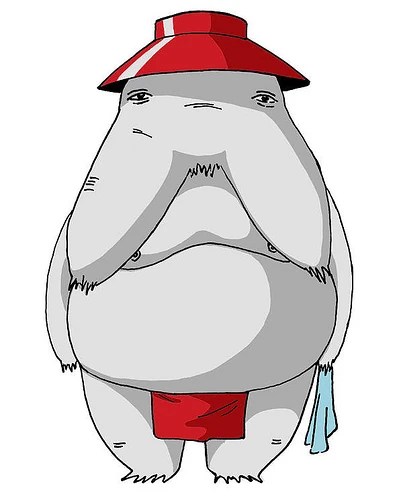
Large bipedal being based on daikon
Radish Spirit from Spirited Away. All rights reserved to Studio Ghibli, image taken from the Ghibli Wiki.

Lethal Lettuce

Lettuce, what a bland vegetable in itself. Add a bit of salt and vinegar and it’s more appetizing. Add some magic or mutagens and it’s a murderous organic drapery waiting for some unlucky soul to get too close. The leaves suggest engulfing foes, or flying, possibly both at the same time. Imagine a giant romaine lettuce flying through the night sky, dropping unsuspected on its prey, killing it by suffocation within the folds of its leaves. Or perhaps using some toxin or digestive acid, why not? Or the same lettuce hanging in the forest canopy above a path, waiting for solitary travelers.
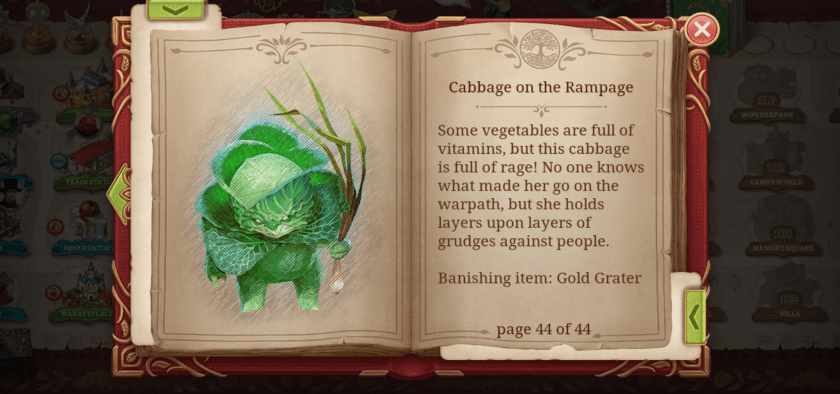
Finally, a cabbage monster from Seekers Notes. All rights reserved to Mytona.

The screen above is once again from Seekers Notes. The highest tier of vegetable monsters in the game is this type IIIa raging cabbage. It’s using an onion as a weapon, and to banish it you need a Gold Grater. It seems quite bulky, built like a golem. Usable as both an enemy and an NPC.

End of part I

There’s a lot you can do with produce as a base for your monsters, or even sentient species. While some players might dismiss them as too nonsensical, I believe when done right they can be an interesting way to liven up your bestiaries. As a DM you know your players (or at least you should), so you probably know what they will like.

These creatures, whether you’re using them only as fireball fodder, or as important NPCs, will broaden your options. You can base them on existing features of real plants, or add new traits that they have evolved or received. Make your party wade through ketchup for once instead of gore!

I would also like to announce that I am working on a produce-themed supplement, part of which will be a bestiary! CLICK HERE to get a free WIP sample!

So that’s it for part I! This article has been on my table for more than a year, and it was starting to get a bit stale. I also feel it would be better to put fruits in a separate article. Get ready for some fruity foes in part II!
D&D Lorwyn: Cosmology and Timeline

In case you haven’t heard, Wizards of the Coast have announced in late February that a new sourcebook is in works. It will resurrect the dual plane Lorwyn-Shadowmoor from Magic: The Gathering, released back in 2007-2008. There was the Lorwyn block, comprised of Lorwyn and Morningtide, and the Shadowmoor block, consisting of Shadowmoor proper and Eventide.

I wanted to dedicate a series of articles to MtG with focus on those two blocks, but Wizards beat me to it with their announcement. There’s no release date so far, so I’ll go for it anyway and write my thoughts, expectations and speculations. I am really looking forward to the end product and wish the team behind it luck. Lorwyn-Shadowmoor is a great setting and should not be left to rot.

Lorwyn-Shadowmoor is clearly inspired by British Isle folklore. It shows in the language, themes, and aesthetic, but it was never marketed in this manner. The creators probably wanted to create a setting influenced by folklore and fairy tales, not build a setting around folklore.

In this article, hopefully first of many, I will describe some of the cosmological aspects of Lorwyn-Shadowmoor in regard to Dungeons and Dragons. There are my speculations on the place of the plane in the multiverse(s), and inevitably a quite large part on the timeline. I wanted to get these out of the way before I start writing about more specific topics, such as the various denizens of the plane.

Dual plane

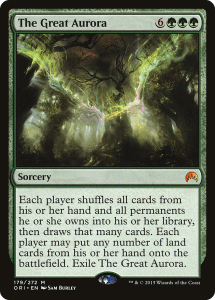
Lorwyn and Shadowmoor are unique in that they’re two sides of one setting. A dual plane changing periodically because of the Great Aurora. Originally a recurring event orchestrated every few centuries by Oona, queen of the fairies.

Many such events have happened apparently, until the last one (the one we see in the MtG blocks). That one was not caused by Oona, to her great unease and discomfort, but rather brought by the Great Mending. The Great Mending is an important event in the Magic multiverse that I will not describe here. Concerning Lorwyn and Shadowmoor the fact that it happened should be enough.

Due to the dualistic nature of the setting, almost everything in Lorwyn has its darker counterpart in Shadowmoor. Lorwyn is a cozy rural fairy tale fantasy inspired by the British Isle folklore. The sun always shines there and even the storms are a made of light instead of pouring rain.

Shadowmoor is the opposite, it is always dark and hostile. It still retains the fairy tale tone, but warm and cozy is replaced with harsh and gloomy. The denizens of Shadowmoor are mostly bereft of their good sides, with their flaws amplified.

The duality of the plane is best seen when the change is part of the equation. Without the Great Aurora the plane is either an idyllic rural haven, or a folk horror darkland. Both have their merits, but a large part of the potential is lost when only one aspect is experienced.

Cosmology

What I am quite interested in is the way Wizards will handle the plane in relation to D&D cosmology. Both multiverses feature planes, but they are not connected.

MtG Multiverse

Based on the Planeshift series my guess is there will be no overlap with Lorwyn either. Rules will be given for playing D&D set in the plane, but you will be expected to act within the MtG multiverse. That’s fine in my book, it makes more sense to travel from Lorwyn to Innistrad, than jump between Lorwyn and Sigil, or one of the many worlds of the Prime Material plane.

In the Magic multiverse one thing you have to consider is that travel between the planes is not easy. Usually the power called “planeswalker’s spark” is required, and the individuals in possession of the spark are known as “planeswalkers”. It takes time and effort to master the spark, so the planeswalkers that could travel to Lorwyn should be fairly high-level.

This changes after another large event in the MtG universe, the Phyrexian Invasion of the Multiverse. One of the the results is that many planeswalkers lost their planeswalking powers. Instead, newly created portals called “omenpaths” now exist, enabling even non-planeswalkers to travel from plane to plane. So the accessibility of interplanar travel depends on your timeline, but more on that later.

D&D Multiverse

Suppose you only wanted to use Lorwyn-Shadowmoor in your campaign. You are using the “default” D&D cosmology, also known as the Great Wheel. From the outside in there are several layers of planes. The Positive and Negative planes are the outermost, then there’s the Astral plane wrapped around the Outer planes, with all the alignment-based fun stuff.

The Inner planes are encased in the Elemental chaos, then there’s the Ethereal plane, and nestled safely in the middle is the (Prime) Material plane. That’s where most of the adventures usually happen, whether it’s on Toril, Krynn, Greyhawk or what have you. Somewhere near the Prime there are the Feywild and Shadowfell, and those are the ones whose relation to Lorwyn-Shadowmoor would need to be resolved.

The Great Wheel as depicted in the Dungeons & Dragons 5th edition Player’s Handbook. All rights reserved to Wizards of the Coast and/or other respective owners.

Personally I would handle Lorwyn as a crystal sphere similar to Realmspace, or Greyspace. One heavily influenced by Feywild in the past, but perhaps cut off since then. Maybe Oona, the queen of fairies is the culprit, seeking dominion and independence in her own plane without intervention from home. That would explain both the influence and isolation, and go well with Oona’s theme of manipulative schemer. But all this depends on another detail of the D&D adaptation, and that is the timeline.

Timeline

The aspect of the plane would dictate much of the tone and play style of any prospective game. There’s actually quite a lot of possible scenarios depending on the timeline the creative team chooses. I believe it makes most sense to present readers with all of the options. They’re making a setting supplement, not a short zine, so there should be plenty of space for that. Everything depends on whether they want to set a particular scenario forth as “canon for D&D play”, or whether they want to give as much freedom as possible.

Before the blocks

The earliest and possibly largest period imaginable would be the one before the Lorwyn block. A time when the aspects were being flipped every couple of centuries by queen Oona and nothing out of the ordinary happened. Or did it?

Prequels are often used and abused by creators to fluff out already established franchises. When done right it can add depth and explain some things that were left unexplained in the original story. When overdone it can lead to the past being more crowded than the main story, and that is not always desirable.

In this scenario we would find some of the more long-lived characters from the blocks, but there would also be plenty of space for new ones. It would give the creators a lot of freedom, and they have the luxury of the Great Aurora effectively resetting almost everything. That gives a lot of leeway for even quite deep plots as long as it’s something Oona can kill with the Aurora.

Lorwyn block

The first two sets of the Lorwyn-Shadowmoor cycle are Lorwyn and Morningtide. The plane is in its bright and sunny aspect, and there is an overall playful mood throughout. The elves are the public villains, and Oona and her fairies the villains in the shadows.

I will not recount the whole story here, you can read it on the MTG Wiki if you like. Just a few remarks. Since there already is a “main story” for the Lorwyn block, there remains less of the freedom for the team working on the new D&D book.

It’s not easy to fit new stories alongside a strong existing main story. In Star Wars such things are possible thanks to the breadth of the universe. In Harry Potter or Lord of the Rings this would be more difficult. In the case of the latter there’s an amazing achievement in the form of the War in the North video game, but such feats are rare.

Shadowmoor block

Shadowmoor was introduced in the eponymous set along with Eventide. The plane has now been shifted by the Great Aurora, and it’s not for the better. Not only almost everyone lost their memories and their good sides. Oona herself is perplexed by the Aurora, as this one wasn’t her doing. In the end Oona’s chokehold on the plane was broken and a new era begins.

A lot of what was applicable to the Lorwyn block story is the same with the Shadowmoor block. There is a story and it might be difficult to squeeze in other worthwhile content without it coming off as secondary. But it can be managed and surely some groups would be able to pull off a nice campaign.

post-Shadowmoor / pre-Phyrexia

The events of the Shadowmoor block leave the plane in a new state, without the constant shifts of aspect. There are no more Great Auroras and a normal daily cycle is restored. The plane should be more or less in its Lorwyn aspect with a few remnants of Shadowmoor. That sounds like a fun mix that’s not all gloomy but still has some darker elements.

After the events of Shadowmoor and Eventide Oona has been dethroned and supplanted by Maralen, though still alive. The elf Maralen is now queen of the fairies and supposedly is going to rule differently. The fairies will probably remain mostly as they were, but we can presume the other tribes will exist in both aspects in this scenario. So we get both kind and xenophobic kithkin, playful and monstrous boggarts, despotic and virtuous elves. The extra Shadowmoor smaller tribes might also stay. It could really mean many cool options for your tabletop campaign.

If there’s only one “canon” scenario, this one would make the most sense to me. Being a sequel there’s a lot to go forth from, and no danger of retroactively stripping logic from already published materials. The only established event concerning the plane of Lorwyn is the one in the next paragraph, and that one should not cause any problems.

Phyrexian invasion

Phyrexia is MtG’s version of hell, a world of machine-and-flesh monstrosities lusting for the whole multiverse to devour and turn, or “compleat” in their own wording. There was an original Phyrexia in the older blocks, that was defeated, but not wholly eradicated. It took hold of Mirrodin (another great plane with a bunch of blocks and lots of great ideas) and transformed it into New Phyrexia, unleashing an invasion into every plane in the multiverse.

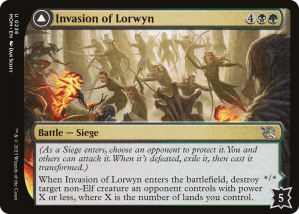
Lorwyn was not an exception, though the focus of the whole story arc was on other, more prominent planes. Lorwyn received only some fleeting mentions. Such is the fate of planes fifteen years dead to the franchise (at the time of Phyrexia: All Will Be One).

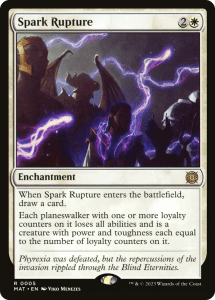
The few bits of information that we have tell us that Lorwyn was indeed invaded. There were those who fell to the lure of the Phyrexians, as we can see on the card above. Ultimately the tribes of the plane joined forces to fight back and resist the machine would-be-overlords. The invasion card art shows only elves, but we can see kithkin and presumably others joining in as well, including the wildlife.

The invasion of Lorwyn by the Phyrexians is another scenario well-suited for your D&D game. A whole campaign could be devised, starting with some early pre-invasion reconnaissance being responsible for trouble on the plane. Followed by full-scale invasion, during which perhaps the party would have some vital quest to help turn the tide. The possibilities here are again quite broad, both for the creative team and for the players.

post-invasion

After the invasion most of the planes invaded were destroyed to various extents. We know nothing of the casualties Lorwyn suffered, but since the Lorwyn invasion wasn’t mentioned too much, we could expect a fairly good result. Maybe we’ll get more information in the prepared supplement. It’s also a direction in which a lot of creative work could be done.

There is an opportunity to come up with some interesting worldbuilding, but it seems wasteful to me to set your game after the invasion. Sure, the rebuilding also has its charm, but from a D&D point of view, the Phyrexian invasion is something you want to be part of, when you’re not setting up your game in Lorwyn’s past.

One outcome of the Phyrexian defeat should be pointed out, however. During what’s called the “Desparking” many Planeswalkers lost their spark. At the same time omenpaths have opened, essentially the means of interplanar travel for non-planeswalkers. This opens the possibilities for parties of non-planeswalkers to visit Lorwyn. For example start playing on Zendikar and then travel to Lorwyn. Again, this is something that broadens your options significantly, but comes only after New Phyrexia is dealt with.

Conclusion

Well, the conclusion is obviously that it’s great Wizards are working on a Lorwyn-Shadowmoor supplement for Dungeons and Dragons. The plane has been neglected for too long, and making it available also for people like me, who are more into TTRPGs than TCGs, is a nice gesture.

I posited various questions and their possible solutions for the future supplement. It will be to interesting to see how the team handles them, or even if they do. Maybe what I’m considering isn’t really what’s important here?

Let me know in the comments what are your thoughts, and how would you handle the issues of possible scenarios and cosmology. Also, it’s entirely possible I’ve got some things wrong, as I’m by no means a MtG buff. Corrections are welcome, as well as suggestions, and any constructive discussion. What are your thoughts on the matters I described?

If you liked the article, your comments and sharing would mean a lot, and give me the necessary feedback. The article is quite long, at roughly 12 minutes reading time. Would you prefer articles of this length, or should I strive for more shorter ones in the future?

Last but not least, some disclaimers: Magic: the Gathering (and Dungeons & Dragons, for that matter) are property of the Wizards of the Coast. The cards embedded in the article are obtained via Scryfall with no foul intent. The content of this article benefits a great deal from the MTG Wiki. I am not affiliated with any of the above mentioned entities in any way.

January Behind

Estimated reading time: 6 minutes

With most of the articles still in need of some polishing, here’s a sort of summary of my activities and other stuff that happened in January. The blog is now active for more than a year, so onward to the next one!

David Lynch Died

… and the creative world is poorer for it.

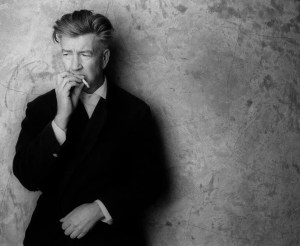
Photo of David Lynch smoking
David Lynch at his Hollywood studio in 2002
Photograph: Chris Weeks/WireImage

I wanted to write a separate article, but found it redundant. After Lynch’s passing there was a myriad of articles summarizing his works, views, or talents. Instead I will share a few thoughts I have concerning David Lynch’s works that are relevant to this site.

The Weirding Dune

No matter how dissatisfied David Lynch (and the general public) was with his Dune, I loved the film. Probably a bit more as a child than I do now, but I still consider it a solid adaptation with a distinct style. There are more accurate adaptations (cheers, Syfy!), and it hasn’t aged that well. Some additions made by Lynch are unnecessary and some make no sense. But the surreal dreaminess goes well with Frank Herbert’s novel, and one can but wonder what would David Lynch’s Dune look like if he had full artistic freedom.

Kyle MacLachlan as Paul wielding the weirding module
Paul demonstrating the weirding module. All rights reserved to Universal Pictures and/or other respective owners.

The weirding modules used in the movie are one of the additions that are not needed for the story. According to some they actually cripple the image of Fremen as a fierce and powerful military force on their own, replacing their prowess with technology. I can agree with that, but I think the idea itself is neat. An item that essentially makes you into a Skyrim Dragonborn, providing you with the ability to kill with your shouts, is something I can imagine in a setting. In the movie I believe they could also set things on fire with the right modulation.

What are your thoughts on David Lynch’s Dune? And would you like something like the weirding modules in your game?

Twin Peaks

The legacy of Twin Peaks is massive, with lots of great creators citing it among their key influences. Having seen it as an adult long after it first came out, I can’t quite imagine the kind of upheaval the series caused at the time it first aired. For me it’s a masterful blend of Americana, horror, fantasy, and mystery. All wrapped in that surreal style called “Lynchian”, a label probably destined to have it’s meaning debated forever in the vein of “Lovecraftian”.

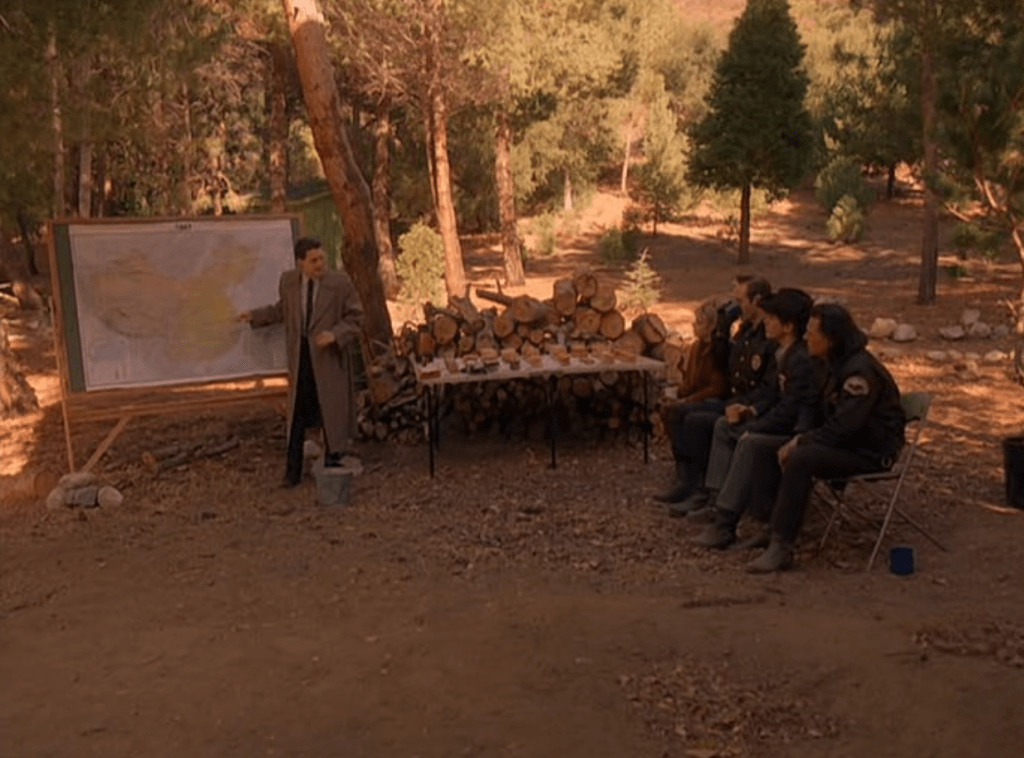
Kyle MacLachlan in front of a map of Tibet speaking to an audience made of Twin Peaks PD members
Agent Cooper presenting Tibet to local police. All rights reserved to CBS, Paramount, and/or other respective owners.

There are many reasons why I hold Twin Peaks dear other than the basic enjoyment of a TV show. Frost and Lynch’s blend of cozy and unsettling, grounded and esoteric, heartwarming and violent, makes for a unique atmosphere. It wouldn’t work just anywhere, though many great shows, movies and video games were inspired by Twin Peaks. As for TV shows, Carnivale and True Detective are my personal favourites, and Alan Wake is the one when it comes to video games. I’m mentioning these three because I also intend to write articles about them, in time. I’ve already touched True Detective Season 4 here.

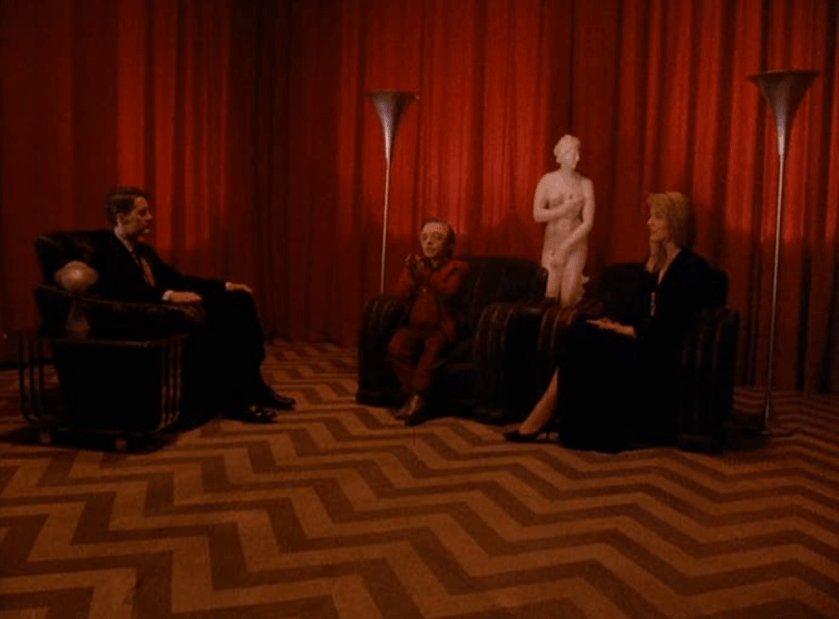
Scene from Agent Cooper's first dream in the Black Lodge with Th Man From Another Place and Laura Palmer doppelganger
The first dream in the Black Lodge. All rights reserved to CBS, Paramount, and/or other respective owners.

In dreams

David Lynch’s surreal style is great seen on the screen, but can it be translated onto tabletop? Some systems might be better than others, I can see a Twin Peaks-inspired game in World of Darkness, or Call of Cthulhu. But can you run a Lynchian game of Dungeons & Dragons, or Pathfinder? They are the kind of games where head on approach is preferable – you find monsters, you kill them, loot them, stick ’em in a stew… But the rules are not really accommodating to subtler modes of play.

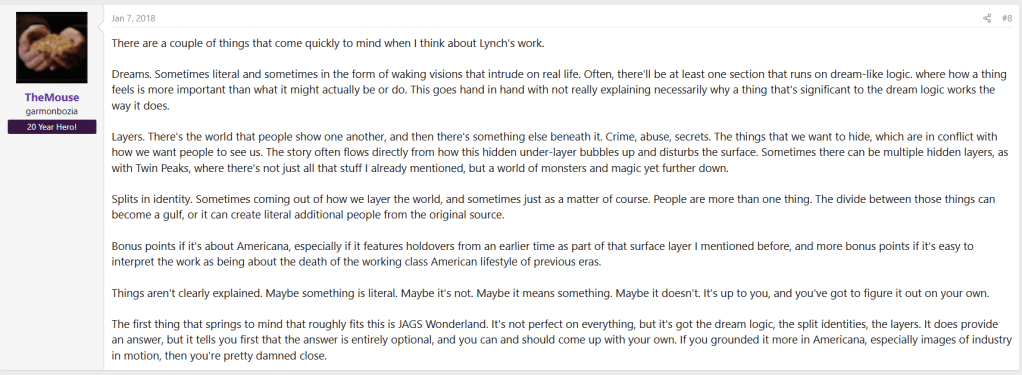
Screenshot of a RPGnet post describing Lynchian characteristis
A nice summary of Lynchian characteristics from rpg.net forums by user TheMouse.

If you want to try it anyway, above is a useful description of some Lynchian characteristics I found in an older thread on the RPGnet forum. Some are quite easy to achieve, others might be more difficult. A lot depends on your group, as always. I’ll also have to check some of the suggestions for other TTRPGs, such as JAGS Wonderland. If you are familiar with the game, leave a comment with your thoughts!

New subclasses

I’ve been working on a few options for 5e DnD, namely new archetypes for the existing classes. There’s a ranger conclave, and a barbarian path that are almost done. Also a bard college, and a druid circle that still need some work. To stay with the topic of David Lynch above, I’ve also been contemplating creating a Twin Peaks inspired subclass in the last few months. I’m not sure I’ll get to it, but Lynch’s passing has served as a reminder that I had plans in this direction.

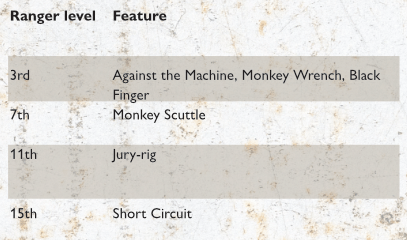
Features of an upcoming ranger conclave
WIP features for the new ranger subclass.

Above is a teaser for the ranger conclave. It’s going to be less magical than those in Tasha’s and Xanathar’s. And a lot more setting-specific than your regular subclasses. While this limits its usability, I believe setting-specific options have their place in the game. If you play it once in ten campaigns, I’d say it’s still a win.

Arco

I’ve been playing this 2024 indie RPG in the last few weeks. It’s not that long, I just can’t dedicate that much time to gaming. However, Arco has it all: good story, great worldbuilding, humour. The graphics, soundtrack, and gameplay are just as great, though largely irrelevant for the kind of article I’m writing. I’m currently on my second playthrough, taking further notes, trying different approaches.

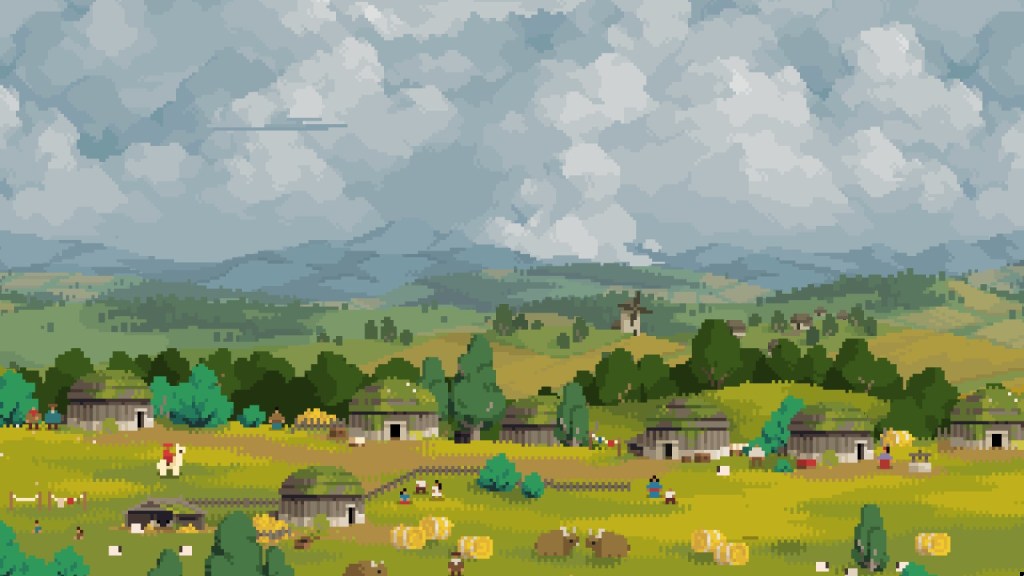
View of a peaceful village from the game Arco
The gorgeous pixel art of Arco. All rights reserved to Franek, Max Cahill, Bibiki, Fáyer, and their publisher Panic.

February

We’ll see what February will bring. I have too many unfinished projects on my desk and too little time to even write these short updates, but I’m determined to finish them.

What are you working on? Feel free to leave a comment and share this post on your favourite networks. It’s greatly appreciated. Thanks for reading and see you soon!

Resource: Video Games

An introduction to video game analyses that will be appearing on the blog. More coming soon!

Estimated reading time: 9 minutes

Video games and TTRPGs have a long history that needs no introductions. Many great computer role-playing games (cRPGs) are based on TTRPG systems or at least their settings, as you probably know well enough. Like other media, video games can be a great resource for your game, and sometimes the less obvious choices can be more interesting. Everyone got some inspiration from some cRPG they played, but great gems to add to your game can be found in any video game genre, and even in those that are not really good as video games.

The other strong point I’d like to make is that video games are very accessible and in my opinion can make TTRPGs more accessible as well. Not everyone starts with ASCII Dwarf Fortress or Space Station 13, but there are tons of games even casual gamers or non-gamers recognize. You are probably thinking about some examples right now. On the other hand not everyone who wants to play TTRPGs is a devoted tabletop gamer, well-versed in all the editions and different systems. Many times your friends are not even avid readers, having read perhaps Lord of the Rings or Harry Potter because everyone read it at the time. They might play video games though, and through them you can explain TTRPGs, whether it’s the mechanics or general principles. I know I have had players whose only connection to TTRPGs was through video games, and the experience helped them get into tabletop gaming.

In this series of articles you will find not exactly reviews, but rather analyses of different video games. Sometimes they will be in-depth, sometimes I will only cover a select mechanic, piece of lore or storytelling, or just make stat blocks for a few interesting monsters. The selection of covered games is not really governed by any principle other than what I find interesting to write about, but if there is a game you would like me to have a look at, please leave a comment and we’ll see about it!

Genres

As I stated above, the obvious genre choice is cRPG. Some amazing titles fall into this category and surely some of them will appear on this blog. There is, however, more to video games than role-playing games, that can be used in your tabletop games. The closest to cRPGs in terms of TTRPG relevance is the triad of adventure, action, and strategy games.

Adventure

Adventure games usually share much with cRPGs in terms of rich story and worldbuilding. What’s usually missing is the progression of the main character(s), but even this is not always true. Adventure games also often rely on puzzles and item combination rather than combat or other contests. Exceptions exist, but generally the are not that common. There are action adventures where there’s combat and platforming interwoven into the adventuring part, like the Legend of Zelda games. There are RPG-adventure hybrids that are not exactly RPGs, but contain many RPG elements, such as character selection, levelling, and combat, with the Quest for Glory series being a wonderful example.

The very beginning of the VGA Quest for Glory I. All rights reserved to Sierra Entertainment and/or other respective owners.

Obviously you can take inspiration from the story, puzzles, or characters in an adventure game. You can also focus on the visual side of these games. Unique environments, fantastic creatures, or spectacular spell effects all find their place in adventure games. Especially in later 90’s and early 00’s with studios such as Cryo there has been a trend of beautiful graphics and wondrous locations that can give you a creative boost.

Action

Action games come in many flavours, from simple shoot-’em-ups or fighting games through platformers and shooters, metroidvanias and souls-likes, to action RPGs. They even differ inside their category, mainly when it comes to depth of the story and worldbuilding. Story is not top priority in these games, but there are exceptional titles with top-notch storytelling – pick any title from Supergiant Games for an example.

Even if an action game isn’t an “action RPG”, RPG elements are often present. Most of the time it’s some form of character progression or selection, and equipment management. Having multiple choices isn’t that common, though again, not unheard of.

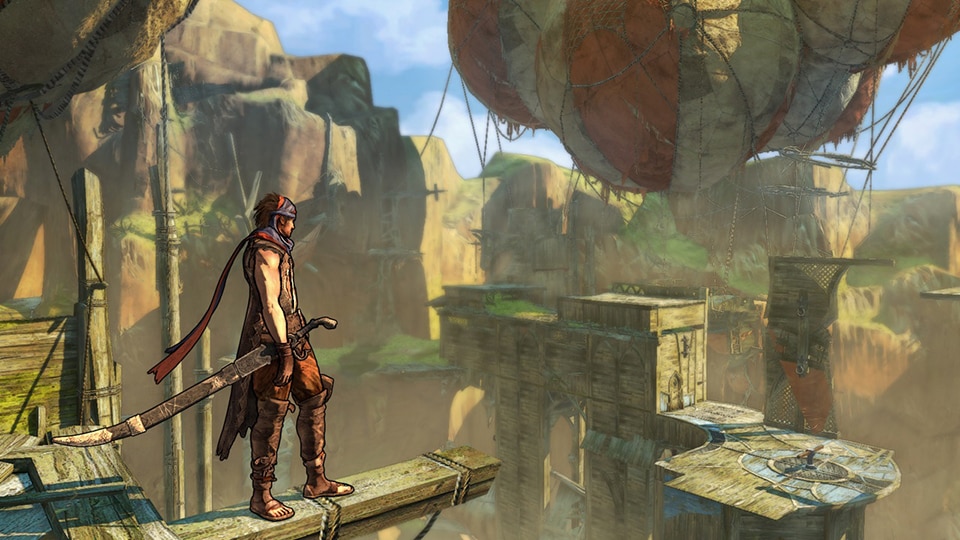
The Prince enjoying a beautiful view in Prince of Persia (2008). All rights reserved to Ubisoft and/or other respective owners.

The various subgenres offer different experiences, but concerning what they can offer your tabletop gaming needs, they are quite similar. Environment and level design, puzzles, enemies, weapons and spells, or character options are some of the features that can be found in most action games. Of course the weapons will be different in a shoot-’em-up like Tyrian from those in Doom or Prince of Persia. The environments will also be of a quite different scale. Can you use them all for inspiration? That’s up to you!

Strategy

As with action games, there is a large spectrum of strategy games at your disposal. The basic distinction is whether they are real-time or turn-based, and this often dictates other parameters of the game. They can be peaceful with little to no fighting involved, or full-scale wargames. The emphasis can be on tactical decisions or large-scale strategy, micro- or macromanagement. Whatever the case, usually there is enough inspiration to be found for your tabletop game in any strategy.

Tactical strategies are often closest to TTRPGs, and the inspiration probably works both ways. As with action games, you can pick enemies, weapons, spells, and all sorts of other options from tactical strategy games. Whether real-time (Commandos, Desperados) or turn-based (UFO, Jagged Alliance, The Banner Saga), they offer plenty of options that can inspire you. RPG elements are often present in the turn-based camp, not so much in real-time games.

Builders such as The Settlers, Cultures, or Anno series offer different scale and experience. While combat is commonly present, it’s usually much simpler than in tactical strategies, and only supplements the main focus of these games – building settlements, bases, kingdoms. Exceptions exist, with Stronghold being a good example of a builder with heavy emphasis on combat of the siege variety. Usually mid-scale economics play a large part in this type of games. They can be used as an exercise in settlement design, and for learning how to think in a slightly larger scale than party-level in your worldbuilding.

Just another day in Crusader Kings 2. Also a good plot hook for your next adventure. All rights reserved to Paradox Interactive and/or other respective owners.

The 4X or grand strategy games are the next step in scaling upwards. Often the focus of these strategies are whole nations, worlds, or planets. The Civilisation series and games by Paradox Interactive are good examples of this subgenre. Again you can get inspired concerning the large-scale matters of your TTRPG. The way kingdoms and empires interact, the issues that need solving both inside and across borders – all of this you can try out in this kind of strategy games before using at your table. Just start a game of Crusader Kings, let the time flow, and you’ll have tons of ideas for your setting in the first ten minutes.

Other genres

What other video game genres you can get inspiration from? Well, the obvious answer is “anything you feel inspired by”! Like racing games with car tuning and championships? Maybe you can use similar ideas but in your game it’s chariots instead of racecars. What about other simulators, such as train simulators or fishing simulators? I bet you can see where this is going. You can also cater to your players’ preferences if you know what genre they like and add just a few noticeable traits from there.

What to use?

You can choose between two approaches. You can lift an element as it is in the source game, i.e. a monster, and use it at your table. Give it stats, maybe figure out its place in your world. Your players will recognize it and either scold you for laziness or praise you for using something they liked elsewhere. Best make sure the second option is more probable before you do this. If you know your players you might have an estimate, but you probably don’t want to do this for your first session with a new group. Either way you should be careful with this approach, as after the twentieth monster and fifteenth item from the games your players love, it might get quite annoying.

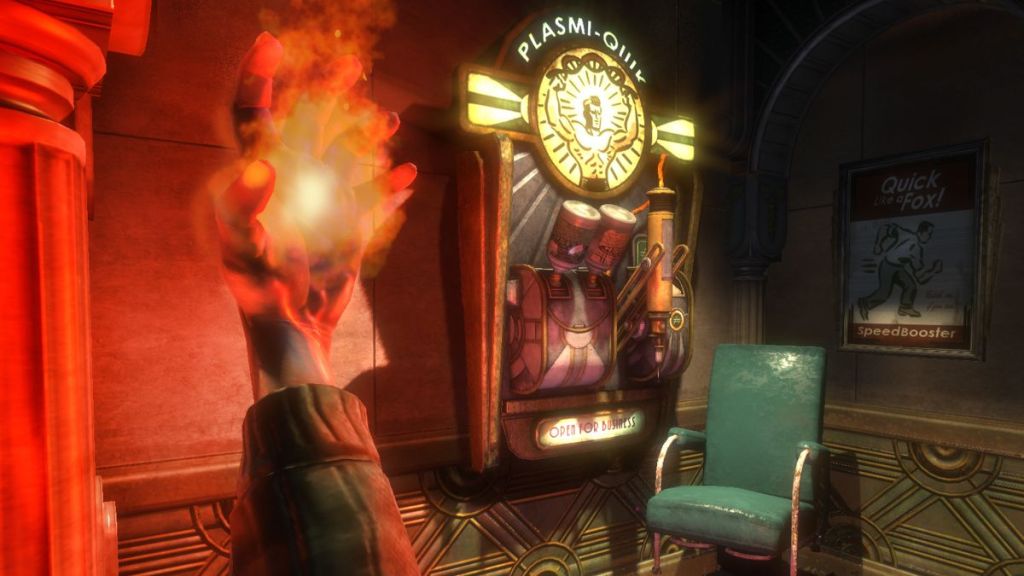
A plasmid vending machine in Bioshock (2007). All rights reserved to 2K Games and/or other respective owners.

The other approach is to analyze what makes the element you like work, and then build upon that. Let’s say you like plasmids and tonics from the Bioshock series. They are essentially consumables that grant spells or spell-like abilities, and are commonly available from vendors. Don’t use the terms “plasmid” or “tonic”, invent a different set of effects, maybe a different delivery method. Someone might still see the inspiration, and you make no claims otherwise, but it should fit better in your setting, and not come off as a rip-off. This is of course applicable to any source of inspiration, not just video games.

I have to say one of the best campaigns I experienced as a player was heavily based on Icewind Dale, where the DM essentially copied most of the plot and added his own elements (a lot, to be fair). But what you get with this approach is often a clash between your players’ expectations and your adaptation. If you’re lucky, you will only be reminded of this a few times each session.

Final remarks

It is quite possible that there’s nothing new for you in this article. You are probably familiar with video games and have used them as inspiration at least sporadically in the past. In that case you may consider this article an obligatory introduction, in which I state my goals and methods. If, on the other hand, you are not at home with video games, you might want to check some out as there are many original ideas scattered around.

As mentioned in the beginning, there will be analyses of video games in the future. Some of the games mentioned in this post will surely have their own articles, and there are many more I would like to write about. I hope you will find the articles interesting and inspiring. First of these will be posted soon, so you might want to follow the blog so you don’t miss anything!

Frozen Horrors

Liked True Detective: Night Country? What about the Thing? Let’s take a look at some other works in similar vein and I will briefly describe the setting or subgenre I call “Frozen Horror”.

Estimated reading time: 13 minutes

It’s been over a week since the Season 4 finale of True Detective by HBO, and it’s been a thoroughly enjoyable ride this past few weeks. Maintaining the high quality writing and production values of the series, the last season takes us to the fictional Alaskan town of Ennis. This is where you might consider stopping reading if you haven’t seen the show, yet. I’m not going to go into any details of the plot, but some technical spoilers might appear. And further down there might be spoilers for other works, so walk softly.

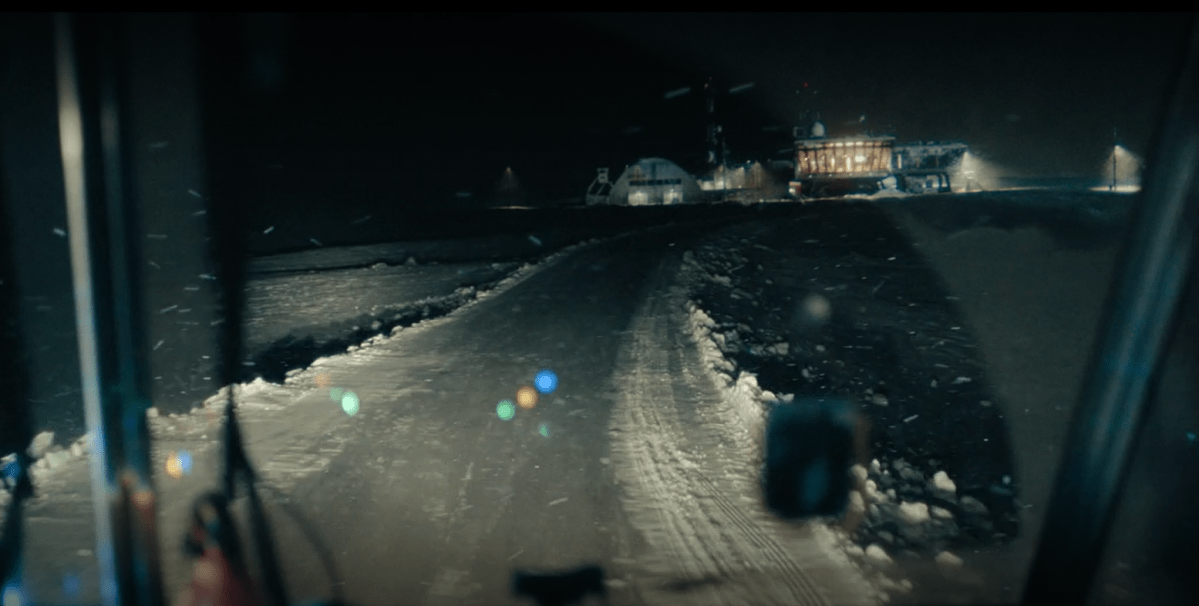
A few minutes into True Detective: Night County.
All rights reserved to HBO and/or other respective owners.

With the exception of Season 2 True Detective always contained elements of supernatural mystery. Season 4 ramps this up quite significantly and due it feels like a mystery/horror series rather than a crime series most of the time. The structure also seems very usable as an inspiration for a tabletop adventure. I can already see an outline with several dungeons and encounters.

Due to its setting there is a resemblance to other works, and I mean it in the most positive sense. The season fits into a category I call “Frozen Horror” and this article will cover that. I will share my thoughts about the characteristics, things that make it unique and that can be used in your game. Afterwards I will provide a short overview of some works that I consider Frozen Horror.

Frozen Horror themes

There are certain themes that are essential for the Frozen Horror feel and I will outline their potential for your games here.

Adverse weather

First of all it’s the adverse weather. We’re dealing with polar areas where outside temperatures fall deep below zero. While this is obviously not an insurmountable obstacle (even more so in a fantasy setting), it sets some rules and boundaries. To stay outside most of the time you need good winter clothes. What if you have no access to them for a reason? Or if they get torn to shreds by a monster attack? Many surfaces get slippery due to ice, and handling equipment without necessary precautions can also be tricky – swords can freeze in their scabbards for example, and some liquids can freeze in their containers.

Low visibility

Snow storms can be fatal even when properly clothed, and this can be used to control when and where can the party go, if you have need for such things. With snow storms there is also the danger of low visibility. All sorts of monsters can move at pike’s length unseen and unheard by the characters due to a raging snow storm. Distress signals, burning settlements, and magical effects can also be hidden by a storm.

Long periods of darkness

If your world is a planet with Earth-like properties or similar season arrangement there are regions where night lasts for weeks at specific times of the year. The resulting darkness of a polar night can be oppressive, depressing, and bring all sorts of trouble – light-sensitive monsters are free to roam, light-based magic might not work as well while dark arts might grow in potency, solar technology is effectively disabled. An interesting twist is the opposite state or polar day, but that has a whole different set of implications. Either way it sets a timeframe for the plot. Things might get better after the long night passes, or perhaps something has to be done before it passes, or even worse things will arrive.

Remoteness and isolation

Another heavily prominent feature of Frozen Horror is the remoteness and isolation experienced throughout the story. These works take place at the edges of settled regions, at remote outposts separated by barren wasteland, or during expeditions into unknown lands. Help and support is often unreachable due to distance, weather conditions, lack of suitable transportation, or a combination of all mentioned. This is even more effective if there’s a specific need that can only be fulfilled elsewhere – the cure for a condition, research capacities, “silver bullets” for a specific monster. As with darkness this might set a timeframe, though differently. A supply ship might arrive only in certain intervals, or mountain passes might be snowed in for a good part of the year.

Frozen secrets!

And last but not least, there’s no Frozen Horror like one with frozen secrets! Whether it is some kind of disease or monster trapped in the ice, or forgotten structures and technology, it’s a classic. The ice might be thawing naturally, or there might be deliberate attempts to release or discover whatever it is that is frozen. Of course not everything that’s frozen is a menace, sometimes it’s the exact opposite. There might be technology, knowledge, or some power that the party needs. But there might be other things frozen with the desired goal, not as much desired.

A good Frozen Horror doesn’t have to include all of these themes, but often it does. Some of them are specific for a certain environment, some can occur elsewhere. You can be very remote and isolated in a desert, and a desert storm will provide low visibility, but there will be no natural long-term darkness (assuming an Earth-like world) and certainly no frozen secrets.

Next there are some examples that I have tried to keep short and without spoilers. There are certainly other works that could be given the Frozen Horror label, and I will be glad to read about them in your comments.

  1. At the Mountains of Madness (1936)
  2. Who Goes There? (1938) and Frozen Hell (2019)
  3. The Thing (1982)
  4. The Thing (2002 game)
  5. 30 Days of Night (2007)
  6. The Thing (2011)
  7. Fortitude (2015-2018)

At the Mountains of Madness (1931)

The H.P. Lovecraft novella deserves to be mentioned first, as it’s the one that many others have taken inspiration from. It’s also one of the best works by HPL, and it should be on your reading list if you want to base your setting or adventure on Frozen Horror.

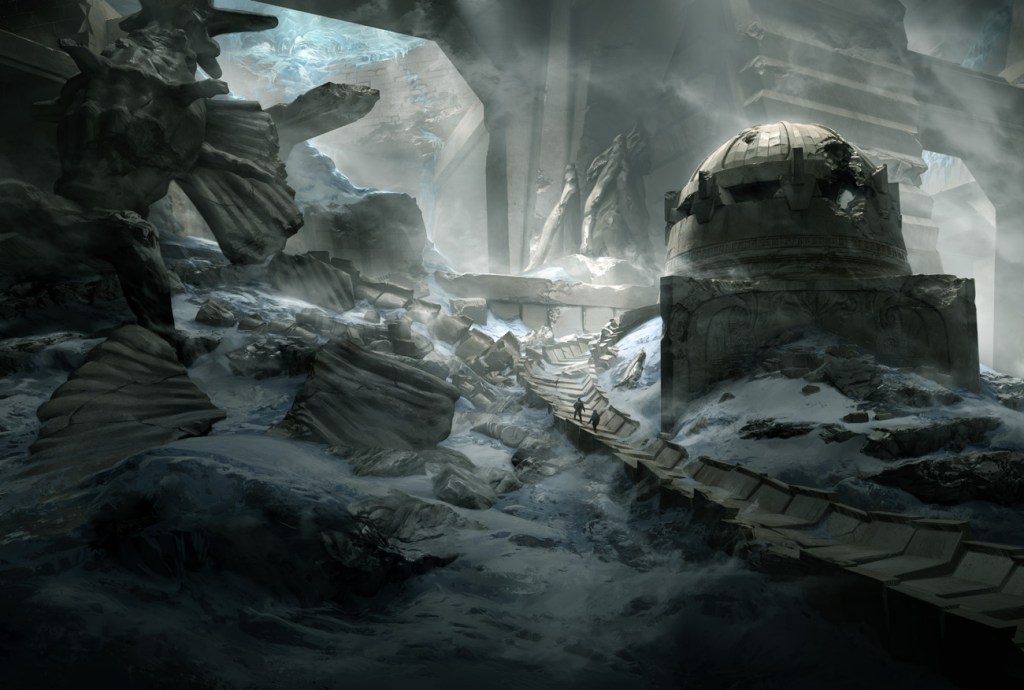
A modern illustration for the novel. All rights reserved to François Baranger.

At the Mountains of Madness tells the story of an Antarctic expedition. An accidental discovery leads to mysterious disappearances and deaths, and ultimately the protagonists find themselves in a lost city. Eons forgotten, the city reveals unsettling secrets, some of which are still alive and dangerous. Narrowly escaping with their lives (but not sanity) the heroes witness things too terrible to describe.

I’m being vague on purpose, because I really wouldn’t want to spoil this to anyone. Go read the novella as soon as you can, it’s public domain already! Lovecraft wrote it later in his career, so he already had an established mythos to reference and draw upon.

One can find themes of isolation and remoteness, and secrets frozen in the ice in At the Mountains of Madness. Even if Lovecraft wasn’t their creator he used those themes expertly. And as I mentioned before, he influenced further works immensely.

Who Goes There? (1938) and Frozen Hell (2019)

Who Goes There? was written by John W. Campbell and published in 1938. In 2018 an original longer manuscript was found and released in 2019 as Frozen Hell. I haven’t read either, but the new release is on my list. Since I can’t offer my own views, I’ll keep it short and only remind that this is the work The Thing was based on. When I get my hands on a copy of Frozen Hell, I’ll either update this post or maybe write a new one. Leave a comment if you have read it!

The Thing (1982)

For me this is it, the perfect example of Frozen Horror, and a top notch horror movie overall. I have seen different opinions, stating that The Thing is overrated. What do those people expect from a great horror movie that they didn’t find in the Carpenter masterpiece is a mystery to me. But hey, I don’t like some generally-accepted masterpieces either, so I accept it with only a little grudge.

The outpost at night with MacReady's cabin in the focus
MacReady’s cabin in the night. All rights reserved to Universal Pictures and/or other respective owners.

The 1982 adaptation of Who Goes There? by J.W. Campbell is set in Antarctic on a remote scientific base, where suddenly things go very wrong (these vague descriptions are a pain, but I wouldn’t like to spoil too much). There’s a lot of psychological horror, body horror made with perfect practical effects (certainly for the time), and an ambiguous ending. The setting ticks off all the hallmarks of a Frozen Horror, with remoteness and isolation, bad weather conditions, and frozen secrets being the most prominent.

It is perfectly adaptable to tabletop gaming, as many have done already. There is also a sequel video game and a prequel movie. If you liked The Thing, check them out as well, or at least read the following paragraphs.

There has also been an earlier adaptation of Campbell’s novella in 1951 under the title The Thing from Another World. I have not yet seen the movie and as with the book I don’t want to rant about it basing my knowledge on what I read on the internet. Therefore until I have the opportunity I will only mention it. As always comments if you’ve seen it are welcome!

The Thing (2002 game)

Intended as a direct sequel to the Carpenter movie, the game picks up right after the ending. It chooses one possible explanation for the ending as canon and elaborates from there.

Wallpaper from the game. All rights reserved to Konami and/or other respective owners.

In this 3rd person team-based action game you are Captain Blake, an US Special Forces operative sent with his team to investigate. Being an action game it offers a lot of shooting and jump scares. I remember when it was new I couldn’t play it myself because of the tense atmosphere and scariness, and instead watched as my dad played the game.

Even though it lacks the slow burn psychological stuff of the movie, the game gets many things right in my opinion. The events of the game don’t collide with what the movie started, or at least as far as I remember. I’ll have to play it myself for a deeper analysis, so expect an article on the game itself in the future. Meanwhile you can check this post by Syfy for some background information and plot synopsis, if you like.

30 Days of Night (2007)

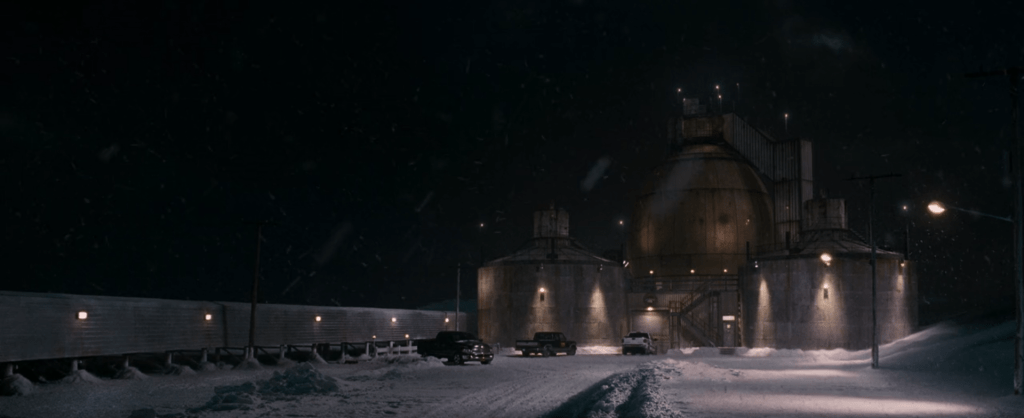
Let’s take a break from The Thing and the Antarctic for a while and visit Alaska again. Based on a comic book 30 Days of Night takes place in Barrow, Alaska (now Utqiaġvik) during the polar night. The local events take a wrong turn after the arrival of a sinister cargo on a ship. The long polar night is central to the plot and you can make a guess what thrives in the long dark.

Oil plant in Barrow, AL
Barrow’s oil plant after night has fallen. All rights reserved to Columbia Pictures and/or other respective owners.

Once again the themes of remoteness, isolation, long period of darkness, and severe weather take the lead. After the movie a miniseries prequel (2007), sequel (2008), and also a direct-to-DVD movie sequel (2010) were made, but I haven’t seen those. The ratings make me a bit uneasy about spending my time on them, but do leave a comment if you have seen them!

The Thing (2011)

A prequel rather than remake to the 1982 Carpenter movie of the same name. I find it commendable that in an age of cheap remakes the creators instead elected to make a tie-in with the original movie. It is up to everyone’s judgement whether they succeeded.

The story is set right before the events of Carpenter’s Thing at another research station, this time Norwegian. You can watch the 1982 movie right after this one and the story will continue almost seamlessly.

Helicopter arriving at an antarctic base
All quiet at the Norwegian base. All rights reserved to Universal Pictures and/or other respective owners.

In my opinion it is not bad. There’s not exactly the level of mystery and suspense as in the 1982 movie, and it’s more predictable as far as I remember. There are similar themes, similar progression, you are aware that this has to do with the other movie all the time. Don’t expect any great novelty or originality, but it does what it aims to and it really feels more like a loving homage than a cash-grab remake.

Fortitude (2015-2018)

I have saved this one for the last, because it is one of my favourite shows, and also one that the latest True Detective series reminds me the most. Fortitude is set in a fictional town of the same name in Svalbard. The inhabitants are employed mostly as scientists, miners, or fishermen, plus the necessary services.

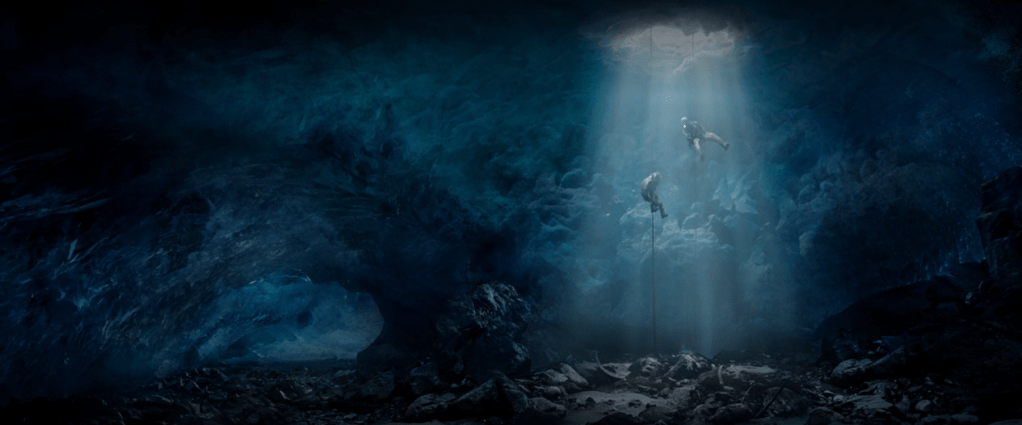
The first season is mostly a crime investigation show with little hints of mystery. With the second season Fortitude goes full mystery/horror with supernatural elements, and this is the season I find both most fun to watch and most usable TTRPG-wise. The latest True Detective series reminds me of this second season in a good sense, as I mentioned before. There is also a third season, but it’s inferior to the first two. It feels like an attempt to tie things up after being scrapped by the producers. What I find the worst about it is what happens to the characters. Formerly complex characters are flat in the last series and behave stupidly. And also it seems the creators tried to make everyone look bad. I’d say you can safely leave the third season out.

Two persons rappelling into an icy cave
What lies below the ice? All rights reserved to Sky Atlantic and/or other respective owners.

Fortitude has a great atmosphere overall and uses the themes I wanted to talk about really well. There is severe weather, darkness, isolation, various political and social tensions as well, and of course frozen secrets. The supernatural is well interwoven into the “normal” problems of an arctic settlement. The cast is very good and the characters and their motivations are well-written (until Season 3). As with True Detective: Night Country, there is a lot of potential for someone who would like to turn it into a tabletop adventure (or campaign).

Final remarks

What I call Frozen Horror (and you might call it differently) offers a unique experience, lately revived by the fourth season of True Detective. I have put some of my thoughts on the topic into this article, as well as some examples I would recommend. Of course there is more to each of them than the things I described – The Thing is a different story than 30 Days of Night. In this article I tried to point out some of the similarities that lie mainly in the environment and setting. I am eager to read your thoughts on this matter and perhaps your suggestions for other movies, TV shows, video games, etc. The more inspiration, the better.

I will also prepare separate articles about some of the media mentioned here. Requests and suggestions will be happily considered. If you found this post interesting, it would be great if you could share it with your friends. Comments are welcome, and don’t forget to follow the blog or our social media accounts for more content!