Estimated reading time: 2 minutes (4 with room descriptions)
As I mentioned in the last update, in March we’ll see some more action. In this post a new level of the dungeon begins, one that is lower than the prison level we finished last time. Six rooms are featured in this update, together forming one complex. The drawing style is a little different from the last level. I’m trying out new techniques in pursuit of raising the quality of the maps. Since I’m sharing them with the world, they could use more attention.
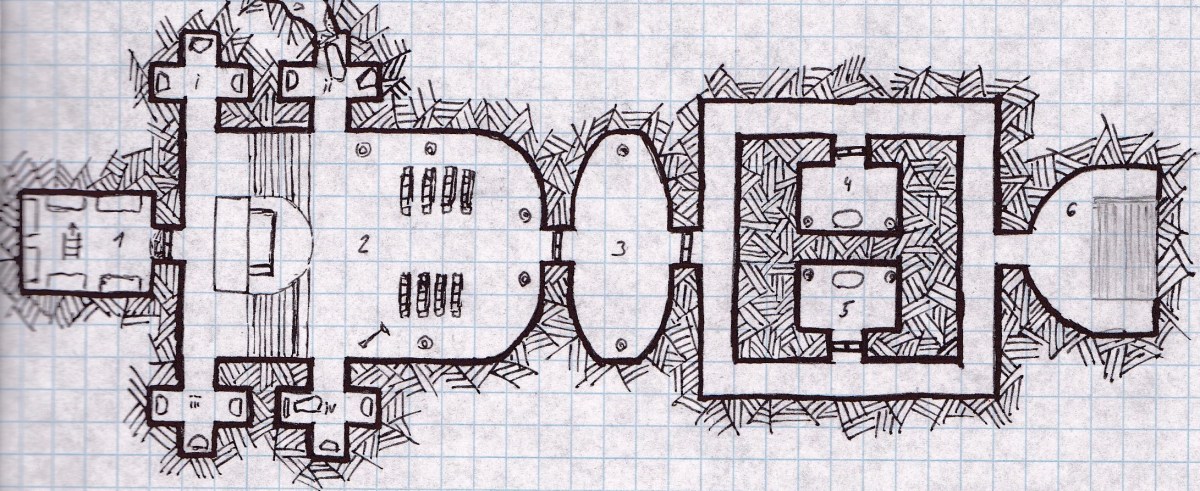
I started below room II/49, or the isolation cell in the gnomish part of the abandoned prison. A shaft leads down from there some 25 ft., first few feet furnished with iron rungs, then a rope ladder leading into a rectangular room with six sarcophagi. The tomb contains the bodily remains of six high priests of a long-vanished cult, and can be left by a door on the eastern side of the room. Someone barricaded the door with slabs of stone that probably come from the ceiling.
The door leads to the nave of a temple. Four alcoves in the shape of a cross contain more sarcophagi, and on the other side of the nave the door leads to an anteroom. One of the alcoves has been breached somehow from an adjacent natural cave (we’ll get to it in the next update). The antechamber is plain and leads to another two rooms serving as shrines for artefacts. One is still present, the other is missing. The whole temple is decorated with murals depicting pastoral scenes, mostly with goats. Some murals are damaged, in the main nave it’s mainly the faces of people that are defaced. In the easternmost room a wide stairway leads down to lower levels.
The temple of goatherds.
The temple has been abandoned long ago, althought it seems the tombs haven’t been looted. Whoever made the access shaft to the tomb probably found it wise to barricade the door. The party is free to loot the sarcophagi, but this should prove difficult enough. With a trap to soften the robbers and then a mummy inside, each sarcophagus could be their last. The horn in room 4 is free to take with no strings attached.
Rooms
Tomb with 6 sarcophagi, there’s a rope ladder dangling from a hole in the ceiling
the door is blokced from the inside with large stone slabs, probably from the ceiling
each sarcophagus contains the remains of a high priest – there are glyphs documenting their names, rank, and deeds
potential grave-robbers might want to open the sarcophagi, though each is trapped and the mummified corpses come to life when tampered with
T: each corpse is adorned with jewellry, some have ceremonial regalia such as a dagger or scepter
E: up to 6 mummified high priests
Temple nave with pews, altar, and 4 alcoves with sarcophagi
the altar is on a raised dais
the walls are covered in faded murals depicting pastoral scenes, faces deliberately damaged
alcoves – ii has 1 toppled sacrophagus behind which a tunnel leads to III/7; one sarcophagus in alcove iii contains a simple lapis lazuli necklace
antechamber, walls covered in murals showing goatherds and scenes from goat husbandry
small shrine, on the altar is a goat’s horn with silver fittings, murals on walls show flocks of goats, sheep, and cattle
T: horn of animal friendship (1 use/day, as spell cast from 5th level slot – 5 animals affected, works only aboveground)
small shrine with empty altar, walls defaced, but remains of hunting scenes can be seen
room with a wide flight of stairs leading one level down
In the next update we’ll have a look at the cave leading from the breached alcove. What will avait intrepid explorers in the darkness behind the toppled sarcophagus? Follow the blog or our social networks so you don’t miss anything!
The February #Dungeon24 update is finally ready. This time we’re dealing with a community of swamp gnomes.
Estimated reading time: 3 minutes (7 with room descriptions)
I’ve been neglecting the dungeon in the last few weeks, and it’s already April. By now there should be around 90 finished rooms. The schedule seems quite unrealistic, so I will just post these whenever I finish a batch. I’m slowly changing the style, as I’m trying out a more detailed approach. Either way these drawings are only wips, I will be redrawing everything at the end of the year or so.
We entered the southern prison block last time and from the few corner cells described not much could be guessed about it. The next few rooms should clarify things.
This prison block is occupied by a small group of swamp gnomes. Their leader is Čitlo [chit-loh], a sorcerer of some skill. The others are mostly simple fisherfolk and craftspeople. They prefer to be left alone, having sought the solitude of the abandoned halls of the complex. The swamp gnomes visit the surface to fish and forage, and once in a while descend to lower levels as well. They keep away from dangerous areas. When asked about the other block, they remain mostly silent or try to change the subject.
Balok the dwarf sometimes trades with them, but their relationship is not that of equals – he sees them as someone who is tolerated and potentially exploited, when possible.
The southern prison block. You can see I added details to most rooms.
Rooms
Twin cells remade into a single room by removing the central partition and covering the bars.
the room is inhabited by a single swamp gnome
contains a seaweed pallet, some coil baskets of various sizes; in one corner a series of shelves is fashioned ou of an old fishing net, still with floats and sinkers
Former kitchen; it is divided by bars with 1 dispensing window on the N side – now reinforced by additional bars bound by locked chain
The “outer” part is empty, only 1 rickety chair stands in NE corner
The “inner” part serves as a sty for 5 eggslugs, that are using what originally served as a cooking fireplace as an egglaying nest; there are remains of foodstuff and organic refuse all over the room
Former larder, now used for storing fodder for slugs – seaweed, food remains, etc.
T: when searched thoroughly (DC 30) a brazen button similar to the one from I/25 is found
Another room fashioned from two cells, the central barred partition is removed untidily, with remains of bars still visible; outside bars covered with blankets
home to two swamp gnomes, brother and sister
two crude seaweed pallets in S part of the room; small table with chairs, few seaweed baskets, a beaten keg made into a chest
on the table there is a figurine similar to those in I/4
storeroom turned into living quarters
home to a single swamp gnome, an old stone carver
N part of the room taken by a crude seaweed pallet, in SW corner a small seaweed rug on the floor, little chips of stone in every corner and nook, dust everywhere
on the rug a set of tools and half-finished stone carvings
former chapel, now common room for the swamp gnomes
in the alcove is an altar used as a counter for food preparation
basin in the middle is usead aas a fireplace – there are potstands, tripods, etc. in and around it
usually at least two gnomes on kitchen duty; more if it’s meal time or there’s a matter to discuss
originally a workshop, now the room serves as the swamp gnome leader’s quarters
divided by a screen made of sailcloth, behind the screen is a pallet, table and chair and a small chest
N wall lined with shelves with various trinkets and containers, SE corner occupied by a corner workbench
the swamp gnomes’ leader Čitlo is rarely in his quarters, more often supervising other gnomes’ activities or spending time in the common room (II/46)
isolation cell reused as a storeroom; it is full of seaweed bundles tied with coarse ropes and twines
T: one of the bundels in the back, under several others, is a hidden stash (DC 30), containing the following: 78 gp 51 sp in various coinages, 2 healing potions (unlabeled), wand of Reduce person
isolation cell remade into secret access shaft to lower levels
the door is locked, key is worn by Čitlo
the room is empty, in SE corner a roughly cut shaft with rungs set into the stone
former utility closets, now larder
shelves, boxes, and sacks containing various foodstuffs – undergorund and coastal
utility closed turned into a toilet, a screen divides the room
behind the screen is a toilet leading to a lover level, climbable by small creatures, though filthy and leading to a sump
another converted twin cell, housing a single swamp gnome woman
right in front of the door is a standing loom
in SW corner is a table and 2 chairs, a large shelf at the S wall, smaller chest on the opposite side, seaweed pallet and coil basket near E wall
twin cell remade into tannery
there are 2 frames with stretched skins along the N wall, 2 vats along S wall, 2 drying rackswith fish skins in W part of the room
Some scraping tools hanging from the frames, and softening hooks on the walls
Twin cell rebuilt into a room, it serves as housing to a pair of swamp gnomes
There’s a larger pallet, a table with 2 chairs, a large coil basket and a chest, one shelf on the N wall
The occupants are leatherworkers/tanners and spend most of their time in the tannery (II/53)
Room made from twin cells, occupied by a single gnome
Caringly repaired furniture – 2 shelves, a table and 2 chairs, a chest, and a pallet
On the table and shelves are various woodworking tools – saws, knives, planes, a hammer and nails, etc.
Corner cells remade into another room, a couple with child lives here
Screens divide the room into sections, N has a larger pallet and a cradle, center part has some chests and a table with chairs
small workshop with a work table, equipped shelves, and a chest
door is locked and barred (1 key for each needed)
inside is a corpse of a dwarf engineer
the workshop is equipped well enough for most basic craft and maintenance needs
T: the dwarf has a dagger, shortsword, and small crossbow with 6 bolts in the quiver; also some jewellery (worth 7 gp total) and coins (2d4 gp in different coinages)
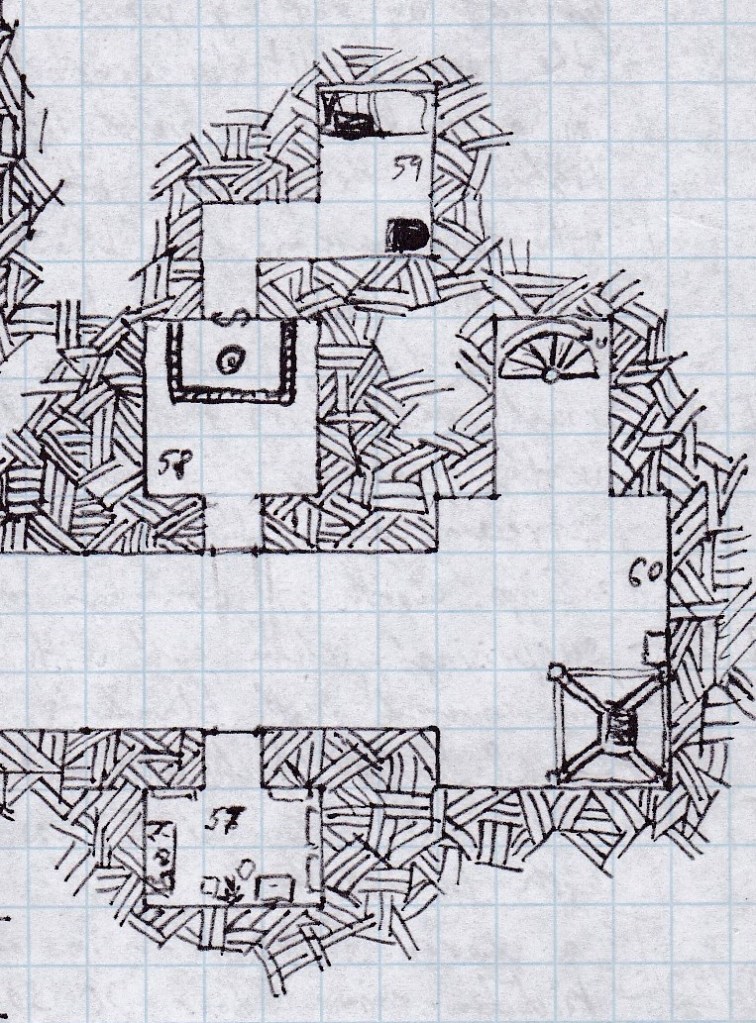
Fountain room – large basin with a fountain; there is no water and the basin is dirty
“secret” door behind the basin (DC 35) leading to fountain maintenance
Maintenance room for the fountain
apart from some machinery there is a shaft leading down
Lift room
the lift is broken, but the shaft can be used to climb up two levels (better access from the top with a rope)
there are also stairs leading up, but only one level, and the door on top is locked
Several exits to different levels are located in this part of the level.
This concludes the prison level of the compound. Another set of inhabitants was introduced, the swamp gnomes. A detailed description of this subrace/heritage will be the content of another post in the future. So far the dungeon didn’t offer much in the way of dangers, but I’m not working on a room-by-room chain of encounters. We’ll see how this goes in the next few months. April is round the corner and I have to start on March, still. I guess I can do a lower level for March and make it more dynamic.
As always, thanks for reading and you’re welcome to like and comment, and share the post and our site on your favourite social media!
Do slingshots have place in fantasy settings? In this article I’ll look at all the angles.
A slingshot is a weapon many may have had their hands on, especially as children, when they made one out of a natural fork and some leftover rubber. With many commercial and artisan makers, and whole clubs and competitions dedicated to target slingshot shooting it’s quite easy to get into the hobby even as an adult.
While their history is rather short compared to other weapons, slingshots are sometimes used in various works of fantasy fiction. Mostly they are depicted as a “youngster” weapon, or a makeshift weapon. Are they worth using in your game? Short answer of course would be: if you want to, use them. But read on if you want to see my thoughts about slingshots in fantasy settings. In this first part I will provide some basic information and examples from fiction. In the next one you will get the when, how, and why I would use them in a fantasy setting.
Sling vs. slingshot
First thing we have to get off the table is this – slings and slingshots are completely different devices, using different laws of physics to propel the projectile, and should not be confused. Often they are, though in a world of ringmail, studded leather armor, and dire flails that can hardly surprise anyone.
A sling is essentially a piece of string with a pouch for a bullet in the middle that you shoot by swinging the whole thing above your head or to your side – no spinning – and releasing one end of the string. A slingshot on the other hand is a rigid frame of wood, metal or other material, usually Y-shaped. The pouch is connected to the ends of the fork by bands of rubber, and you shoot the thing by drawing the pouch with bullet like and letting go. With a sling you need some some space, slingshots should work fine even in tighter places. This of course has implications concerning their usefullness in various situations. You might not be able to use a sling in a long narrow corridor (have to test this), and trying to use a slingshot to shoot someone a hundred metres away is probably inefficient.
Materials
The slingshot consists of three main parts – the body, bands and pouch. While competitive shooters would probably disagree, the pouch doesn’t matter from our point of view. Leather is ok and easily obtainable in probably every setting. What matters are body and bands. The body can be of any material strong enough to withstand the stresses put on it by flexing the bands. This can be the most traditional wood, but also metal, bone, or various plastics (with or without a metal core). So the body is also quite clear and easy to find in any setting. What makes it difficult are the bands.
Slingshot bands are made of rubber. That’s it. That’s why slingshots didn’t exist in our world until rubber was invented and widespread enough. It’s also why slingshots in a world without rubber or a passable substitute look out of place. Catgut is not a good substitute, as it’s not flexible enough. Try using violin strings for your first slingshot. Though it probably could be used in a sling.
But we are in fantasy and there might either be another material with qualities similar to rubber, or rubber itself might be available via the wonders of alchemy (more on this in an upcoming post). For example the body parts of some monster might be flexible enough to substitute rubber. Maybe even whole bodies of some worm species could serve as bands. It’s fantasy, so it shouldn’t be hard to come up with something, but I believe you should have that something thought through, so when someone comes asking, you have an explanation ready.
Slingshot wielders
Let’s take a look at some characters using a slingshot as their preferred weapon. I’m not trying to count every one of them, since folks over at TV Tropes have already done this quite extensively. I’m picking a few that come up to my mind when I think of slingshot-wielding characters, and only in fantasy (-ish) settings. So no Bart Simpson, sorry.
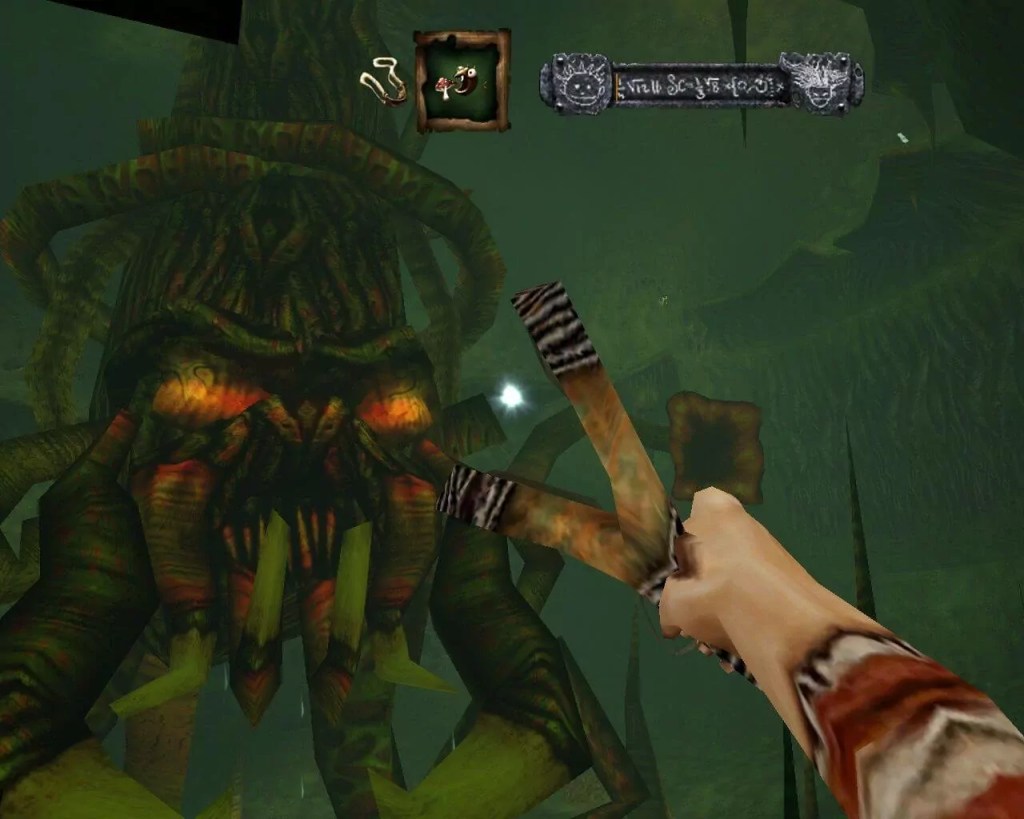
Evil Twin: Cyprien’s Chronicles (2001)
There was a time when platformers enjoyed a much greater popularity even among PC gamers. One of those is Evil Twin by In Utero. The main character is the titular Cyprien, an orphan who has to visit a grotesquely fantastic world to save his friends. It has a very Alice in Wonderland feel, and from what I remember it had cool level design, if somewhat less original story. I’ve been trying to get my old copy to work, but to no avail. Once I’m able to replay the game, I might write a post about it.
Cyprien shooting some plant monster. Borrowed from myabandonware.com, all rights reserved Ubisoft, In Utero and/or other respective owners.
However the reason I’m mentioning the game is that Cyprien uses slingshot as his primary weapon. This goes well with the “youngster” image of slingshots in media. Throughout the game special ammunition can be found, including bubblegum and paper planes. That doesn’t make much sense, but since the game setting is some kind of nightmare dreamworld, I guess it doesn’t matter.
Kender
I have never read a Dragonlance novel, nor have I read either the old or the recently issued setting supplements. I know next to nothing about the setting other than that it has dragons and kender. Based on what I learned on various sites I probably couldn’t appreciate the kender in a game (or novel). Maybe if I read the novels they could grow on me, who knows?
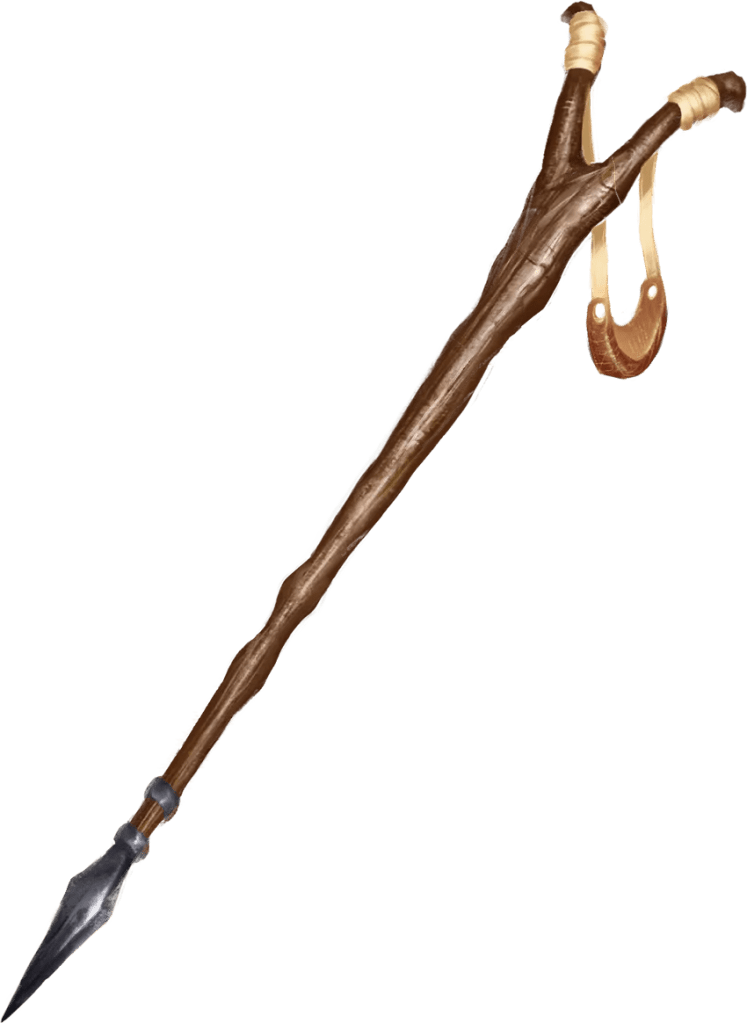
Anyway they use a number of signature weapons and two of these employ slingshots in their design. They are the hoopak, essentially a staff with a slingshot on one end and a spear tip on the other, and the chapak, which is a hand axe with the back of the axe head extending into a slingshot. Both supposedly also serve as musical instruments – the hoopak as a bull-roarer, and the chapak handle is hollowed with finger holes, so you can remove the axe head and plugs in the finger holes and use it as a flute. And those two belong to the more sensible weapons in the kender arsenal.
A rendition of the hoopak from the Shadow of the Dragon Queen supplement. All rights reserved to Crystal Sully, Wizards of the Coast, and/or other respective owners.
The hoopak is referred to as a staff sling, which it obviously isn’t. It’s a slingshot on a staff and that’s not a terrible idea. Joerg Sprave even reviewed his rendition of a weapon like this from the One Piece manga (see below). The descriptions of hoopak I found vary but it seems it is supposed to be working both as a slingshot when planted in the ground by the spike, or as a staff sling. I think this goes with the general theme of kender weapons – trying to slap as many diverse uses on them until they become unusable or silly. If we keep it as a staff/spear with a sling on one end, it’s ok. If we change the sling into a slingshot and find rubber somewhere, it could work as well. Just stay away from catgut, please.
The other one, chapak, is supposed to be a handaxe with a slingshot on prongs extending from the back of the axe. The slingshot uses catgut, of course. I imagine this setup would provide a very uncomfortable and weak grip when shooting the slingshot, and the bands and pouch would get in the way of hacking with the hatchet. That the haft is hollow with drilled fingerholes (plugged when not in use), so it can be used as a flute, blowgun, and snorkel is just a cherry on top of this unpalatable pie. Again there seems to be a desire to cram every possible utility into one weapon. And it would not work well.
One Piece
During Joerg Sprave’s slingshot era he made a reconstruction of a staff slingshot used by the character Usopp. Apparently it’s one of the character’s three different slingshots. I’m not familiar with either the manga or anime One Piece past “it’s got some wacky pirates”, but it seems using a slingshot isn’t the strangest thing and it probably doesn’t look out of place. Feel free to share your thoughts in the comments, if you’re a fan.
Usopp with one of his slingshots. All rights reserved to Toei Animation and/or other respective owners.
Legend of Zelda
Link from Ocarina of Time wielding a slingshot. All rights reserved to Nintendo and/or other respective owners.
Link uses a slingshot in several of the titles. My firsthand experience with the series is quite limited, having played only Ocarina of Time for a short while. From what I’ve gathered online, the slingshot is not a particularly powerful weapon in the games, and often it is used to solve puzzles rather than fight enemies. Sometimes it may stun them, which is always nice. In some of the games Link only uses the slingshot while he’s a kid, so again it goes with the “youngster” themes. Not much is told about the materials used for the slingshot construction, but we know that Deku seeds are used as ammunition. As a side note, for shooting stuff like seeds, nuts, etc. a slingshot seems to be a better choice than a sling. Slingshots don’t rely that much on the weight of the projectile.
The Hobbit series (2012-2014)
The Peter Jackson adaptation of The Hobbit is very good overall (though nowhere near the Lord of the Rings trilogy) and mostly makes sense. There are comedic elements interwoven into the narrative and each successive movie strays further from the books.
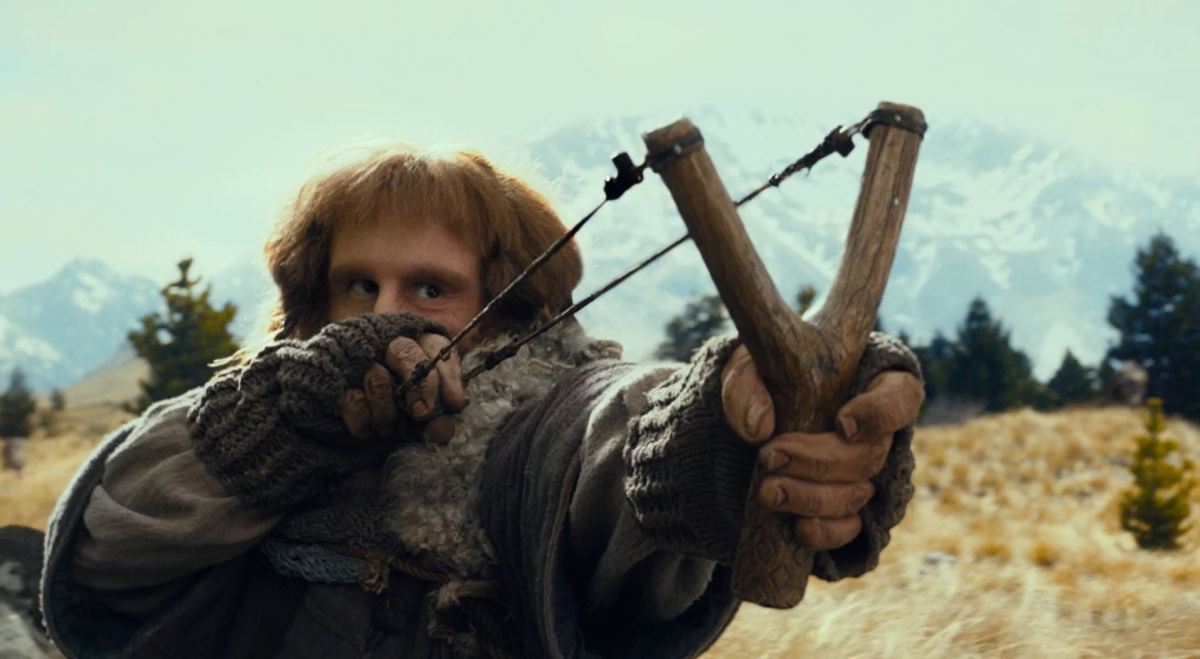
Ori shooting his slingshot at orcs. All rights reserved to New Line Productions, Inc. and/or other respective owners.
Our interest this time is one of the dwarves, Ori. He is portrayed as a young scribe using a slingshot for a weapon. It is only a minor detail in the scope of the movie, but it suffers from the same problems as other slingshots in fantasy. There should be no rubber available to make the bands, and it doesn’t fit the setting. I understand that the creators wanted to make each dwarf unique a tried to give Ori the unarmed youngster image, but this wasn’t a good choice. Slingshots don’t really belong in Tolkien’s Arda. It is however interesting that during the dwarves’ flight through the goblin warrens Ori uses a sizeable warhammer. So he’s not limited to the slingshot.
Walking Dead series (2010-2022)
Not so long ago (well, a few seasons I guess) several new characters appeared in the Walking Dead and two of them, the sisters Connie and Kelly, were using slingshots.
Connie with a slingshot, Kelly in background. All rights reserved to AMC and/or other respective owners.
Somehow this felt out of place even though Jörg Sprave based a great portion of his Youtube channel on zombie-killing slingshots. Maybe this has something to do with the slowly deteriorating quality of the show in general, with new characters being a lot less likeable than the original survivors or even the ones we got a bunch of seasons in. Anyway it’s an example that ticks the “youngster” archetype (at least with Kelly) and actually doesn’t need any handwaving, because there would be a lot of usable slingshots available after the walker apocalypse.
Dungeons & Dragons: Honor Among Thieves (2023)
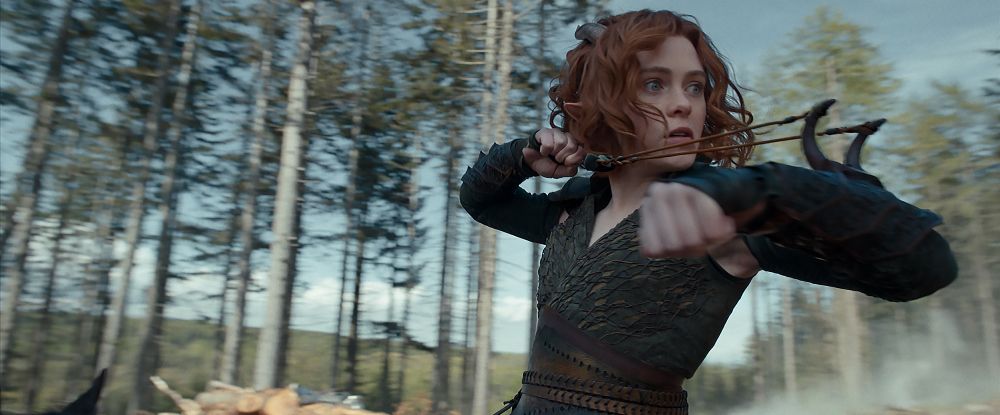
I have left this one for the end of the article. It could be seen in the trailer, but I wanted to watch the full movie before finishing this article. The young tiefling druid Doric uses a slingshot mounted sideways on her forearm. She uses it for flinging stones at her enemies, but more like a distraction or stun than for doing serious damage. For that she’s got her Wild Shape. Near the end of the movie Doric also shoots a small sachet from the slingshot, so here it’s used as a delivery system.
Doric using her forearm-mounted slingshot. All rights reserved to Paramount Pictures and/or other respective owners.
Once again no explanation for the slingshot’s existence is given, so it’s probably a case of fantasy handwaving. Since Forgotten Realms is a more colorful setting than Arda, it didn’t look out of place. And if you don’t need it explained, this is the way you can do it in your fantasy setting. Just stay away from catgut.
Final remarks
In this first article of two I have provided a very basic description of a slingshot, hopefully distinguished it from a sling, and listed a few examples of fantasy fiction featuring slingshots. As I said in the introduction, part II will be about using slingshots in your game.
The examples from fiction are quite arbitrarily picked and I’m sure you could find a lot more even without consulting TVTropes. I might seem a bit harsh on the kender weapons, but those things are really bad. Any handwaving is better than totally missing the mark, as with using catgut for slingshot bands. In The Hobbit the slingshot Ori uses is unnecessary and feels out of place for no good reason. On the other hand, the Dungeons and Dragons movie handles its slingshot quite well. The creators probably relied on the fact that it’s a high-magic fantasy setting and it works.
What about you? How do you feel about slingshots being used as weapons or tools in fantasy? Do you care whether it makes sense or don’t need any explanations as long as it’s cool and/or the slingshot has good stats? Leave a comment and follow the blog or our social media so you don’t miss the second part!
Liked True Detective: Night Country? What about the Thing? Let’s take a look at some other works in similar vein and I will briefly describe the setting or subgenre I call “Frozen Horror”.
Estimated reading time: 13 minutes
It’s been over a week since the Season 4 finale of True Detective by HBO, and it’s been a thoroughly enjoyable ride this past few weeks. Maintaining the high quality writing and production values of the series, the last season takes us to the fictional Alaskan town of Ennis. This is where you might consider stopping reading if you haven’t seen the show, yet. I’m not going to go into any details of the plot, but some technical spoilers might appear. And further down there might be spoilers for other works, so walk softly.
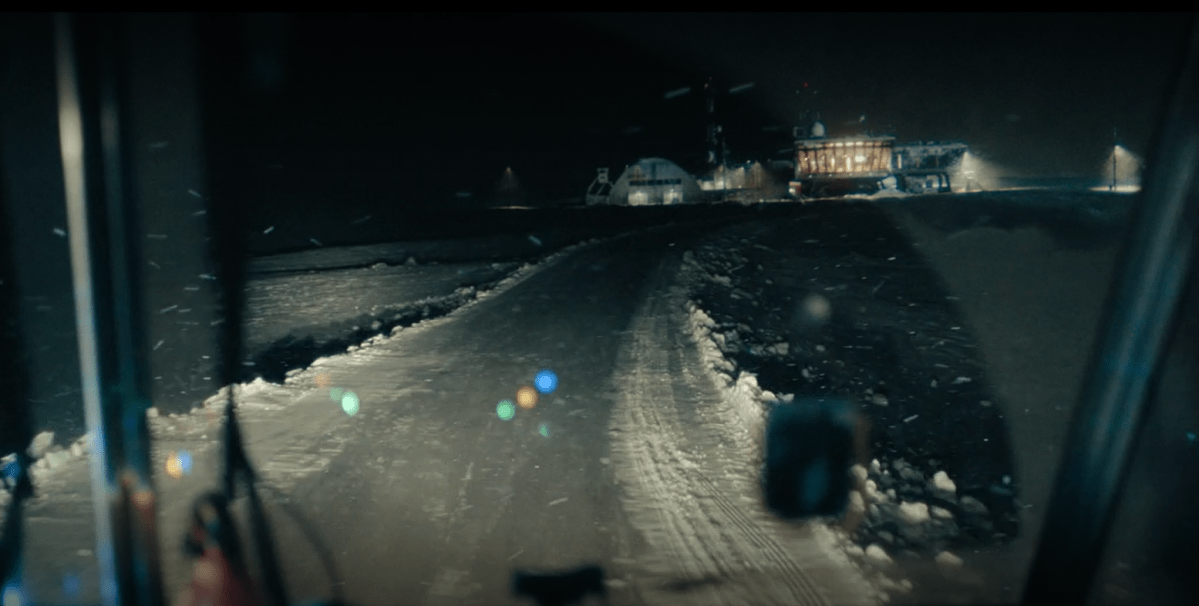
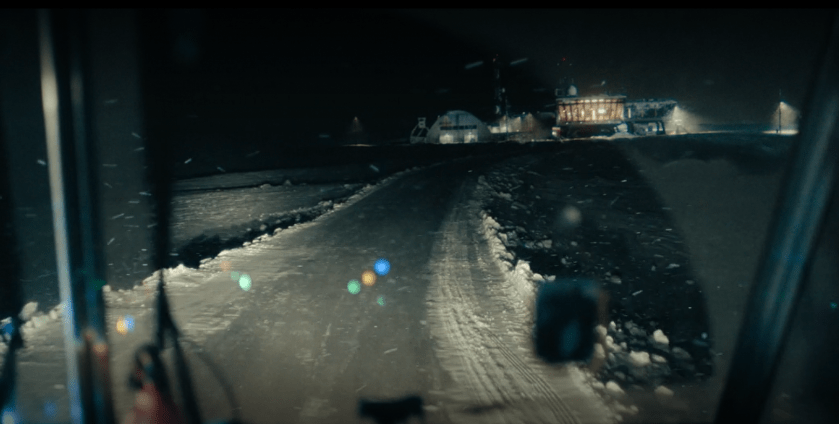
A few minutes into True Detective: Night County. All rights reserved to HBO and/or other respective owners.
With the exception of Season 2 True Detective always contained elements of supernatural mystery. Season 4 ramps this up quite significantly and due it feels like a mystery/horror series rather than a crime series most of the time. The structure also seems very usable as an inspiration for a tabletop adventure. I can already see an outline with several dungeons and encounters.
Due to its setting there is a resemblance to other works, and I mean it in the most positive sense. The season fits into a category I call “Frozen Horror” and this article will cover that. I will share my thoughts about the characteristics, things that make it unique and that can be used in your game. Afterwards I will provide a short overview of some works that I consider Frozen Horror.
Frozen Horror themes
There are certain themes that are essential for the Frozen Horror feel and I will outline their potential for your games here.
Adverse weather
First of all it’s the adverse weather. We’re dealing with polar areas where outside temperatures fall deep below zero. While this is obviously not an insurmountable obstacle (even more so in a fantasy setting), it sets some rules and boundaries. To stay outside most of the time you need good winter clothes. What if you have no access to them for a reason? Or if they get torn to shreds by a monster attack? Many surfaces get slippery due to ice, and handling equipment without necessary precautions can also be tricky – swords can freeze in their scabbards for example, and some liquids can freeze in their containers.
Low visibility
Snow storms can be fatal even when properly clothed, and this can be used to control when and where can the party go, if you have need for such things. With snow storms there is also the danger of low visibility. All sorts of monsters can move at pike’s length unseen and unheard by the characters due to a raging snow storm. Distress signals, burning settlements, and magical effects can also be hidden by a storm.
Long periods of darkness
If your world is a planet with Earth-like properties or similar season arrangement there are regions where night lasts for weeks at specific times of the year. The resulting darkness of a polar night can be oppressive, depressing, and bring all sorts of trouble – light-sensitive monsters are free to roam, light-based magic might not work as well while dark arts might grow in potency, solar technology is effectively disabled. An interesting twist is the opposite state or polar day, but that has a whole different set of implications. Either way it sets a timeframe for the plot. Things might get better after the long night passes, or perhaps something has to be done before it passes, or even worse things will arrive.
Remoteness and isolation
Another heavily prominent feature of Frozen Horror is the remoteness and isolation experienced throughout the story. These works take place at the edges of settled regions, at remote outposts separated by barren wasteland, or during expeditions into unknown lands. Help and support is often unreachable due to distance, weather conditions, lack of suitable transportation, or a combination of all mentioned. This is even more effective if there’s a specific need that can only be fulfilled elsewhere – the cure for a condition, research capacities, “silver bullets” for a specific monster. As with darkness this might set a timeframe, though differently. A supply ship might arrive only in certain intervals, or mountain passes might be snowed in for a good part of the year.
Frozen secrets!
And last but not least, there’s no Frozen Horror like one with frozen secrets! Whether it is some kind of disease or monster trapped in the ice, or forgotten structures and technology, it’s a classic. The ice might be thawing naturally, or there might be deliberate attempts to release or discover whatever it is that is frozen. Of course not everything that’s frozen is a menace, sometimes it’s the exact opposite. There might be technology, knowledge, or some power that the party needs. But there might be other things frozen with the desired goal, not as much desired.
A good Frozen Horror doesn’t have to include all of these themes, but often it does. Some of them are specific for a certain environment, some can occur elsewhere. You can be very remote and isolated in a desert, and a desert storm will provide low visibility, but there will be no natural long-term darkness (assuming an Earth-like world) and certainly no frozen secrets.
Next there are some examples that I have tried to keep short and without spoilers. There are certainly other works that could be given the Frozen Horror label, and I will be glad to read about them in your comments.
The H.P. Lovecraft novella deserves to be mentioned first, as it’s the one that many others have taken inspiration from. It’s also one of the best works by HPL, and it should be on your reading list if you want to base your setting or adventure on Frozen Horror.
At the Mountains of Madness tells the story of an Antarctic expedition. An accidental discovery leads to mysterious disappearances and deaths, and ultimately the protagonists find themselves in a lost city. Eons forgotten, the city reveals unsettling secrets, some of which are still alive and dangerous. Narrowly escaping with their lives (but not sanity) the heroes witness things too terrible to describe.
I’m being vague on purpose, because I really wouldn’t want to spoil this to anyone. Go read the novella as soon as you can, it’s public domain already! Lovecraft wrote it later in his career, so he already had an established mythos to reference and draw upon.
One can find themes of isolation and remoteness, and secrets frozen in the ice in At the Mountains of Madness. Even if Lovecraft wasn’t their creator he used those themes expertly. And as I mentioned before, he influenced further works immensely.
Who Goes There? (1938) and Frozen Hell (2019)
Who Goes There? was written by John W. Campbell and published in 1938. In 2018 an original longer manuscript was found and released in 2019 as Frozen Hell. I haven’t read either, but the new release is on my list. Since I can’t offer my own views, I’ll keep it short and only remind that this is the work The Thing was based on. When I get my hands on a copy of Frozen Hell, I’ll either update this post or maybe write a new one. Leave a comment if you have read it!
The Thing (1982)
For me this is it, the perfect example of Frozen Horror, and a top notch horror movie overall. I have seen different opinions, stating that The Thing is overrated. What do those people expect from a great horror movie that they didn’t find in the Carpenter masterpiece is a mystery to me. But hey, I don’t like some generally-accepted masterpieces either, so I accept it with only a little grudge.
MacReady’s cabin in the night. All rights reserved to Universal Pictures and/or other respective owners.
The 1982 adaptation of Who Goes There? by J.W. Campbell is set in Antarctic on a remote scientific base, where suddenly things go very wrong (these vague descriptions are a pain, but I wouldn’t like to spoil too much). There’s a lot of psychological horror, body horror made with perfect practical effects (certainly for the time), and an ambiguous ending. The setting ticks off all the hallmarks of a Frozen Horror, with remoteness and isolation, bad weather conditions, and frozen secrets being the most prominent.
It is perfectly adaptable to tabletop gaming, as many have done already. There is also a sequel video game and a prequel movie. If you liked The Thing, check them out as well, or at least read the following paragraphs.
There has also been an earlier adaptation of Campbell’s novella in 1951 under the title The Thing from Another World. I have not yet seen the movie and as with the book I don’t want to rant about it basing my knowledge on what I read on the internet. Therefore until I have the opportunity I will only mention it. As always comments if you’ve seen it are welcome!
The Thing (2002 game)
Intended as a direct sequel to the Carpenter movie, the game picks up right after the ending. It chooses one possible explanation for the ending as canon and elaborates from there.
Wallpaper from the game. All rights reserved to Konami and/or other respective owners.
In this 3rd person team-based action game you are Captain Blake, an US Special Forces operative sent with his team to investigate. Being an action game it offers a lot of shooting and jump scares. I remember when it was new I couldn’t play it myself because of the tense atmosphere and scariness, and instead watched as my dad played the game.
Even though it lacks the slow burn psychological stuff of the movie, the game gets many things right in my opinion. The events of the game don’t collide with what the movie started, or at least as far as I remember. I’ll have to play it myself for a deeper analysis, so expect an article on the game itself in the future. Meanwhile you can check this post by Syfy for some background information and plot synopsis, if you like.
30 Days of Night (2007)
Let’s take a break from The Thing and the Antarctic for a while and visit Alaska again. Based on a comic book 30 Days of Night takes place in Barrow, Alaska (now Utqiaġvik) during the polar night. The local events take a wrong turn after the arrival of a sinister cargo on a ship. The long polar night is central to the plot and you can make a guess what thrives in the long dark.
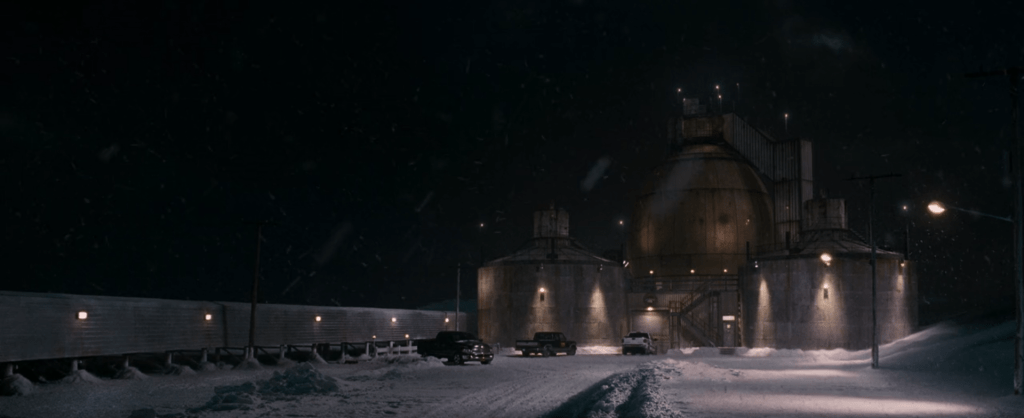
Barrow’s oil plant after night has fallen. All rights reserved to Columbia Pictures and/or other respective owners.
Once again the themes of remoteness, isolation, long period of darkness, and severe weather take the lead. After the movie a miniseries prequel (2007), sequel (2008), and also a direct-to-DVD movie sequel (2010) were made, but I haven’t seen those. The ratings make me a bit uneasy about spending my time on them, but do leave a comment if you have seen them!
The Thing (2011)
A prequel rather than remake to the 1982 Carpenter movie of the same name. I find it commendable that in an age of cheap remakes the creators instead elected to make a tie-in with the original movie. It is up to everyone’s judgement whether they succeeded.
The story is set right before the events of Carpenter’s Thing at another research station, this time Norwegian. You can watch the 1982 movie right after this one and the story will continue almost seamlessly.
All quiet at the Norwegian base. All rights reserved to Universal Pictures and/or other respective owners.
In my opinion it is not bad. There’s not exactly the level of mystery and suspense as in the 1982 movie, and it’s more predictable as far as I remember. There are similar themes, similar progression, you are aware that this has to do with the other movie all the time. Don’t expect any great novelty or originality, but it does what it aims to and it really feels more like a loving homage than a cash-grab remake.
Fortitude (2015-2018)
I have saved this one for the last, because it is one of my favourite shows, and also one that the latest True Detective series reminds me the most. Fortitude is set in a fictional town of the same name in Svalbard. The inhabitants are employed mostly as scientists, miners, or fishermen, plus the necessary services.
The first season is mostly a crime investigation show with little hints of mystery. With the second season Fortitude goes full mystery/horror with supernatural elements, and this is the season I find both most fun to watch and most usable TTRPG-wise. The latest True Detective series reminds me of this second season in a good sense, as I mentioned before. There is also a third season, but it’s inferior to the first two. It feels like an attempt to tie things up after being scrapped by the producers. What I find the worst about it is what happens to the characters. Formerly complex characters are flat in the last series and behave stupidly. And also it seems the creators tried to make everyone look bad. I’d say you can safely leave the third season out.
What lies below the ice? All rights reserved to Sky Atlantic and/or other respective owners.
Fortitude has a great atmosphere overall and uses the themes I wanted to talk about really well. There is severe weather, darkness, isolation, various political and social tensions as well, and of course frozen secrets. The supernatural is well interwoven into the “normal” problems of an arctic settlement. The cast is very good and the characters and their motivations are well-written (until Season 3). As with True Detective: Night Country, there is a lot of potential for someone who would like to turn it into a tabletop adventure (or campaign).
Final remarks
What I call Frozen Horror (and you might call it differently) offers a unique experience, lately revived by the fourth season of True Detective. I have put some of my thoughts on the topic into this article, as well as some examples I would recommend. Of course there is more to each of them than the things I described – The Thing is a different story than 30 Days of Night. In this article I tried to point out some of the similarities that lie mainly in the environment and setting. I am eager to read your thoughts on this matter and perhaps your suggestions for other movies, TV shows, video games, etc. The more inspiration, the better.
I will also prepare separate articles about some of the media mentioned here. Requests and suggestions will be happily considered. If you found this post interesting, it would be great if you could share it with your friends. Comments are welcome, and don’t forget to follow the blog or our social media accounts for more content!
February is dedicated to another prison block, not as abandoned as the first one!
Estimated reading time: 3 minutes
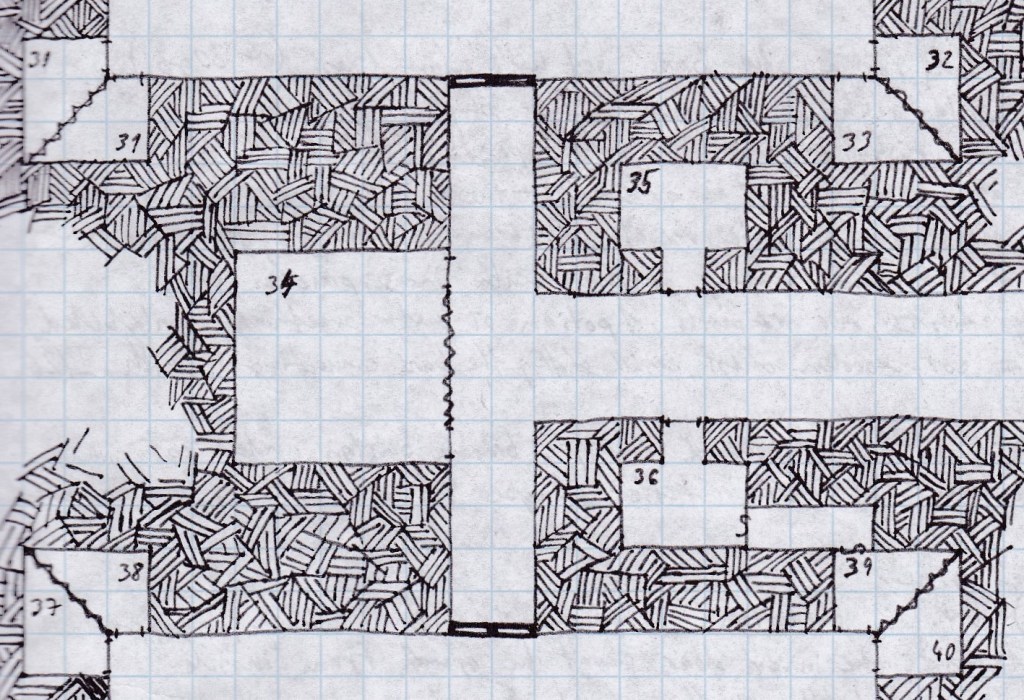
Last time I provided a summary of an abandoned prison block that has been inhabited by squatters at some point in the past. There was also a hidden section of the prison where torture and alchemical work took place. In this post I will finish the last two cells remaining in the first block and we will move on. As we’re still on one floor, the rooms are numbered continuosly, but since January has 31 days, rooms 32 and on are obviously from February.
The last two corner cells of block 1 once again offer a glimpse of sinister happenings. If the party gets here after seeing the rest of the block, the atmosphere might be already quite tense. As one of the first rooms to be explored it might put the party on alert, although there is little to fear in the block, excluding the wraith.
Explore another block of the prison or follow the corridor leading eastwards?
Beyond the door to the south lies a corridor leading to another prison block. At the junction with the larger corridor there is a former guardpost occupied by Balok. Balok is a vermin dwarf who calls the old prison his home. If he’s not making his rounds he’s probably asleep in his room. While not entirely unfriendly, he will not help the party in any way unless it’s in his own interest, and would prefer if they left the premises soon. Particularly hostile parties might receive directions into various hazards, whether it’s monsters or traps.
The two opposite rooms to the east, an office and a storeroom, are not interesting at all, except for the hidden passage from the storeroom to one of the cells in southern block. The cell itself and its twin are quite unremarkable. The other corner twins contain some transportation devices and a lot of oyster shells.
Who is hoarding the shells and for what purpose? And what’s a “vermin dwarf”? For the first one keep following my #Dungeon24 updates, and don’t forget to like, share, and comment! As for the second question, there will be a post dedicated to this new dwarven subrace/heritage in the near future, so stay tuned!
Rooms
Corner cell, door missing, no cot or other furniture; walls and floor covered in colorful drawings. Closer examination reveals unsettling details – monsters, murder, etc. in childish styl
Corner cell with bound door; inside is a human-shaped sailcloth bundle bound by rope. There is no body, only rags and seaweed shaped into humanoid form. T: 7 cp, perforated, can be found among the rags
Balok’s quarters
The former guardpost was claimed by Balok, a vermin dwarf
N door is jammed, almost all of the E wall is cowered with furniture – mostly backed shelves, some cabinets
S door is locked whether Balok is in or not; he wears the key on a chain around his neck; when he’s in the door is blocked with a bar as well
there is a crossbow trained on the door that shoots if not disarmed when opening (DC 30 spot check)
Former office, now this room is empty except for small pieces of broken furniture and damp rags
Storeroom, mostly empty shelves, some missing (ask Balok); secret door behind one shelf (DC 30)
Corner cell wth no furniture, only burlap sacks filled with oyster shells, 14 in total
Corner cell with one rickety trolley and three wooden pack-frames
Corner cell, 3 barred pannels leaning on the wall opposite the door; behind them secret door (DC 20)








 Rashundai Games