Slingshots part I

Do slingshots have place in fantasy settings? In this article I’ll look at all the angles.

A slingshot is a weapon many may have had their hands on, especially as children, when they made one out of a natural fork and some leftover rubber. With many commercial and artisan makers, and whole clubs and competitions dedicated to target slingshot shooting it’s quite easy to get into the hobby even as an adult. 

While their history is rather short compared to other weapons, slingshots are sometimes used in various works of fantasy fiction. Mostly they are depicted as a “youngster” weapon, or a makeshift weapon. Are they worth using in your game? Short answer of course would be: if you want to, use them. But read on if you want to see my thoughts about slingshots in fantasy settings. In this first part I will provide some basic information and examples from fiction. In the next one you will get the when, how, and why I would use them in a fantasy setting.

Sling vs. slingshot

First thing we have to get off the table is this – slings and slingshots are completely different devices, using different laws of physics to propel the projectile, and should not be confused. Often they are, though in a world of ringmail, studded leather armor, and dire flails that can hardly surprise anyone. 

A sling is essentially a piece of string with a pouch for a bullet in the middle that you shoot by swinging the whole thing above your head or to your side – no spinning – and releasing one end of the string. A slingshot on the other hand is a rigid frame of wood, metal or other material, usually Y-shaped. The pouch is connected to the ends of the fork by bands of rubber, and you shoot the thing by drawing the pouch with bullet like and letting go. With a sling you need some some space, slingshots should work fine even in tighter places. This of course has implications concerning their usefullness in various situations. You might not be able to use a sling in a long narrow corridor (have to test this), and trying to use a slingshot to shoot someone a hundred metres away is probably inefficient.

Materials

The slingshot consists of three main parts – the body, bands and pouch. While competitive shooters would probably disagree, the pouch doesn’t matter from our point of view. Leather is ok and easily obtainable in probably every setting. What matters are body and bands. The body can be of any material strong enough to withstand the stresses put on it by flexing the bands. This can be the most traditional wood, but also metal, bone, or various plastics (with or without a metal core). So the body is also quite clear and easy to find in any setting. What makes it difficult are the bands. 

Slingshot bands are made of rubber. That’s it. That’s why slingshots didn’t exist in our world until rubber was invented and widespread enough. It’s also why slingshots in a world without rubber or a passable substitute look out of place. Catgut is not a good substitute, as it’s not flexible enough. Try using violin strings for your first slingshot. Though it probably could be used in a sling.

But we are in fantasy and there might either be another material with qualities similar to rubber, or rubber itself might be available via the wonders of alchemy (more on this in an upcoming post). For example the body parts of some monster might be flexible enough to substitute rubber. Maybe even whole bodies of some worm species could serve as bands. It’s fantasy, so it shouldn’t be hard to come up with something, but I believe you should have that something thought through, so when someone comes asking, you have an explanation ready. 

Slingshot wielders

Let’s take a look at some characters using a slingshot as their preferred weapon. I’m not trying to count every one of them, since folks over at TV Tropes have already done this quite extensively. I’m picking a few that come up to my mind when I think of slingshot-wielding characters, and only in fantasy (-ish) settings. So no Bart Simpson, sorry. 

Evil Twin: Cyprien’s Chronicles (2001)

There was a time when platformers enjoyed a much greater popularity even among PC gamers. One of those is Evil Twin by In Utero. The main character is the titular Cyprien, an orphan who has to visit a grotesquely fantastic world to save his friends. It has a very Alice in Wonderland feel, and from what I remember it had cool level design, if somewhat less original story. I’ve been trying to get my old copy to work, but to no avail. Once I’m able to replay the game, I might write a post about it.
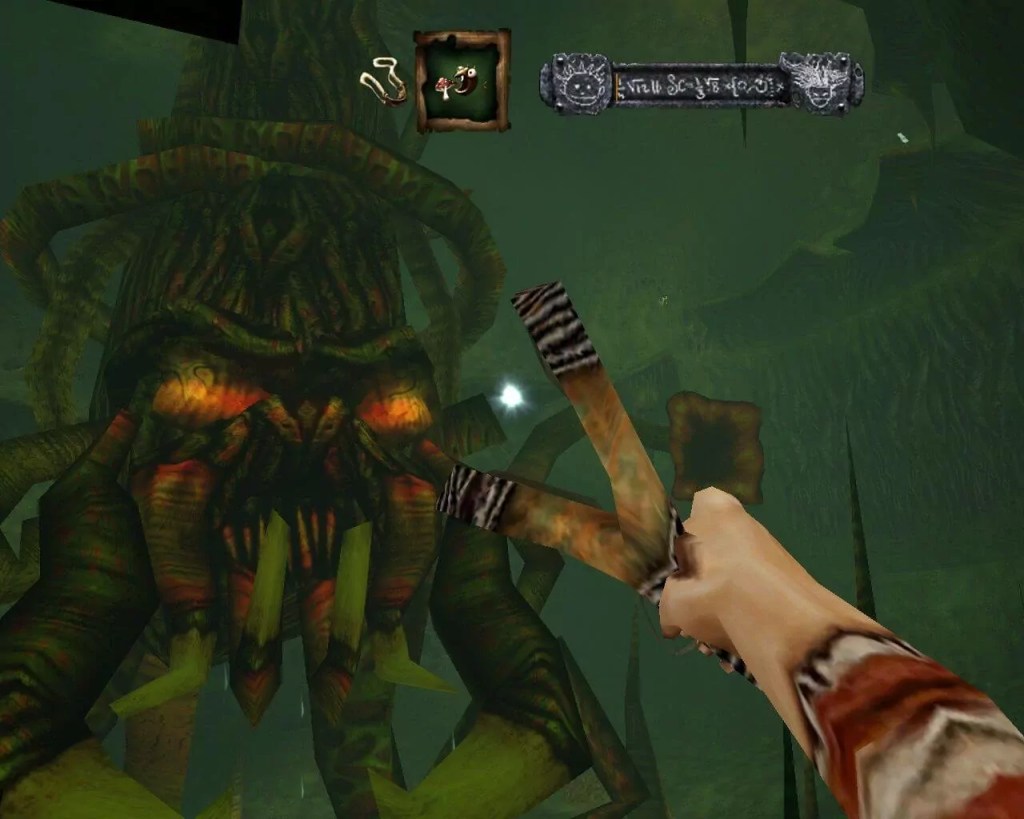
Cyprien shooting some plant monster. Borrowed from myabandonware.com, all rights reserved Ubisoft, In Utero and/or other respective owners.

However the reason I’m mentioning the game is that Cyprien uses slingshot as his primary weapon. This goes well with the “youngster” image of slingshots in media. Throughout the game special ammunition can be found, including bubblegum and paper planes. That doesn’t make much sense, but since the game setting is some kind of nightmare dreamworld, I guess it doesn’t matter.

Kender

I have never read a Dragonlance novel, nor have I read either the old or the recently issued setting supplements. I know next to nothing about the setting other than that it has dragons and kender. Based on what I learned on various sites I probably couldn’t appreciate the kender in a game (or novel). Maybe if I read the novels they could grow on me, who knows? 

Anyway they use a number of signature weapons and two of these employ slingshots in their design. They are the hoopak, essentially a staff with a slingshot on one end and a spear tip on the other, and the chapak, which is a hand axe with the back of the axe head extending into a slingshot. Both supposedly also serve as musical instruments – the hoopak as a bull-roarer, and the chapak handle is hollowed with finger holes, so you can remove the axe head and plugs in the finger holes and use it as a flute. And those two belong to the more sensible weapons in the kender arsenal. 
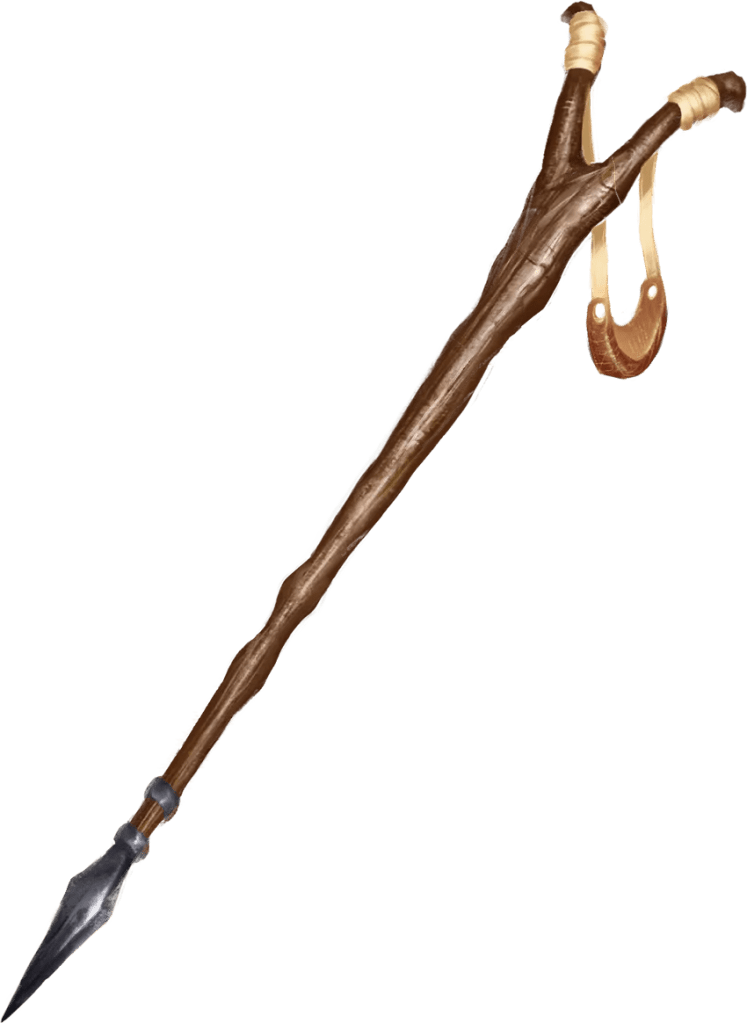
a staff with a slingshot on one end and a spear tip on the other
A rendition of the hoopak from the Shadow of the Dragon Queen supplement. All rights reserved to Crystal Sully, Wizards of the Coast, and/or other respective owners.

The hoopak is referred to as a staff sling, which it obviously isn’t. It’s a slingshot on a staff and that’s not a terrible idea. Joerg Sprave even reviewed his rendition of a weapon like this from the One Piece manga (see below). The descriptions of hoopak I found vary but it seems it is supposed to be working both as a slingshot when planted in the ground by the spike, or as a staff sling. I think this goes with the general theme of kender weapons – trying to slap as many diverse uses on them until they become unusable or silly. If we keep it as a staff/spear with a sling on one end, it’s ok. If we change the sling into a slingshot and find rubber somewhere, it could work as well. Just stay away from catgut, please.

The other one, chapak, is supposed to be a handaxe with a slingshot on prongs extending from the back of the axe. The slingshot uses catgut, of course. I imagine this setup would provide a very uncomfortable and weak grip when shooting the slingshot, and the bands and pouch would get in the way of hacking with the hatchet. That the haft is hollow with drilled fingerholes (plugged when not in use), so it can be used as a flute, blowgun, and snorkel is just a cherry on top of this unpalatable pie. Again there seems to be a desire to cram every possible utility into one weapon. And it would not work well.

One Piece

During Joerg Sprave’s slingshot era he made a reconstruction of a staff slingshot used by the character Usopp. Apparently it’s one of the character’s three different slingshots. I’m not familiar with either the manga or anime One Piece past “it’s got some wacky pirates”, but it seems using a slingshot isn’t the strangest thing and it probably doesn’t look out of place. Feel free to share your thoughts in the comments, if you’re a fan.

Usopp with one of his slingshots. All rights reserved to Toei Animation and/or other respective owners.

Legend of Zelda

Link from Ocarina of Time wielding a slingshot. All rights reserved to Nintendo and/or other respective owners.

Link uses a slingshot in several of the titles. My firsthand experience with the series is quite limited, having played only Ocarina of Time for a short while. From what I’ve gathered online, the slingshot is not a particularly powerful weapon in the games, and often it is used to solve puzzles rather than fight enemies. Sometimes it may stun them, which is always nice. In some of the games Link only uses the slingshot while he’s a kid, so again it goes with the “youngster” themes. Not much is told about the materials used for the slingshot construction, but we know that Deku seeds are used as ammunition. As a side note, for shooting stuff like seeds, nuts, etc. a slingshot seems to be a better choice than a sling. Slingshots don’t rely that much on the weight of the projectile.

The Hobbit series (2012-2014)

The Peter Jackson adaptation of The Hobbit is very good overall (though nowhere near the Lord of the Rings trilogy) and mostly makes sense. There are comedic elements interwoven into the narrative and each successive movie strays further from the books.

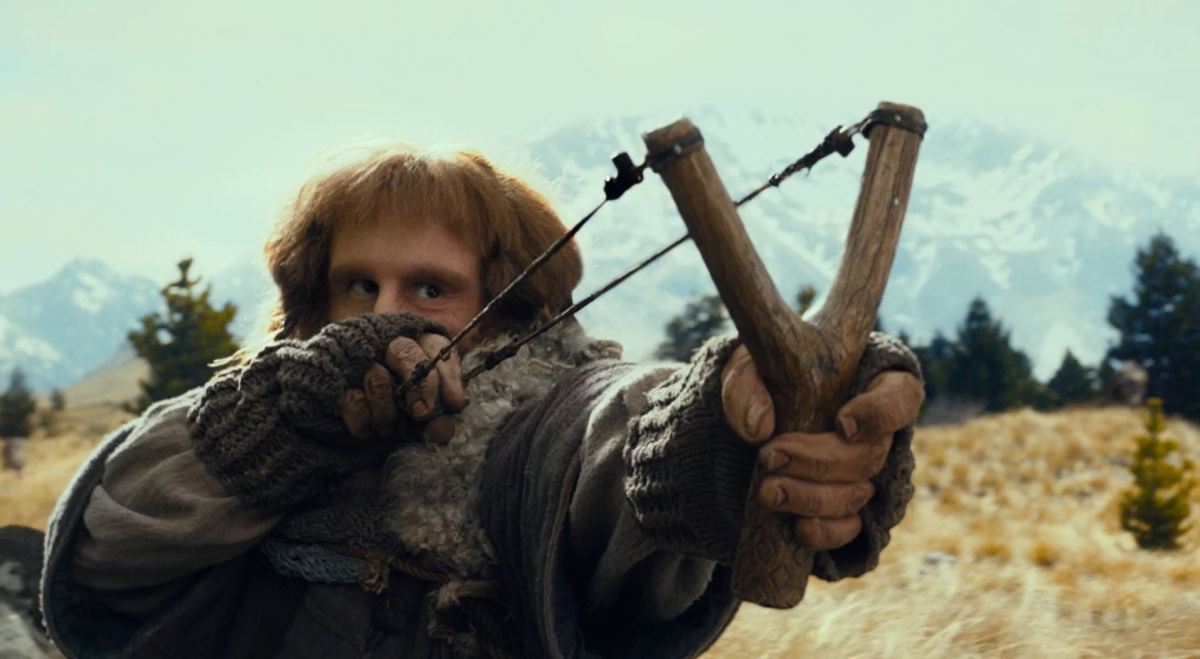
the dwarf Ori shooting a slingshot
Ori shooting his slingshot at orcs. All rights reserved to New Line Productions, Inc. and/or other respective owners.

Our interest this time is one of the dwarves, Ori. He is portrayed as a young scribe using a slingshot for a weapon. It is only a minor detail in the scope of the movie, but it suffers from the same problems as other slingshots in fantasy. There should be no rubber available to make the bands, and it doesn’t fit the setting. I understand that the creators wanted to make each dwarf unique a tried to give Ori the unarmed youngster image, but this wasn’t a good choice. Slingshots don’t really belong in Tolkien’s Arda. It is however interesting that during the dwarves’ flight through the goblin warrens Ori uses a sizeable warhammer. So he’s not limited to the slingshot.

Walking Dead series (2010-2022)

Not so long ago (well, a few seasons I guess) several new characters appeared in the Walking Dead and two of them, the sisters Connie and Kelly, were using slingshots.

Connie with a slingshot, Kelly in background. All rights reserved to AMC and/or other respective owners.

Somehow this felt out of place even though Jörg Sprave based a great portion of his Youtube channel on zombie-killing slingshots. Maybe this has something to do with the slowly deteriorating quality of the show in general, with new characters being a lot less likeable than the original survivors or even the ones we got a bunch of seasons in. Anyway it’s an example that ticks the “youngster” archetype (at least with Kelly) and actually doesn’t need any handwaving, because there would be a lot of usable slingshots available after the walker apocalypse. 

Dungeons & Dragons: Honor Among Thieves (2023)

I have left this one for the end of the article. It could be seen in the trailer, but I wanted to watch the full movie before finishing this article. The young tiefling druid Doric uses a slingshot mounted sideways on her forearm. She uses it for flinging stones at her enemies, but more like a distraction or stun than for doing serious damage. For that she’s got her Wild Shape. Near the end of the movie Doric also shoots a small sachet from the slingshot, so here it’s used as a delivery system.
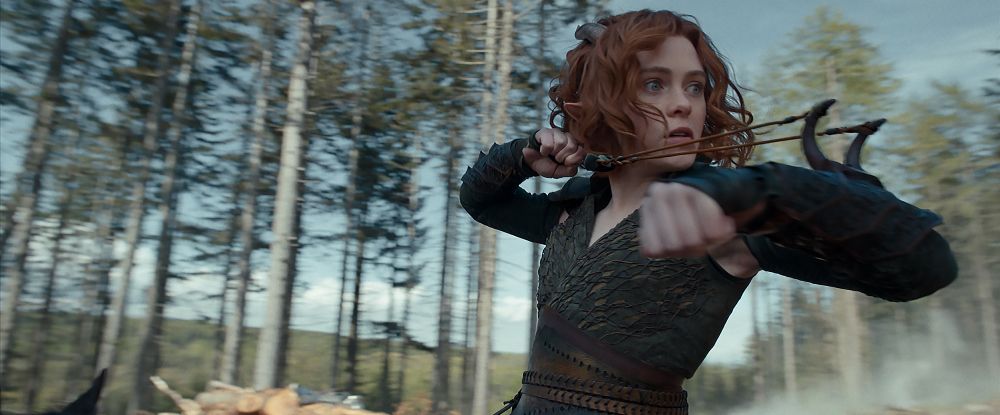
Doric using her forearm-mounted slingshot. All rights reserved to Paramount Pictures and/or other respective owners.

Once again no explanation for the slingshot’s existence is given, so it’s probably a case of fantasy handwaving. Since Forgotten Realms is a more colorful setting than Arda, it didn’t look out of place. And if you don’t need it explained, this is the way you can do it in your fantasy setting. Just stay away from catgut.

Final remarks

In this first article of two I have provided a very basic description of a slingshot, hopefully distinguished it from a sling, and listed a few examples of fantasy fiction featuring slingshots. As I said in the introduction, part II will be about using slingshots in your game.

The examples from fiction are quite arbitrarily picked and I’m sure you could find a lot more even without consulting TVTropes. I might seem a bit harsh on the kender weapons, but those things are really bad. Any handwaving is better than totally missing the mark, as with using catgut for slingshot bands. In The Hobbit the slingshot Ori uses is unnecessary and feels out of place for no good reason. On the other hand, the Dungeons and Dragons movie handles its slingshot quite well. The creators probably relied on the fact that it’s a high-magic fantasy setting and it works.

What about you? How do you feel about slingshots being used as weapons or tools in fantasy? Do you care whether it makes sense or don’t need any explanations as long as it’s cool and/or the slingshot has good stats? Leave a comment and follow the blog or our social media so you don’t miss the second part!
Frozen Horrors

Liked True Detective: Night Country? What about the Thing? Let’s take a look at some other works in similar vein and I will briefly describe the setting or subgenre I call “Frozen Horror”.

Estimated reading time: 13 minutes

It’s been over a week since the Season 4 finale of True Detective by HBO, and it’s been a thoroughly enjoyable ride this past few weeks. Maintaining the high quality writing and production values of the series, the last season takes us to the fictional Alaskan town of Ennis. This is where you might consider stopping reading if you haven’t seen the show, yet. I’m not going to go into any details of the plot, but some technical spoilers might appear. And further down there might be spoilers for other works, so walk softly.

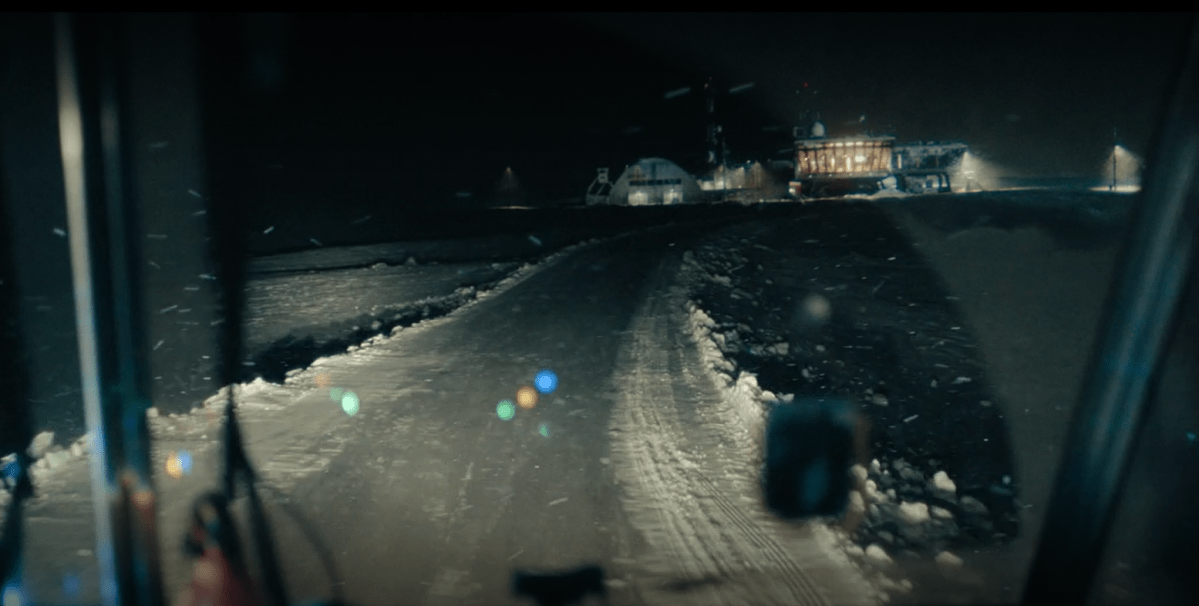
A few minutes into True Detective: Night County.
All rights reserved to HBO and/or other respective owners.

With the exception of Season 2 True Detective always contained elements of supernatural mystery. Season 4 ramps this up quite significantly and due it feels like a mystery/horror series rather than a crime series most of the time. The structure also seems very usable as an inspiration for a tabletop adventure. I can already see an outline with several dungeons and encounters.

Due to its setting there is a resemblance to other works, and I mean it in the most positive sense. The season fits into a category I call “Frozen Horror” and this article will cover that. I will share my thoughts about the characteristics, things that make it unique and that can be used in your game. Afterwards I will provide a short overview of some works that I consider Frozen Horror.

Frozen Horror themes

There are certain themes that are essential for the Frozen Horror feel and I will outline their potential for your games here.

Adverse weather

First of all it’s the adverse weather. We’re dealing with polar areas where outside temperatures fall deep below zero. While this is obviously not an insurmountable obstacle (even more so in a fantasy setting), it sets some rules and boundaries. To stay outside most of the time you need good winter clothes. What if you have no access to them for a reason? Or if they get torn to shreds by a monster attack? Many surfaces get slippery due to ice, and handling equipment without necessary precautions can also be tricky – swords can freeze in their scabbards for example, and some liquids can freeze in their containers.

Low visibility

Snow storms can be fatal even when properly clothed, and this can be used to control when and where can the party go, if you have need for such things. With snow storms there is also the danger of low visibility. All sorts of monsters can move at pike’s length unseen and unheard by the characters due to a raging snow storm. Distress signals, burning settlements, and magical effects can also be hidden by a storm.

Long periods of darkness

If your world is a planet with Earth-like properties or similar season arrangement there are regions where night lasts for weeks at specific times of the year. The resulting darkness of a polar night can be oppressive, depressing, and bring all sorts of trouble – light-sensitive monsters are free to roam, light-based magic might not work as well while dark arts might grow in potency, solar technology is effectively disabled. An interesting twist is the opposite state or polar day, but that has a whole different set of implications. Either way it sets a timeframe for the plot. Things might get better after the long night passes, or perhaps something has to be done before it passes, or even worse things will arrive.

Remoteness and isolation

Another heavily prominent feature of Frozen Horror is the remoteness and isolation experienced throughout the story. These works take place at the edges of settled regions, at remote outposts separated by barren wasteland, or during expeditions into unknown lands. Help and support is often unreachable due to distance, weather conditions, lack of suitable transportation, or a combination of all mentioned. This is even more effective if there’s a specific need that can only be fulfilled elsewhere – the cure for a condition, research capacities, “silver bullets” for a specific monster. As with darkness this might set a timeframe, though differently. A supply ship might arrive only in certain intervals, or mountain passes might be snowed in for a good part of the year.

Frozen secrets!

And last but not least, there’s no Frozen Horror like one with frozen secrets! Whether it is some kind of disease or monster trapped in the ice, or forgotten structures and technology, it’s a classic. The ice might be thawing naturally, or there might be deliberate attempts to release or discover whatever it is that is frozen. Of course not everything that’s frozen is a menace, sometimes it’s the exact opposite. There might be technology, knowledge, or some power that the party needs. But there might be other things frozen with the desired goal, not as much desired.

A good Frozen Horror doesn’t have to include all of these themes, but often it does. Some of them are specific for a certain environment, some can occur elsewhere. You can be very remote and isolated in a desert, and a desert storm will provide low visibility, but there will be no natural long-term darkness (assuming an Earth-like world) and certainly no frozen secrets.

Next there are some examples that I have tried to keep short and without spoilers. There are certainly other works that could be given the Frozen Horror label, and I will be glad to read about them in your comments.

  1. At the Mountains of Madness (1936)
  2. Who Goes There? (1938) and Frozen Hell (2019)
  3. The Thing (1982)
  4. The Thing (2002 game)
  5. 30 Days of Night (2007)
  6. The Thing (2011)
  7. Fortitude (2015-2018)

At the Mountains of Madness (1931)

The H.P. Lovecraft novella deserves to be mentioned first, as it’s the one that many others have taken inspiration from. It’s also one of the best works by HPL, and it should be on your reading list if you want to base your setting or adventure on Frozen Horror.

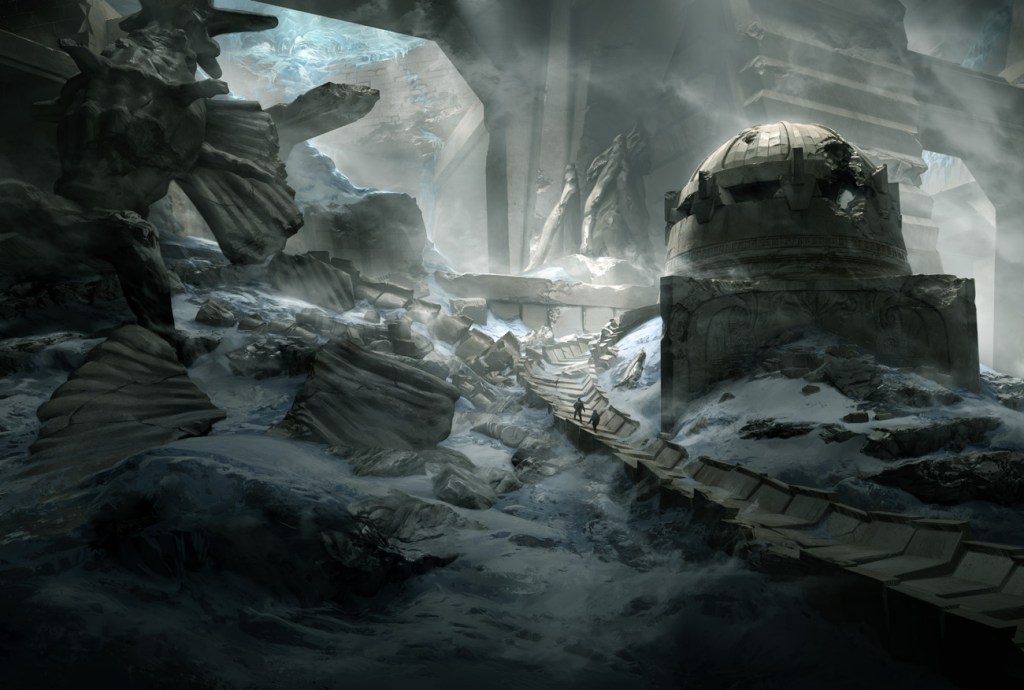
A modern illustration for the novel. All rights reserved to François Baranger.

At the Mountains of Madness tells the story of an Antarctic expedition. An accidental discovery leads to mysterious disappearances and deaths, and ultimately the protagonists find themselves in a lost city. Eons forgotten, the city reveals unsettling secrets, some of which are still alive and dangerous. Narrowly escaping with their lives (but not sanity) the heroes witness things too terrible to describe.

I’m being vague on purpose, because I really wouldn’t want to spoil this to anyone. Go read the novella as soon as you can, it’s public domain already! Lovecraft wrote it later in his career, so he already had an established mythos to reference and draw upon.

One can find themes of isolation and remoteness, and secrets frozen in the ice in At the Mountains of Madness. Even if Lovecraft wasn’t their creator he used those themes expertly. And as I mentioned before, he influenced further works immensely.

Who Goes There? (1938) and Frozen Hell (2019)

Who Goes There? was written by John W. Campbell and published in 1938. In 2018 an original longer manuscript was found and released in 2019 as Frozen Hell. I haven’t read either, but the new release is on my list. Since I can’t offer my own views, I’ll keep it short and only remind that this is the work The Thing was based on. When I get my hands on a copy of Frozen Hell, I’ll either update this post or maybe write a new one. Leave a comment if you have read it!

The Thing (1982)

For me this is it, the perfect example of Frozen Horror, and a top notch horror movie overall. I have seen different opinions, stating that The Thing is overrated. What do those people expect from a great horror movie that they didn’t find in the Carpenter masterpiece is a mystery to me. But hey, I don’t like some generally-accepted masterpieces either, so I accept it with only a little grudge.

The outpost at night with MacReady's cabin in the focus
MacReady’s cabin in the night. All rights reserved to Universal Pictures and/or other respective owners.

The 1982 adaptation of Who Goes There? by J.W. Campbell is set in Antarctic on a remote scientific base, where suddenly things go very wrong (these vague descriptions are a pain, but I wouldn’t like to spoil too much). There’s a lot of psychological horror, body horror made with perfect practical effects (certainly for the time), and an ambiguous ending. The setting ticks off all the hallmarks of a Frozen Horror, with remoteness and isolation, bad weather conditions, and frozen secrets being the most prominent.

It is perfectly adaptable to tabletop gaming, as many have done already. There is also a sequel video game and a prequel movie. If you liked The Thing, check them out as well, or at least read the following paragraphs.

There has also been an earlier adaptation of Campbell’s novella in 1951 under the title The Thing from Another World. I have not yet seen the movie and as with the book I don’t want to rant about it basing my knowledge on what I read on the internet. Therefore until I have the opportunity I will only mention it. As always comments if you’ve seen it are welcome!

The Thing (2002 game)

Intended as a direct sequel to the Carpenter movie, the game picks up right after the ending. It chooses one possible explanation for the ending as canon and elaborates from there.

Wallpaper from the game. All rights reserved to Konami and/or other respective owners.

In this 3rd person team-based action game you are Captain Blake, an US Special Forces operative sent with his team to investigate. Being an action game it offers a lot of shooting and jump scares. I remember when it was new I couldn’t play it myself because of the tense atmosphere and scariness, and instead watched as my dad played the game.

Even though it lacks the slow burn psychological stuff of the movie, the game gets many things right in my opinion. The events of the game don’t collide with what the movie started, or at least as far as I remember. I’ll have to play it myself for a deeper analysis, so expect an article on the game itself in the future. Meanwhile you can check this post by Syfy for some background information and plot synopsis, if you like.

30 Days of Night (2007)

Let’s take a break from The Thing and the Antarctic for a while and visit Alaska again. Based on a comic book 30 Days of Night takes place in Barrow, Alaska (now Utqiaġvik) during the polar night. The local events take a wrong turn after the arrival of a sinister cargo on a ship. The long polar night is central to the plot and you can make a guess what thrives in the long dark.

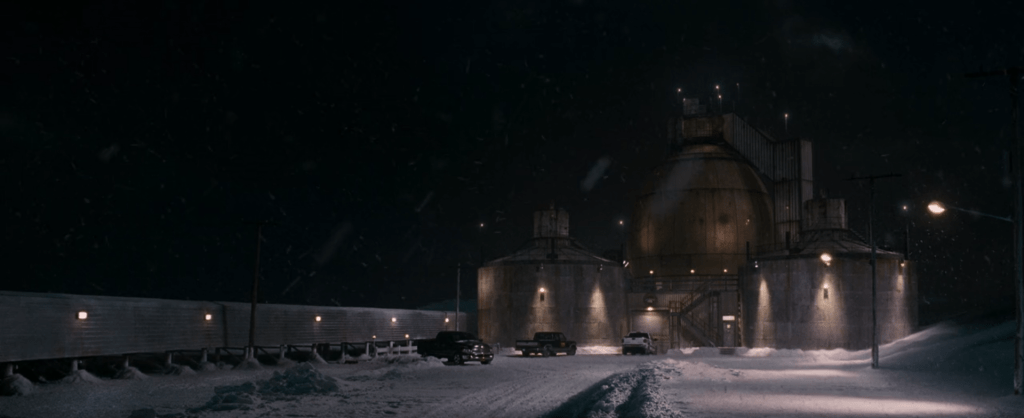
Oil plant in Barrow, AL
Barrow’s oil plant after night has fallen. All rights reserved to Columbia Pictures and/or other respective owners.

Once again the themes of remoteness, isolation, long period of darkness, and severe weather take the lead. After the movie a miniseries prequel (2007), sequel (2008), and also a direct-to-DVD movie sequel (2010) were made, but I haven’t seen those. The ratings make me a bit uneasy about spending my time on them, but do leave a comment if you have seen them!

The Thing (2011)

A prequel rather than remake to the 1982 Carpenter movie of the same name. I find it commendable that in an age of cheap remakes the creators instead elected to make a tie-in with the original movie. It is up to everyone’s judgement whether they succeeded.

The story is set right before the events of Carpenter’s Thing at another research station, this time Norwegian. You can watch the 1982 movie right after this one and the story will continue almost seamlessly.

Helicopter arriving at an antarctic base
All quiet at the Norwegian base. All rights reserved to Universal Pictures and/or other respective owners.

In my opinion it is not bad. There’s not exactly the level of mystery and suspense as in the 1982 movie, and it’s more predictable as far as I remember. There are similar themes, similar progression, you are aware that this has to do with the other movie all the time. Don’t expect any great novelty or originality, but it does what it aims to and it really feels more like a loving homage than a cash-grab remake.

Fortitude (2015-2018)

I have saved this one for the last, because it is one of my favourite shows, and also one that the latest True Detective series reminds me the most. Fortitude is set in a fictional town of the same name in Svalbard. The inhabitants are employed mostly as scientists, miners, or fishermen, plus the necessary services.

The first season is mostly a crime investigation show with little hints of mystery. With the second season Fortitude goes full mystery/horror with supernatural elements, and this is the season I find both most fun to watch and most usable TTRPG-wise. The latest True Detective series reminds me of this second season in a good sense, as I mentioned before. There is also a third season, but it’s inferior to the first two. It feels like an attempt to tie things up after being scrapped by the producers. What I find the worst about it is what happens to the characters. Formerly complex characters are flat in the last series and behave stupidly. And also it seems the creators tried to make everyone look bad. I’d say you can safely leave the third season out.

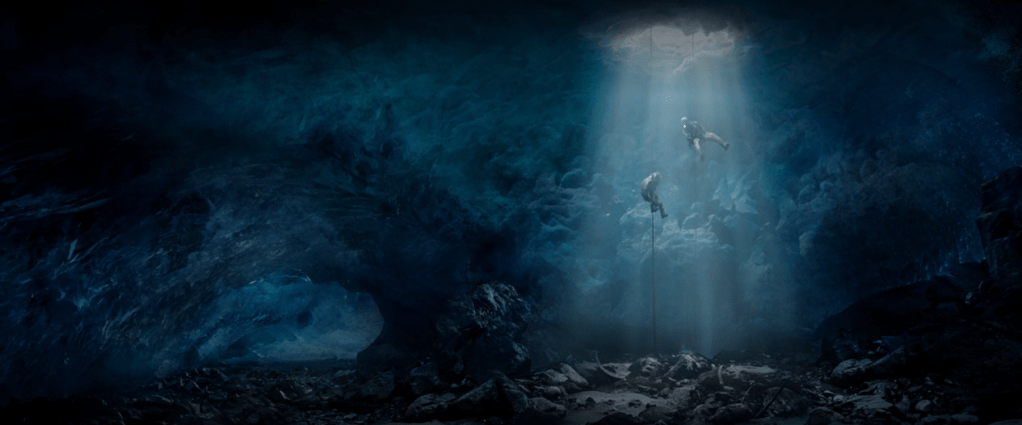
Two persons rappelling into an icy cave
What lies below the ice? All rights reserved to Sky Atlantic and/or other respective owners.

Fortitude has a great atmosphere overall and uses the themes I wanted to talk about really well. There is severe weather, darkness, isolation, various political and social tensions as well, and of course frozen secrets. The supernatural is well interwoven into the “normal” problems of an arctic settlement. The cast is very good and the characters and their motivations are well-written (until Season 3). As with True Detective: Night Country, there is a lot of potential for someone who would like to turn it into a tabletop adventure (or campaign).

Final remarks

What I call Frozen Horror (and you might call it differently) offers a unique experience, lately revived by the fourth season of True Detective. I have put some of my thoughts on the topic into this article, as well as some examples I would recommend. Of course there is more to each of them than the things I described – The Thing is a different story than 30 Days of Night. In this article I tried to point out some of the similarities that lie mainly in the environment and setting. I am eager to read your thoughts on this matter and perhaps your suggestions for other movies, TV shows, video games, etc. The more inspiration, the better.

I will also prepare separate articles about some of the media mentioned here. Requests and suggestions will be happily considered. If you found this post interesting, it would be great if you could share it with your friends. Comments are welcome, and don’t forget to follow the blog or our social media accounts for more content!

Dungeon 24: Block junction

February is dedicated to another prison block, not as abandoned as the first one!

Estimated reading time: 3 minutes

Last time I provided a summary of an abandoned prison block that has been inhabited by squatters at some point in the past. There was also a hidden section of the prison where torture and alchemical work took place. In this post I will finish the last two cells remaining in the first block and we will move on. As we’re still on one floor, the rooms are numbered continuosly, but since January has 31 days, rooms 32 and on are obviously from February.

The last two corner cells of block 1 once again offer a glimpse of sinister happenings. If the party gets here after seeing the rest of the block, the atmosphere might be already quite tense. As one of the first rooms to be explored it might put the party on alert, although there is little to fear in the block, excluding the wraith.

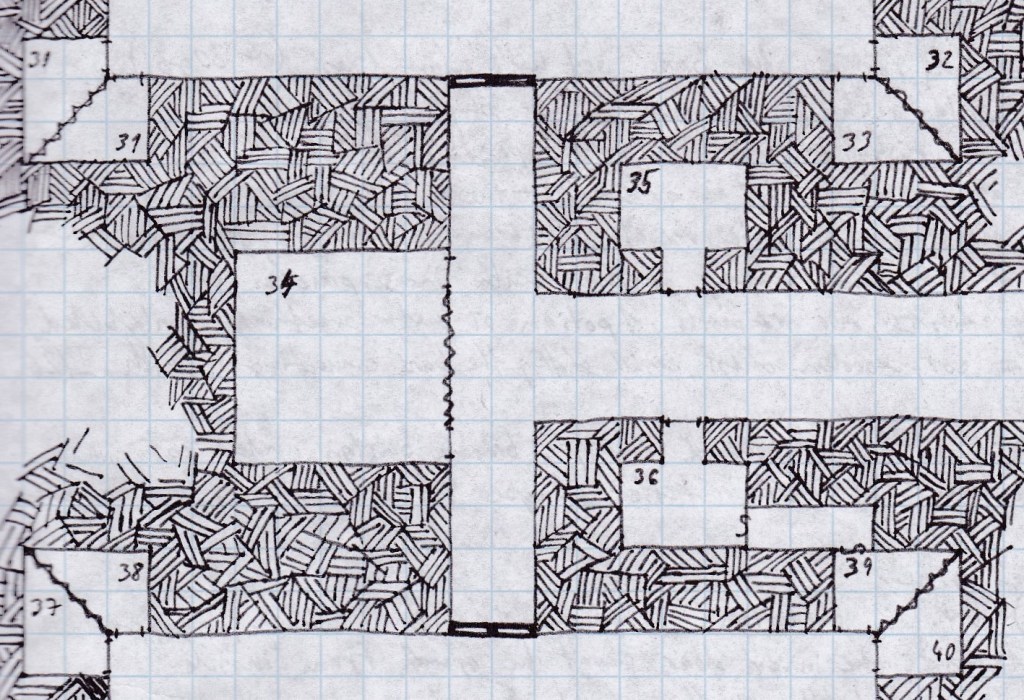
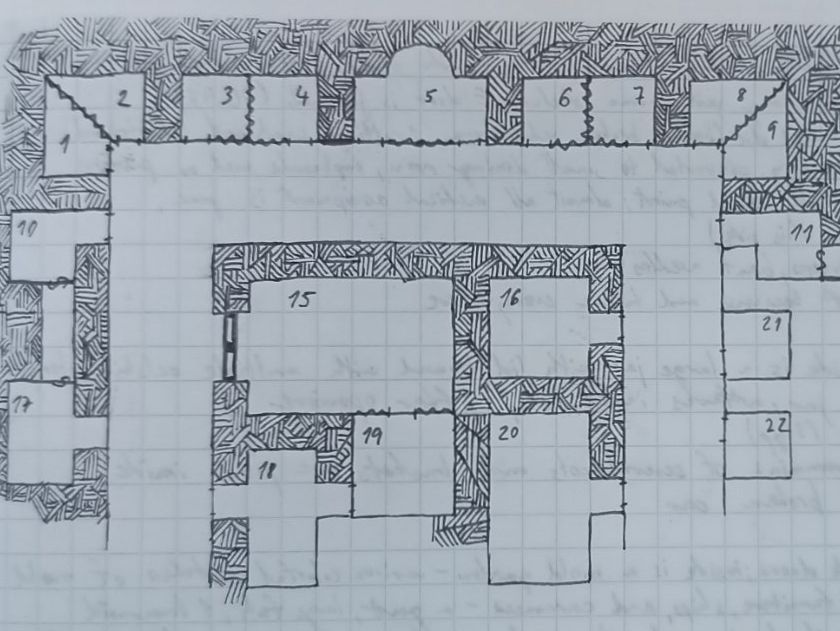
Rooms 30 to 40 are pictured here, along with a corridor leading eastwards
Explore another block of the prison or follow the corridor leading eastwards?

Beyond the door to the south lies a corridor leading to another prison block. At the junction with the larger corridor there is a former guardpost occupied by Balok. Balok is a vermin dwarf who calls the old prison his home. If he’s not making his rounds he’s probably asleep in his room. While not entirely unfriendly, he will not help the party in any way unless it’s in his own interest, and would prefer if they left the premises soon. Particularly hostile parties might receive directions into various hazards, whether it’s monsters or traps.

The two opposite rooms to the east, an office and a storeroom, are not interesting at all, except for the hidden passage from the storeroom to one of the cells in southern block. The cell itself and its twin are quite unremarkable. The other corner twins contain some transportation devices and a lot of oyster shells.

Who is hoarding the shells and for what purpose? And what’s a “vermin dwarf”? For the first one keep following my #Dungeon24 updates, and don’t forget to like, share, and comment! As for the second question, there will be a post dedicated to this new dwarven subrace/heritage in the near future, so stay tuned!

Rooms

  1. Corner cell, door missing, no cot or other furniture; walls and floor covered in colorful drawings. Closer examination reveals unsettling details – monsters, murder, etc. in childish styl
  2. Corner cell with bound door; inside is a human-shaped sailcloth bundle bound by rope. There is no body, only rags and seaweed shaped into humanoid form. T: 7 cp, perforated, can be found among the rags
  3. Balok’s quarters
    • The former guardpost was claimed by Balok, a vermin dwarf
    • N door is jammed, almost all of the E wall is cowered with furniture – mostly backed shelves, some cabinets
    • S door is locked whether Balok is in or not; he wears the key on a chain around his neck; when he’s in the door is blocked with a bar as well
    • there is a crossbow trained on the door that shoots if not disarmed when opening (DC 30 spot check)
  4. Former office, now this room is empty except for small pieces of broken furniture and damp rags
  5. Storeroom, mostly empty shelves, some missing (ask Balok); secret door behind one shelf (DC 30)
  6. Corner cell wth no furniture, only burlap sacks filled with oyster shells, 14 in total
  7. Corner cell with one rickety trolley and three wooden pack-frames
  8. Corner cell, 3 barred pannels leaning on the wall opposite the door; behind them secret door (DC 20)
  9. Corner cell, empty

Dungeon 24: January

An abandoned prison block has been the focus of my January #dungeon24 effort. Check the summary here!

Estimated reading time: 3 minutes (10 with room descriptions)

It’s already February and I haven’t been always punctual with the daily rooms of my new (mega)dungeon. There is however a whole month’s worth of rooms in my notebook. In the first post I’ve only offered a teaser, so this one will be more detailed. For full descriptions of the rooms scroll to the end of the post.

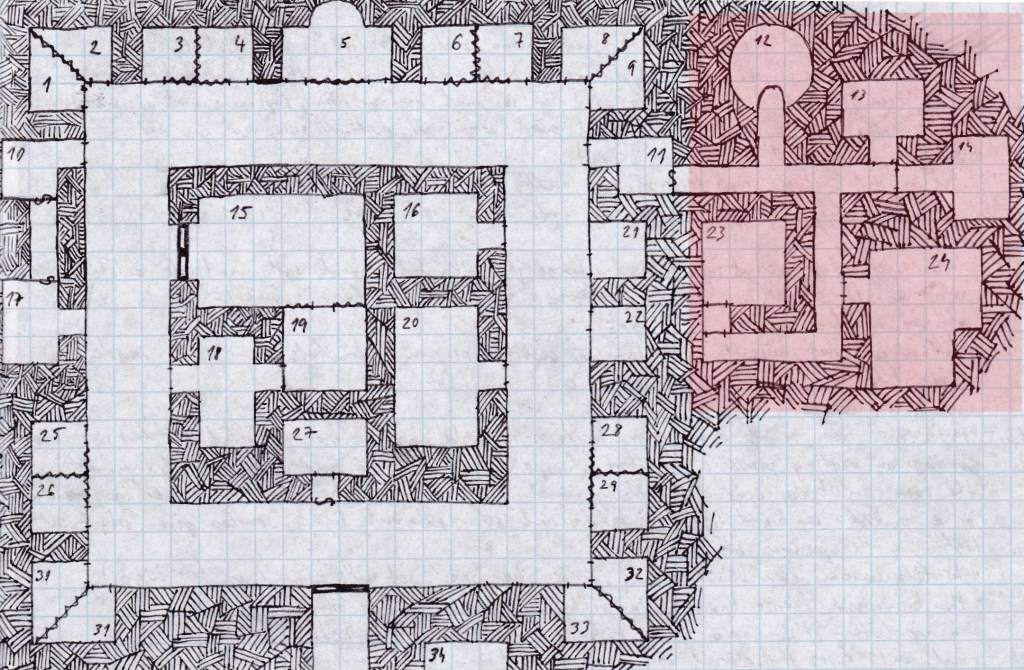
As I mentioned earlier I chose an abandoned prison as a starting point. You can read the reasoning behind this in the first post so I won’t repeat myself here. On the provided map you can see two distinct sections that I have distinguished by a red filter. The left side is the original prison architecture as built (well, cut into rock) by its founders. The right (red) side is a more recent addition and hides a more sinister side to the place.

Dungeon plan for january
Finished January, one prison block plus secret recent addition.

There are several cells lining the main corridor, most of which are twinned, except for the two isolation cells. Several storerooms and utility closets are also present. In the centre of the main corridor loop there are workshops and the infirmary. Apparently the infirmary has been used as a sort of children’s room, if it’s to be judged from the furnishings. There is also a secret room that served as a shelter for two unlucky squatters.

The cells are for the most part devoid of anything interesting, with only a few stray coins and low-value items to be found inside them. Two humanoid skeletons can be found in the cells, with copper coin charms. There is a small shrine to an unknown deity fashioned from one twinned cell. The only static combat encounter is in one of the isolation cells, where a brine wraith (stats and description later) is imprisoned in a large jar.

The right side of the plan, accessible from the trolley utility room, consists of two interrogation/torture chambers, a room with a pit to lower levels, an alchemists workshop, and a mold garden. There’s not much to see there, but for a potion of water breathing in the workshop and some trinkets (and infection hazard) in the mold garden. The molds might be of use to an alchemist, herbalist, poisoner, or other persons of similar vocations.

The overall picture any explorer should be getting is that this part of the prison has been used by several squatters including children. At least 4 adults have been present, and their bodies can be found in various cells. The bodies in the mold garden are more recent. The prison block has then been abandoned again, except for the shrine, where relatively fresh food can be found as an offering.

Although not much is happening in this prison block, I tried to create a sense of mystery with the small details. Also an atmosphere of something sinister and ominous that took place in the block not too far in the past. I won’t be fleshing everything out right now, and I’m not going to add dynamic encounters just yet. As I mentioned before I am not a fan of making a dungeon on the run this way, so I will return to this part of the dungeon later. As the dungeon grows, so will my options to tie everything in.

February will be dedicated to another prison block. This time the area will be occupied. There will be some clues that would add to the snippets from January, and we’ll get a fuller picture. If you want to see where this is headed, be sure to follow our social media, where updates will be posted Thursdays. And as always, feel free to like, share, and comment!

Rooms

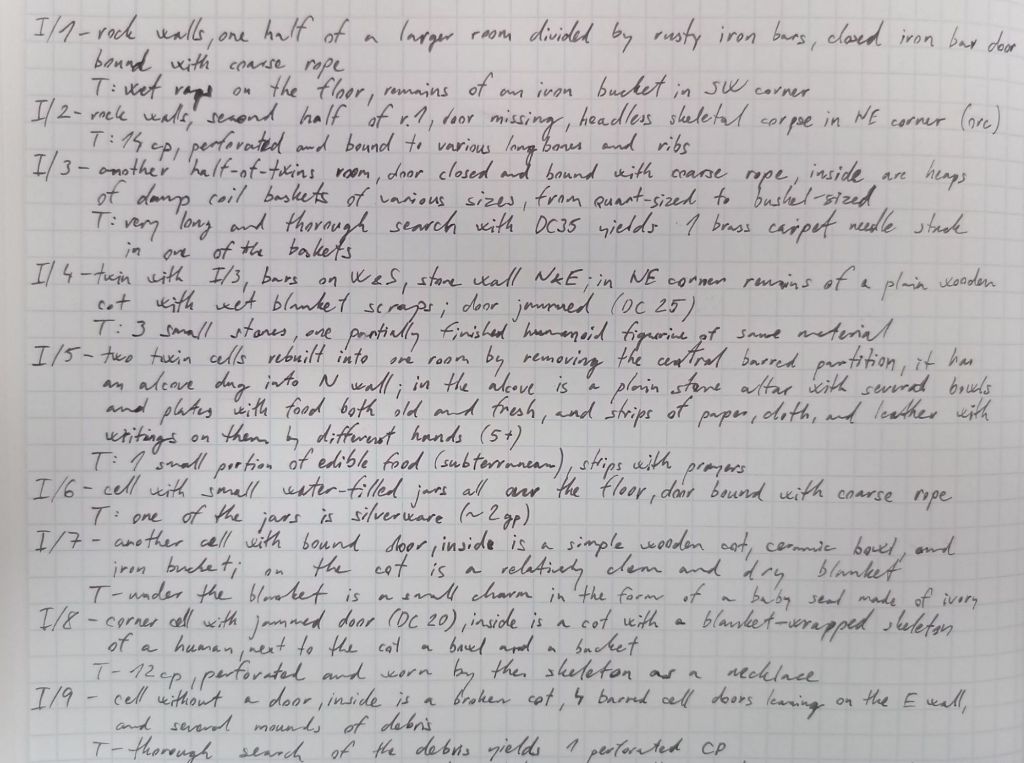
And now the complete room descriptions. Please note that these are almost verbatim (minus typos etc.) from the notebook I use and I definitely do not consider these well described. They are rather notes than descriptions, really.

  1. Rock walls, one half of a larger room divided by rusty iron bars, closed iron bar door bound with coarse rope. T: wet rope on the floor, remains of an iron bucket in SW corner
  2. Rock walls, second half of room 1, door missing, headles skeletal corpse in NE corner (orc). T: 14 cp, perforated and bound to various long bones and ribs
  3. Another half of twin rooms, door closed and bound with coarse rope, inside are heaps of damp coil baskets of various sizes, from quart-sized to bushel-sized. T: very long and thorough search with DC35 yields 1 brass carpet needle stuck in one of the baskets
  4. Twin with room 3, bars on W and S sides, stone wall N and E; in NE corner remains of a plain wooden cot with wet blanket scraps; door jammed (DC 25). T: 3 small stones, one partially finished humanoid figurine from the same material
  5. Two twin cells rebuilt into one room by removing the central barred partition. It has an alcove dug into the N wall; in the alcove is a plain stone altar with several bowls and plates with food both old and fresh; also strips of paper, cloth, and leather with writings on them by different hands (5+). T: 1 small portion of edible food (subterranean), strips with prayers
  6. Cell with small water-filled jars all ove the floor, door bound with coarse rope. T: one of the jars is silverware (2 gp)
  7. Another cell with bound door, inside is a simple wooden cot, ceramic bowl and iron bucket; on the cot is a relatively clean and dry blanket. T: under the blanket is a small charm in the form of a baby seal made of ivory
  8. Corner cell with jammed door (DC 20); inside is a cot with a blanket-wrapped skeleton of a human; next to the cot a bowl and a basket. T: 12 cp, perforated and worn by the skeleton as a necklace
  9. Cell without a door; inside is a broken cot, 4 barred cell doors leaning on the E wall, and several mounds of debris. T: thorough search of the debris yields 1 perforated copper piece
  10. Utility room, S wall lined with broom racks and other sanitary utensils mostly in bad shape; there is a stone sink in the NW corner covered with an iron grate. S: behind broom rack is a secret door, DC 15 when searching the rack
  11. Utility room for trolleys, one broken is lying in SW corner; E wall covered by hanging rags, blankets, and raincoats on hooks. S: behind blankets on E wall is a secret door (DC 30)
  12. Round shaft leading down with only a small promontory from the corridor
  13. Rough-cut room behind iron-bound door; inside are various restraining devices – chains on walls, stocks, restraining chair. T: rucsty wicked-looking curved knife lying under the chair
  14. In this rough-cut room there is only a single iron chair with shackles in the middle and several tables lining the walls; on the tables various tools and torture instruments can be found; a curtain bar is at the entrance, the curtain is missing. T: torture insturments; silver chain wrapped in dirty rag (1 gp)
  15. The room looks better cut than others, there are four infirmary folding beds along the N wall and several cabinets along the S wall; half of the S wall is barred, there used to be a door to room 19, but it is lying nearby. The walls are covered with childrens’ drawings. T: articulated wooden dol with 1 arm missing
  16. Workshop with several wool-processing worksations; there are various wool-processing tools scattered around (hackles, carders, combs), along with baskets and rotting clumps of wool. T: bone carding comb decorated with scrimshaw (1 gp)
  17. Storeroom with broken shelves and crates, evidently looted. T: 2 stoneware oil bottles (1 quart each), firesteel, 1d6 rusty iron nails, several buckets, bowls, small flat chisel. S: secret door behind shelf, DC 15
  18. Guardroom, an empty weapon rack on the N wall, table with chairs (all in bad shape) in the S part of the room, along with some shelves; E door is jammed (DC 40). T: 1d6 cp in various places; an 8-sided bone die, broken whetstone, 1 rotting shortsword scabbard
  19. Doctor’s room adjacent to infirmary, converted to small dining room; cupboards used as pantries (some food remains), walls painted with faded paint; almost all medical equipment is gone. T: slightly bent scalpel, small forceps, bent needles
  20. Chandler’s workshop; clumps of beeswax everywhere. T: 2d6 usable candles, few candlemaking resources
  21. Isolation cell, door locked. Inside is a large jar with lid bound with multiple eelskin straps. E: brine wraith sealed in the jar, attacks immediately after opening the jar. T: abalone necklace in the jar (5 gp)
  22. Isolation cell, door missing. Remains of several cots and buckets are piled inside along with a battered and broken oar from a galley. T: usable wooden pulley
  23. Rough-cut room behind double doors. Inside is a mold garden – various colourful patches of mold growing on rotting pieces of furniture, ships, and carcasses – a goat, a large fish, 1 humanoid. The room is lit by crystal shards jammed into cracks in the walls and ceiling, resulting in a pinkish ambient light. Torches and other external light sources give only faint light in the presence of the crystals. T: the fish carcass can be searched for a silver brooch set with almandines (30 gp); the humanoid corpse has 1 gold tooth that comes out easily (1 gp). Manipulating the bodies is a risk, infection is highly possible (CON DC 25)
  24. Rough-cut room that formerly served as an alchemy laboratory. Broken vessels and various instruments lie scattered on the floor and surfaces. T: 2 gp worth of common ingredients, mortar and pestle, 1 potion of water-breathing
  25. Surprisingly clean cell with a cot, wooden chest, small shelf; the bars connecting it with its twin are covered with blankets. T: small leather pouch with needles and thread behind the chest, 1 brazen button under the cot
  26. Twin cell to I/25, less clean but still in better shape than most others; bars covered with blankets. T: a worn iron shortspear in one corner
  27. Hidden room (door DC 30) with 2 humanoid skeletons in embrace; around them are some small items. The inner door can’t be opened from the inside. T: iron key to I/21, firesteel, empty bottle, small rusty knife
  28. Door missing, almost empty cell, remains of a cot scattered on the floor
  29. Another empty cell, thorough search (DC 35) reveals a well-made stash in the wall. T: 2d6 cp, simple gold earring, plain silver ring (3 gp + 1 gp)
  30. Corner cell, door bound by rope, inside on a cot are potsherds from 3 large jars; the bars are covered with blankets. T: 5 cp can be found among the sherds
  31. Corner cell, all barred walls covered with blankets smeared with blood from the inside. Door bound, inside there is a large clay amphora without lid, covered in blood, same as the rest of the cell. There is too much blood to fit within the amphora alone

If you read all the way down here, take some time to like, share, or comment. Thanks for your interest, until next week!

Dungeons: How to Behave

Does the party have to clear the whole dungeon every time? Does it always make sense? Are there different approaches? Let’s see in this part of the Dungeons series.

Estimated reading time: 9 minutes

This post is part of a series analysing several aspects of one of the most recognizable parts of the TTRPGs we all love – the dungeons. The posts can be read in any order and they will be cross-linked when necessary. Throughout the series (and also elsewhere) “dungeon” is used as a technical term and can be used to describe any clearly defined environment containing multiple non-random encounters. These include natural caves, mines, keeps and castles, crypts, temples, ships and other vehicles, and many others.

In this part I would like to look at the PCs’ behaviour during their stay in a dungeon. Not necessarily about vandalism or littering, though these can also play a part in what I’m talking about.

The archetypal “dungeon crawl” consists of the party entering a complex of rooms and systematically (or not) clearing one after another, often with combat and puzzle encounters waiting in most of the rooms. While this is what many players expect and many gamemasters deliver, it often does not make sense. In the cases it makes sense for the dungeon, other parts of the plot are probably lacking. It makes for static dungeons that are easier to prepare and manage, but less immersive, believable and in my opinion rewarding. That’s not to say that people can’t have fun with such dungeons, but you might be looking for something more if you’re reading these lines.

To help make my point I will refer to master Tolkien and his works. They of course need no introduction and I will assume you are familiar with both The Hobbit and The Lord of the Rings.

Reasons for entering

The best example I can think of is Moria. Khazad-dûm was an underground dwarven kingdom that has fallen at some point in the history and was occupied by goblins, orcs and cave-trolls. An expedition led by Balin, son of Fundin, aimed to reclaim (sic!) the halls of Moria. After some success it ultimately failed. The Fellowship then enters Khazad-dûm with an intent to get across (or under) the Misty Mountains expecting a welcome by the dwarves. After discovering their fate, the Fellowship takes flight through the deep halls and manages to leave through the East-gate of Moria.

The Mines of Moria concept art for “Lord of the Rings” (1978) by Ralph Bakshi. All rights belong to the author, who shared the painting here.

We have two different “dungeon crawls” going on with Moria. The first of these, Balin’s reclamation expedition, was probably quite a massive undertaking. Though we don’t know any numbers other than a few named characters, I believe we can safely assume there were hundreds of dwarves. The fighting was of course done by the soldiers, but many others, including craftsmen and servants had to be part of the expedition. They started reclaiming Khazad-dûm from the east and established a colony in a small part of the former kingdom that lasted five years till it succumbed to the orcs and worse. The dwarves had to proceed systematically, retaking room after room, securing entry points, building strongpoints and safe zones. Clearly that’s not something a party of four to six can manage. Unless the dungeon is static and the monsters are content with staying in their rooms until the heroes get their long rest, of course. In a dynamic dungeon this could not happen and a small party would lack the manpower to keep the cleared areas clear. Ambushes and attacks from behind would happen all the time.

The other instance is the Fellowship’s crossing of Moria, where after finding out there won’t be a welcome party the Fellowship’s goal was to simply cross to the other side. They moved fast, trying not to make their presence known, and certainly didn’t go room to room slaying monsters. And the party was rather high-level even without considering Gandalf, the only low-level members being the halflings.

I want to propose several different ways of handling dungeoneering, each with its own merits and shortcomings. They can overlap slightly, or they can change during the course of adventure. There are plenty of ways to ensure the party has to explore, even if they only need to get from A to B. But I believe there ought to be a better reason for exploration or room-by-room cleaning.

Apart from reclamation (Balin) and transit (Fellowship) we can have other reasons to enter a dungeon. The party might be after a certain foe (assassination). They might be after every single monster in the dungeon, but not care about the dungeon itself, then it’s not reclamation but rather extermination. If searching for an item let’s call it treasure hunt, regardless of whether it’s an actual treasure or for example hostages.

Let’s put those into a table with some factors that interest us:

Explore everythingDefeat everythingTime spanManpower needed
Transitnonoshortparty
Assassinationnonomediumparty
Exterminationyesyesmedium to longarmy
Treasure huntnonomediumparty
Reclamationyesyeslongarmy

Many TTRPG dungeon crawls fall into the assassination, extermination, or treasure hunt categories, or their combinations. Either way you have to crawl through the whole dungeon to finish it. It is especially true in video games, where there are often items placed in a way that you have to explore everything. I guess it makes sense from gaming perspective, but not from the dungeon design one.

Does it work elsewhere?

Apart from the already mentioned Moria from Lord of the Rings, can we get some other easily recognizable and acknowledgeable examples from media? Sure we can!

What about another legend, Star Wars: A New Hope? Did the heroes clean room after room full of stormtroopers aboard the Death Star? No, they had their objectives and went after them. In this case we would talk about a combination of treasure hunt and transit. And in the prequels, did Obi-Wan and Anakin clear out the whole flagship of General Grievous while rescuing Palpatine from Count Dooku? On the other hand, when Darth Vader captured the Tantive IV corvette carrying Princess Leia and the droids the stormtroopers had to eliminate all opposition. The same can be said of the attack on the Rebel base on Hoth. See the pattern?

I believe that should be enough to get a feeling for what I’m trying to point out, if it wasn’t clear before. Unless your goal is to clear out the whole area, you won’t do it, you just do what you came to do and get out. But since we don’t want to present players with just a string of encounters, they should be introduced to a larger dungeon than necessary. More on that in another part of this dungeon series, now I’d like to finish with party behaviour.

Do’s and don’ts

Depending on the party goals and the dungeon crawl category there are some things the players and gamemasters should keep in mind. From the player point of view time should matter – if you’re on a rescue mission, you leave looting for after the rescue, and stay on the move. They should also be conscious of their position within the dungeon and of the positions of potential foes. Of course you as a GM won’t hand them a plan with marked enemies. The party should however take mental notes of unexplored corridors, rooms, and other potential risks, especially if there’s going to be a return journey or a later return to the same dungeon (more on that in another post). Battle encounters should be avoided if possible, as even weak foes can buy time for an ambush or flanking move by others.

On the other hand, if your party is clearing out an old keep to serve as their headquarters, let them take their time. It is also necessary to be conscious of what’s happening where, but there should ideally be secured areas behind the party. And those could be contested as the occupants try to expel the invaders or break out and flee. The party would try to eliminate all opposition, although fighting is not always the best option – some monsters might rather accept eviction than death, even if highly repaid.

And what about extermination? Even when your goal is to kill or subdue all enemies you could have a better plan than just room-after-room slaughter. Stealth is always your friend and if there are leaders or enemies whose presence makes other stronger, it would be wise to target them first. There might also be means of calling reinforcements, and eliminating those is also something that should be prioritized.

Note that I have omitted exploration from my categories. Of course one can imagine a party that just ventured down some stairs to see what’s down there. But I also think in this kind of situation there is something missing – motive. It’s in the meta-gaming territory when players just go into a dungeon because the gamemaster prepared it and the PCs have no real motivation. At least have them search for valuables (treasure hunt), or menaces to surrounding lands (extermination). Or if it’s a mine or something similar, they would probably want to stake their claim to it (reclamation).

Dungeon dynamics

To conclude this article I will just outline the focus of a future post, the dynamics of a dungeon. At the beginning I mentioned static dungeons and that I found them less interesting and believable. Without devouring the upcoming article I can share that dynamic dungeons are another thing that makes room-by-room dungeon clearing unnecessary. The enemies are not going to wait until you slaughter their friends on the other side of the door; they either come to their help or fortify their positions. And that’s just one aspect of dungeon dynamics, but more in the coming article. There won’t be any sources for this one, but if you have been living in a dungeon and haven’t read either The Hobbit or the Lord of the Rings by J.R.R. Tolkien, yet, you better do it fast!

As always, your thoughts and questions are welcome in the comments. Can you think of another dungeon crawl category? Is there an example from media that supports or even refutes that categorization that you would like to share?

Please share this post on your favourite social media if you found it interesting, and don’t forget to follow Rashundai Games for further updates!

All mentioned IP’s belong to their respective owners.

Dungeon 24

The introductory post to the #Dungeon24 challenge you’ll be seeing on this site.

Estimated reading time: 4 minutes

New year, new challenge. I abandoned Dungeon 23 because I found that the dungeon in progress deserved better treatment than this challenge provides. More on that later. This year however I’m going to try and see it through. If I get a usable megadungeon out of this, all the better, but I will be trying to make some points about dungeon design, dungeon ecology, megadungeons, and other related topics. This challenge should prove a good substrate for that.

For those unfamiliar with the concept, Dungeon 23 was a challenge set by Sean McCoy for 2023. You map and describe a megadungeon one room a day. Each month is a separate level, so you get 12 levels. The emphasis is on finishing rather than on it making perfect sense, with 5 bland room descriptions being better than 1 detailed room. In this regard it’s more of an excercise in seeing things through and creating a habit rather than good dungeon design exercise, but it’s a fun thing to do during your lunch break or commute each day. For me however the interesting part is making a dungeon that can be used in an adventure.

Some people have modified the challenge and instead of one megadungeon with 12 levels and 365 rooms they make a different dungeon each month. They end up with 12 smaller dungeons and that’s quite sensible in my opinion. It’s easier to maintain the logic of the dungeon if you’re not creating it over the course of a year, one room at a time.

To be honest I would rather choose something that could benefit from the diversity and incoherency you easily get from a year-long challenge. Single magic items, monsters, or market stalls (as I saw somewhere on the internet) are all sound choices. You still get the sense of accomplishment, plus you will probably be able to use more of what you create this way.

But the challenge is to make a dungeon, so I will make one, one room a day, and I will try to keep it coherent and functional.

You wake up in a cell

My first room is a prison cell, and a good part of the first few months will be prison-themed. Prisons are a good choice for this kind of exercise, because you have a lot of similar rooms that make sense together, you only have to furnish them. My prison will be an abandoned one, that is currently being used by squatters. Or so it seems from the first few rooms.

Other similarly convenient places are living areas (dormitiories, tenements, trailer parks, even villages and towns), necropolises (preferably made of tombs, not single graves), or other locations consisting of multiple similarly built rooms or buildings. This will be the backbone of your dungeon (or level, or just a section) to which you will add other necessary facilities. For example a prison could have rooms for guards, storerooms, workshops, kitchens, maybe a torture chamber or a recreation room, depending on the tone and setting. A barrow field would contain the barrows themselves (some maybe with multiple chambers), and then maybe a temple and some maintenance buildings. Why not multiple temples or shrines, and maybe an inn for travellers. You probably get the idea.

I originally wanted to post this after only a few rooms but I’ve been delayed by work on the site. Therefore at the time of posting this I have about three weeks worth of finished rooms. I will probably work on this only on weekdays and catch up Mondays. These updates will be posted on Wednesdays or Thursdays.

First few rooms of a yet-unnamed megadungeon.
Small sample of room descriptions

Are you doing the #Dungeon24 challenge as well? Or perhaps are you working on #Hexplore24, a similar challenge proposed for this year? Leave a comment and feel free to link your creations!

It’s (a)live!

The site is online and this is the first blog post. Have fun and follow the raccoons!

After a year of deliberations and preparations I’ve decided to go live with this site. It still requires a bit of polishing but I hope to make up for the lack of glamour with content. What can you expect to find here?

There will be regular blog posts concerning various TTRPG-related topics. At least at first this will form the bulk of the content. Over time I would like to steadily increase the amount of playable 3rd party content for your tabletop games.

As of now there is only one official crewmember, and I’m neither a web designer, nor a marketer, and it will probably show. This whole project is just a hobby right now, allowing me to share the things I love with people with similar interests.

For now the goal is to have at least one post per week. I will also post on Facebook and Twitter, so don’t forget to click the respective buttons on the bottom right of the page! I will be glad for any likes, shares, follows, and comments you will make. And of course you can also use the comment section below.

Have fun and follow the raccoons!