D&D Lorwyn: Cosmology and Timeline

In case you haven’t heard, Wizards of the Coast have announced in late February that a new sourcebook is in works. It will resurrect the dual plane Lorwyn-Shadowmoor from Magic: The Gathering, released back in 2007-2008. There was the Lorwyn block, comprised of Lorwyn and Morningtide, and the Shadowmoor block, consisting of Shadowmoor proper and Eventide.

I wanted to dedicate a series of articles to MtG with focus on those two blocks, but Wizards beat me to it with their announcement. There’s no release date so far, so I’ll go for it anyway and write my thoughts, expectations and speculations. I am really looking forward to the end product and wish the team behind it luck. Lorwyn-Shadowmoor is a great setting and should not be left to rot.

Lorwyn-Shadowmoor is clearly inspired by British Isle folklore. It shows in the language, themes, and aesthetic, but it was never marketed in this manner. The creators probably wanted to create a setting influenced by folklore and fairy tales, not build a setting around folklore.

In this article, hopefully first of many, I will describe some of the cosmological aspects of Lorwyn-Shadowmoor in regard to Dungeons and Dragons. There are my speculations on the place of the plane in the multiverse(s), and inevitably a quite large part on the timeline. I wanted to get these out of the way before I start writing about more specific topics, such as the various denizens of the plane.

Dual plane

Lorwyn and Shadowmoor are unique in that they’re two sides of one setting. A dual plane changing periodically because of the Great Aurora. Originally a recurring event orchestrated every few centuries by Oona, queen of the fairies.

Many such events have happened apparently, until the last one (the one we see in the MtG blocks). That one was not caused by Oona, to her great unease and discomfort, but rather brought by the Great Mending. The Great Mending is an important event in the Magic multiverse that I will not describe here. Concerning Lorwyn and Shadowmoor the fact that it happened should be enough.
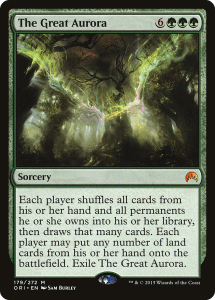
Due to the dualistic nature of the setting, almost everything in Lorwyn has its darker counterpart in Shadowmoor. Lorwyn is a cozy rural fairy tale fantasy inspired by the British Isle folklore. The sun always shines there and even the storms are a made of light instead of pouring rain.

Shadowmoor is the opposite, it is always dark and hostile. It still retains the fairy tale tone, but warm and cozy is replaced with harsh and gloomy. The denizens of Shadowmoor are mostly bereft of their good sides, with their flaws amplified.

The duality of the plane is best seen when the change is part of the equation. Without the Great Aurora the plane is either an idyllic rural haven, or a folk horror darkland. Both have their merits, but a large part of the potential is lost when only one aspect is experienced.

Cosmology

What I am quite interested in is the way Wizards will handle the plane in relation to D&D cosmology. Both multiverses feature planes, but they are not connected.

MtG Multiverse

Based on the Planeshift series my guess is there will be no overlap with Lorwyn either. Rules will be given for playing D&D set in the plane, but you will be expected to act within the MtG multiverse. That’s fine in my book, it makes more sense to travel from Lorwyn to Innistrad, than jump between Lorwyn and Sigil, or one of the many worlds of the Prime Material plane.

In the Magic multiverse one thing you have to consider is that travel between the planes is not easy. Usually the power called “planeswalker’s spark” is required, and the individuals in possession of the spark are known as “planeswalkers”. It takes time and effort to master the spark, so the planeswalkers that could travel to Lorwyn should be fairly high-level.

This changes after another large event in the MtG universe, the Phyrexian Invasion of the Multiverse. One of the the results is that many planeswalkers lost their planeswalking powers. Instead, newly created portals called “omenpaths” now exist, enabling even non-planeswalkers to travel from plane to plane. So the accessibility of interplanar travel depends on your timeline, but more on that later.

D&D Multiverse

Suppose you only wanted to use Lorwyn-Shadowmoor in your campaign. You are using the “default” D&D cosmology, also known as the Great Wheel. From the outside in there are several layers of planes. The Positive and Negative planes are the outermost, then there’s the Astral plane wrapped around the Outer planes, with all the alignment-based fun stuff.

The Inner planes are encased in the Elemental chaos, then there’s the Ethereal plane, and nestled safely in the middle is the (Prime) Material plane. That’s where most of the adventures usually happen, whether it’s on Toril, Krynn, Greyhawk or what have you. Somewhere near the Prime there are the Feywild and Shadowfell, and those are the ones whose relation to Lorwyn-Shadowmoor would need to be resolved.

The Great Wheel as depicted in the Dungeons & Dragons 5th edition Player’s Handbook. All rights reserved to Wizards of the Coast and/or other respective owners.

Personally I would handle Lorwyn as a crystal sphere similar to Realmspace, or Greyspace. One heavily influenced by Feywild in the past, but perhaps cut off since then. Maybe Oona, the queen of fairies is the culprit, seeking dominion and independence in her own plane without intervention from home. That would explain both the influence and isolation, and go well with Oona’s theme of manipulative schemer. But all this depends on another detail of the D&D adaptation, and that is the timeline.

Timeline

The aspect of the plane would dictate much of the tone and play style of any prospective game. There’s actually quite a lot of possible scenarios depending on the timeline the creative team chooses. I believe it makes most sense to present readers with all of the options. They’re making a setting supplement, not a short zine, so there should be plenty of space for that. Everything depends on whether they want to set a particular scenario forth as “canon for D&D play”, or whether they want to give as much freedom as possible.

Before the blocks

The earliest and possibly largest period imaginable would be the one before the Lorwyn block. A time when the aspects were being flipped every couple of centuries by queen Oona and nothing out of the ordinary happened. Or did it?

Prequels are often used and abused by creators to fluff out already established franchises. When done right it can add depth and explain some things that were left unexplained in the original story. When overdone it can lead to the past being more crowded than the main story, and that is not always desirable.

In this scenario we would find some of the more long-lived characters from the blocks, but there would also be plenty of space for new ones. It would give the creators a lot of freedom, and they have the luxury of the Great Aurora effectively resetting almost everything. That gives a lot of leeway for even quite deep plots as long as it’s something Oona can kill with the Aurora.

Lorwyn block

The first two sets of the Lorwyn-Shadowmoor cycle are Lorwyn and Morningtide. The plane is in its bright and sunny aspect, and there is an overall playful mood throughout. The elves are the public villains, and Oona and her fairies the villains in the shadows.

I will not recount the whole story here, you can read it on the MTG Wiki if you like. Just a few remarks. Since there already is a “main story” for the Lorwyn block, there remains less of the freedom for the team working on the new D&D book.

It’s not easy to fit new stories alongside a strong existing main story. In Star Wars such things are possible thanks to the breadth of the universe. In Harry Potter or Lord of the Rings this would be more difficult. In the case of the latter there’s an amazing achievement in the form of the War in the North video game, but such feats are rare.

Shadowmoor block

Shadowmoor was introduced in the eponymous set along with Eventide. The plane has now been shifted by the Great Aurora, and it’s not for the better. Not only almost everyone lost their memories and their good sides. Oona herself is perplexed by the Aurora, as this one wasn’t her doing. In the end Oona’s chokehold on the plane was broken and a new era begins.

A lot of what was applicable to the Lorwyn block story is the same with the Shadowmoor block. There is a story and it might be difficult to squeeze in other worthwhile content without it coming off as secondary. But it can be managed and surely some groups would be able to pull off a nice campaign.

post-Shadowmoor / pre-Phyrexia

The events of the Shadowmoor block leave the plane in a new state, without the constant shifts of aspect. There are no more Great Auroras and a normal daily cycle is restored. The plane should be more or less in its Lorwyn aspect with a few remnants of Shadowmoor. That sounds like a fun mix that’s not all gloomy but still has some darker elements.

After the events of Shadowmoor and Eventide Oona has been dethroned and supplanted by Maralen, though still alive. The elf Maralen is now queen of the fairies and supposedly is going to rule differently. The fairies will probably remain mostly as they were, but we can presume the other tribes will exist in both aspects in this scenario. So we get both kind and xenophobic kithkin, playful and monstrous boggarts, despotic and virtuous elves. The extra Shadowmoor smaller tribes might also stay. It could really mean many cool options for your tabletop campaign.

If there’s only one “canon” scenario, this one would make the most sense to me. Being a sequel there’s a lot to go forth from, and no danger of retroactively stripping logic from already published materials. The only established event concerning the plane of Lorwyn is the one in the next paragraph, and that one should not cause any problems.

Phyrexian invasion

Phyrexia is MtG’s version of hell, a world of machine-and-flesh monstrosities lusting for the whole multiverse to devour and turn, or “compleat” in their own wording. There was an original Phyrexia in the older blocks, that was defeated, but not wholly eradicated. It took hold of Mirrodin (another great plane with a bunch of blocks and lots of great ideas) and transformed it into New Phyrexia, unleashing an invasion into every plane in the multiverse.
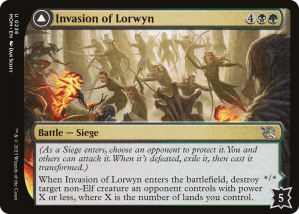
Lorwyn was not an exception, though the focus of the whole story arc was on other, more prominent planes. Lorwyn received only some fleeting mentions. Such is the fate of planes fifteen years dead to the franchise (at the time of Phyrexia: All Will Be One).

The few bits of information that we have tell us that Lorwyn was indeed invaded. There were those who fell to the lure of the Phyrexians, as we can see on the card above. Ultimately the tribes of the plane joined forces to fight back and resist the machine would-be-overlords. The invasion card art shows only elves, but we can see kithkin and presumably others joining in as well, including the wildlife.

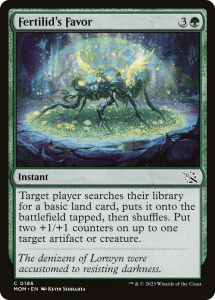
The invasion of Lorwyn by the Phyrexians is another scenario well-suited for your D&D game. A whole campaign could be devised, starting with some early pre-invasion reconnaissance being responsible for trouble on the plane. Followed by full-scale invasion, during which perhaps the party would have some vital quest to help turn the tide. The possibilities here are again quite broad, both for the creative team and for the players.
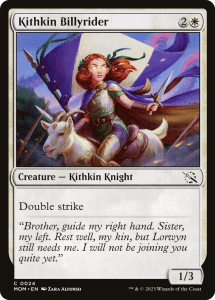
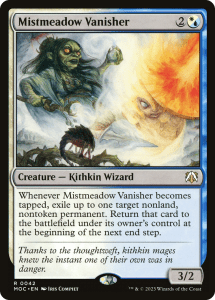
post-invasion

After the invasion most of the planes invaded were destroyed to various extents. We know nothing of the casualties Lorwyn suffered, but since the Lorwyn invasion wasn’t mentioned too much, we could expect a fairly good result. Maybe we’ll get more information in the prepared supplement. It’s also a direction in which a lot of creative work could be done.

There is an opportunity to come up with some interesting worldbuilding, but it seems wasteful to me to set your game after the invasion. Sure, the rebuilding also has its charm, but from a D&D point of view, the Phyrexian invasion is something you want to be part of, when you’re not setting up your game in Lorwyn’s past.
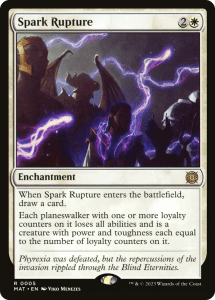
One outcome of the Phyrexian defeat should be pointed out, however. During what’s called the “Desparking” many Planeswalkers lost their spark. At the same time omenpaths have opened, essentially the means of interplanar travel for non-planeswalkers. This opens the possibilities for parties of non-planeswalkers to visit Lorwyn. For example start playing on Zendikar and then travel to Lorwyn. Again, this is something that broadens your options significantly, but comes only after New Phyrexia is dealt with.

Conclusion

Well, the conclusion is obviously that it’s great Wizards are working on a Lorwyn-Shadowmoor supplement for Dungeons and Dragons. The plane has been neglected for too long, and making it available also for people like me, who are more into TTRPGs than TCGs, is a nice gesture.

I posited various questions and their possible solutions for the future supplement. It will be to interesting to see how the team handles them, or even if they do. Maybe what I’m considering isn’t really what’s important here?

Let me know in the comments what are your thoughts, and how would you handle the issues of possible scenarios and cosmology. Also, it’s entirely possible I’ve got some things wrong, as I’m by no means a MtG buff. Corrections are welcome, as well as suggestions, and any constructive discussion. What are your thoughts on the matters I described?

If you liked the article, your comments and sharing would mean a lot, and give me the necessary feedback. The article is quite long, at roughly 12 minutes reading time. Would you prefer articles of this length, or should I strive for more shorter ones in the future?

Last but not least, some disclaimers: Magic: the Gathering (and Dungeons & Dragons, for that matter) are property of the Wizards of the Coast. The cards embedded in the article are obtained via Scryfall with no foul intent. The content of this article benefits a great deal from the MTG Wiki. I am not affiliated with any of the above mentioned entities in any way.
February of Magic and Wonders

Estimated reading time: 6 minutes

Gathering Magic

Over the past few months I have come to realize that my relation with Fantasy has been shaped by Magic: The Gathering more than I would think. Possibly more than by Dungeons & Dragons. It makes sense, Magic influenced other works for decades as well. Nothing exists in isolation and everything is influenced by something.

While not a TTRPG itself, Magic: The Gathering is a game into which tremendous creative effort has been poured over the years. You may not like every set, particularly the newer ones are questionable at times, but there’s a lot worth it about Magic. It took quite long before Wizards realized they could cross-over with Dungeons & Dragons, but now we have supplements for whole nine planes! Ravnica, Theros, and Strixhaven have their own physical sourcebooks you can buy. You can find older stuff for Ixalan, Kaladesh, Innistrad, Zendikar, Dominaria, and Amonkhet in the Planeshift series available on DM’s Guild for free.

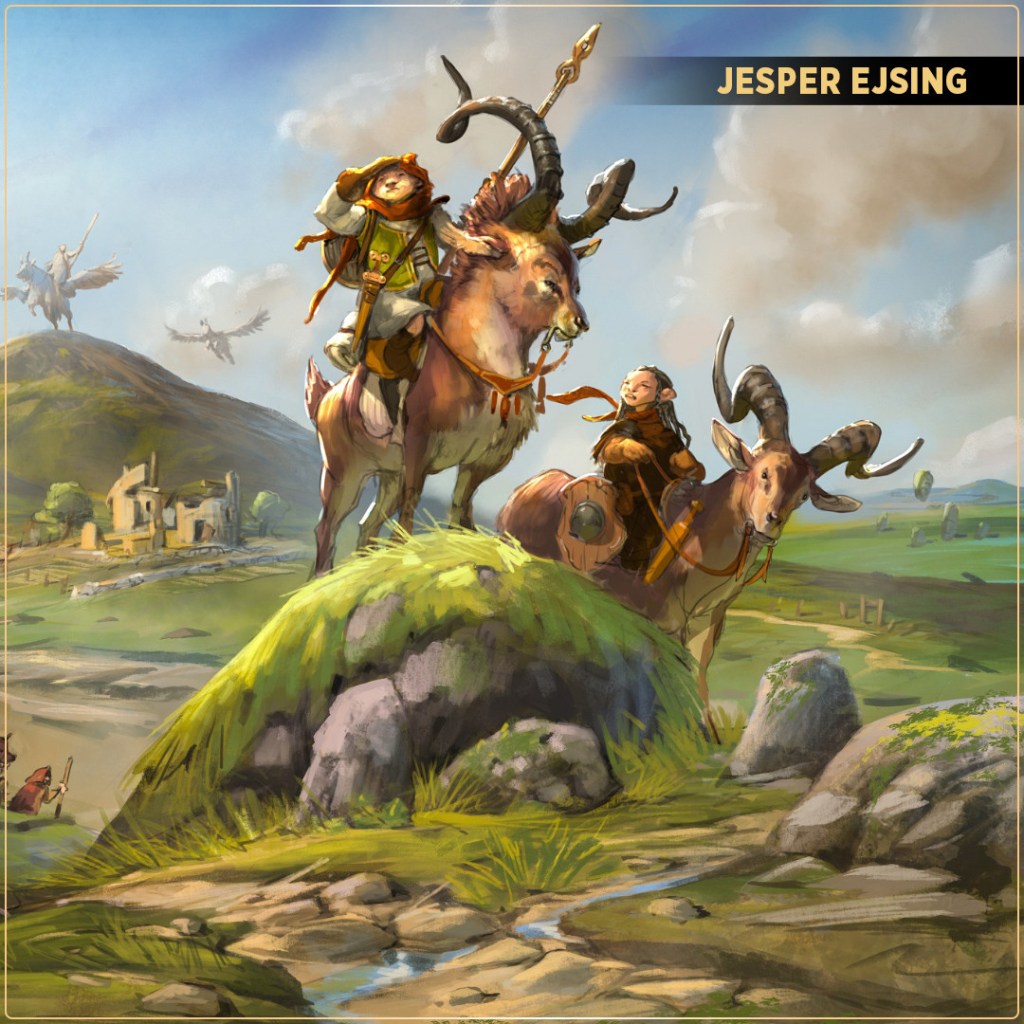
Jesper Ejsing’s art from the upcoming Lorwyn-Shadowmoor D&D Supplement! All rights reserved to Jesper Ejsing, Wizards of the Coast, and/or other respective owners.

Now we’ve been promised another supplement taking place in the Lorwyn-Shadowmoor dual plane! I am both excited and frustrated. The Lorwyn and Shadowmoor blocks were the first ones that got caught my attention for real when they came out. I didn’t collect Magic back then, and only read the lore and oggled the art, but I was captivated by the setting. It’s a fey setting that doesn’t scream “FOLKLORE” in every sentence. Many settings I see being advertised these days are trying real hard to convince us they are full of folklore. I believe they are, and that they will be great when they’re finished. I just don’t need it so explicitly stated, subtlety works wonders sometimes. Lorwyn did this well in my opinion. You can see the British Isles folklore clearly, but nobody is forcing it onto you.

A Shadowmoor elf shaman. All rights reserved to Wizards of the Coast and/or other respective owners.

But as I said I am also frustrated. Remember my last post, where I advertised an exciting new series? I meant to start writing commentaries on various Magic: The Gathering cards, and their potential for your TTRPG needs. With an emphasis on the plane I liked the most. You already guessed which one it is, didn’t you?

The cinders of Shadowmoor should not be messed with. All rights reserved to Wizards of the Coast and/or other respective owners.

So what I’m going to do is probably go for it anyway. We will be getting a supplement with lots of lore, stats for various monsters, place descriptions, etc. done by professionals with access to the original notes (hopefully). In the meantime I can offer my take on the already published stuff, and speculations about what will be in the sourcebook. That should not be seen as anything wrong by Wizards; if anything, it would be a warm up before the release. There’s no date, yet, so I might be able to put out a few articles before then. We’ll see.

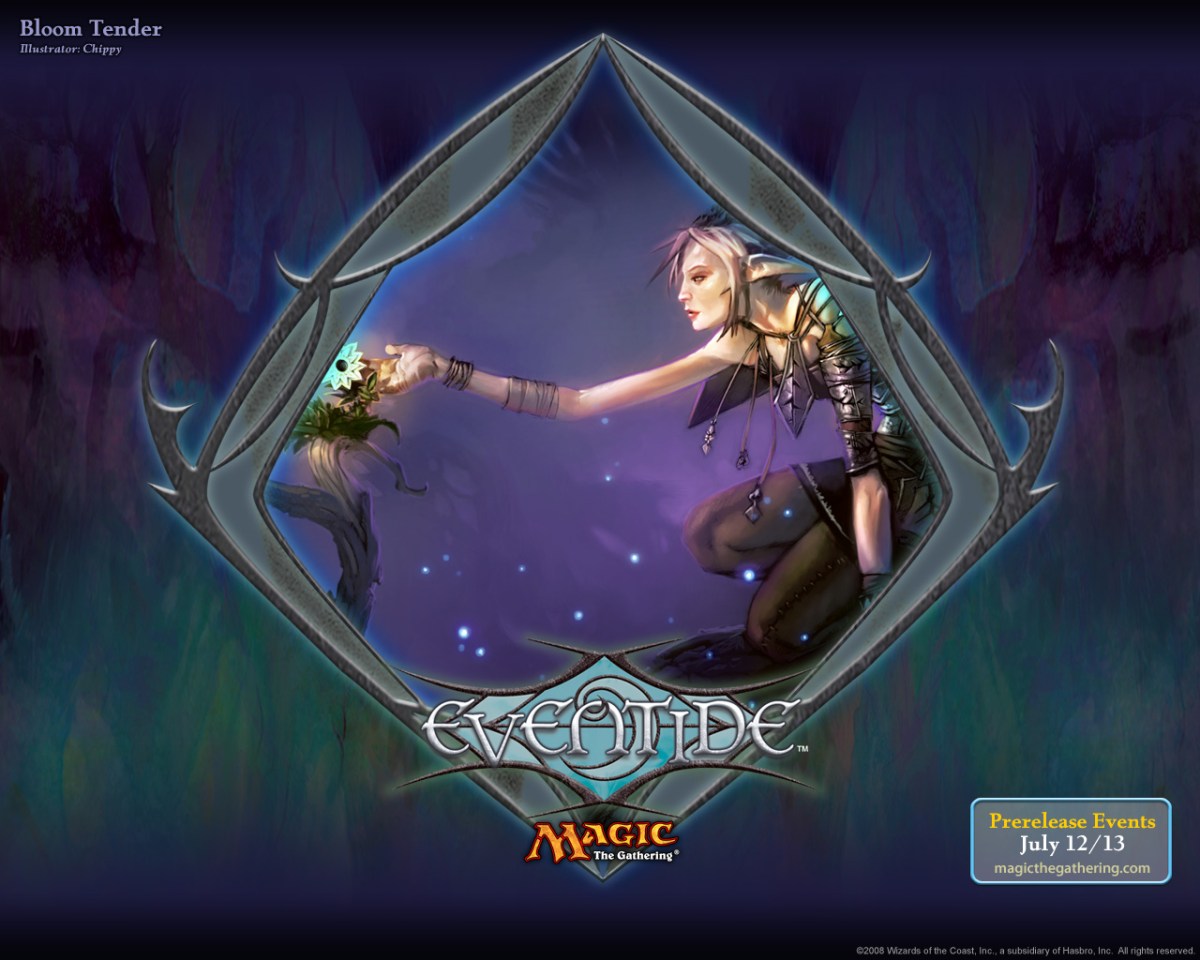
A beauty-obsessed elf tending to a bloom. All rights reserved to Wizards of the Coast and/or other respective owners.

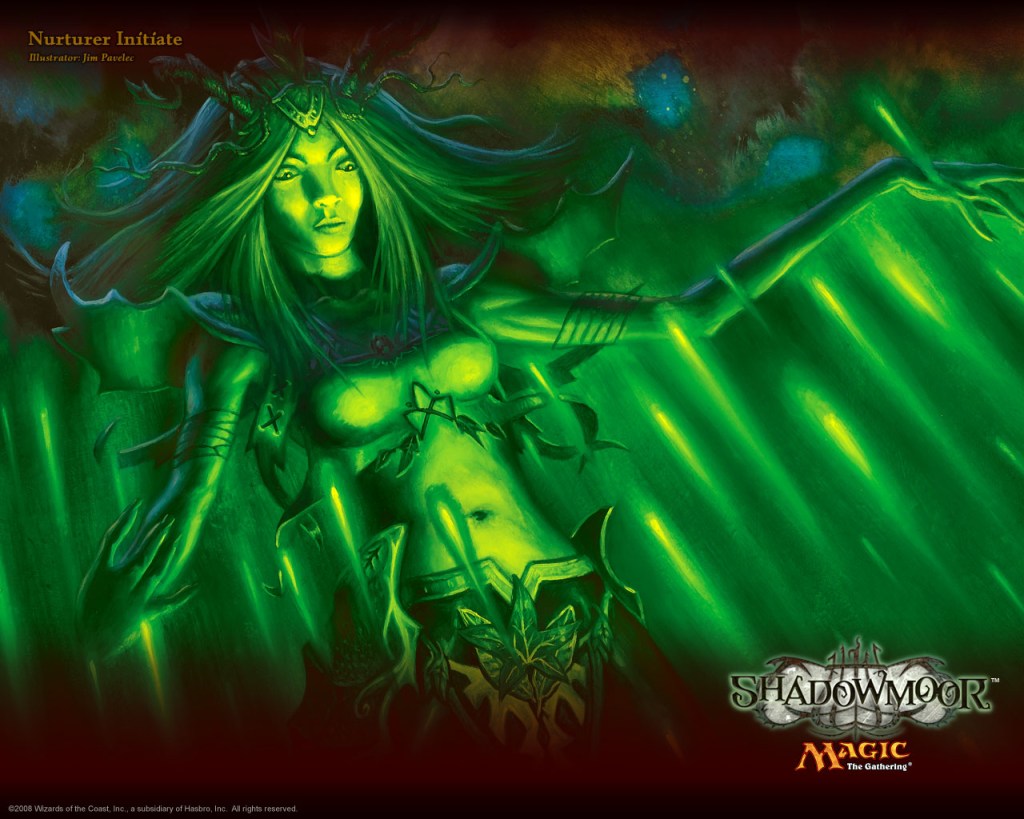
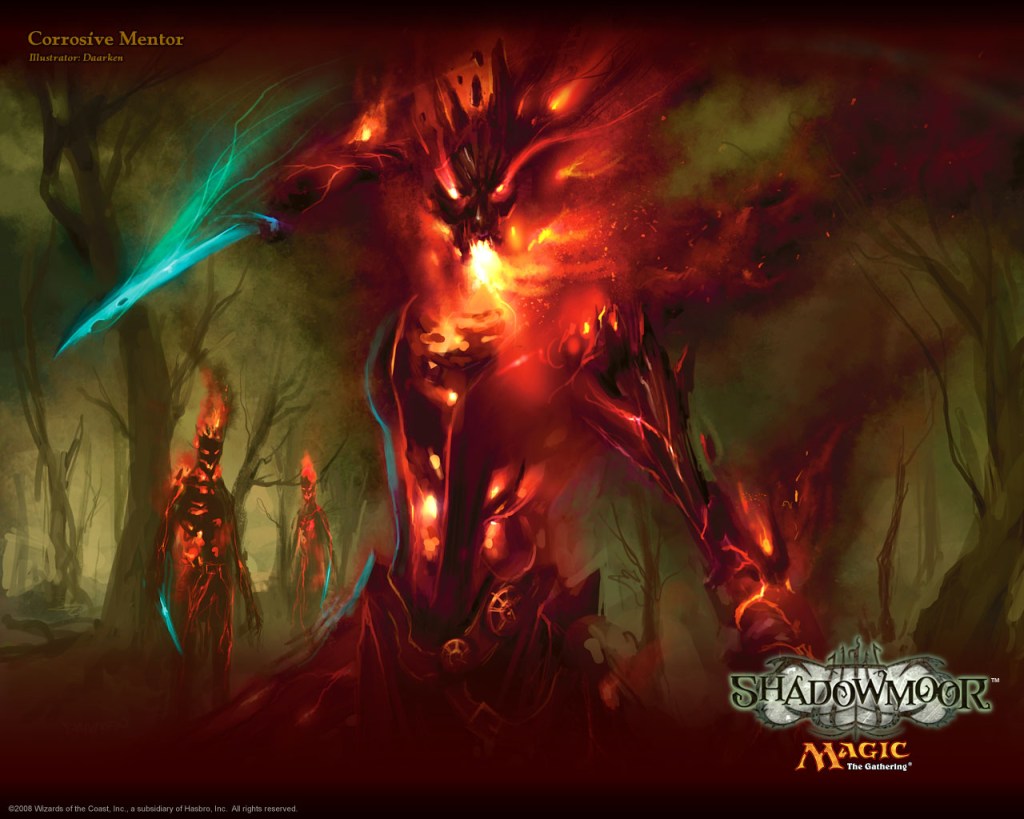
Hope you enjoyed those original wallpapers I saved from the Shadowmoor and Eventide releases back in 2008. Are you excited for the new Lorwyn/Shadowmoor sourcebook? Leave a comment and don’t forget to subscribe so you don’t miss the upcoming articles!

JAGS Wonderland

While writing about Lynchian gaming in the last month’s post I found out about JAGS Wonderland by Marco Chacon. It’s a free TTRPG about descending into madness and transcending reality. Or at least so it seems after some fifty pages. I have to say the book is wild. Though I consider myself not easily shaken, Wonderland made me quite uneasy. Well done. The rulebook references Lewis Carrol’s works heavily and combines it with secret agencies, aliens, cults, and conspiracies.

The cover for JAGS Wonderland. All rights reserved to Marco Chacon and/or other respective owners.

There’s a lot of thought behind the rulebook. It’s a game more suited for experienced players wanting a different sort of game than dungeoneering and monster slaying. It should be possible to do that in JAGS Wonderland as well, if anyone was so inclined. And vice versa you could probably use some worldbuilding elements and game mechanics from Wonderland in your game regardless of the system. Imagine Dungeons and Dragons with the “traditional” cosmology of planes replaced with that of Wonderland. Would you be interested in a setting like that?

I still have over a half of the first book and then the Book of Knots sourcebook to go through.There’s a lot of interesting stuff in this game and I will probably mention it from time to time in these summaries. And if there’s anyone with experience with JAGS Wonderland (or JAGS in general), leave a comment below!

Kickstarter

There are some new campaigns on Kickstarter that caught my eye. I will have to think some more before I pledge, but the least I can do is spread the word.

Firstly there’s the Blades of Gixa campaign by Quadra. It is the result of #Dungeon23 challenge by a person who actually managed to finish it. Those are quite rare, and from what I’ve seen on social media, Quadra’s work both looks great and is captivating to explore. The product should be system agnostic with some stats etc. provided by the author. Definitely worth a look.

Another campaign I am watching is the Heavy Metal Monster Manual by Greedy Gorgon Press. You might recall their earlier works, all of them with catchy names showing heavy influence by rock and metal bands and songs. What I’ve seen so far was funny and with lot of appeal to rock and metal fans, so don’t forget to check it our, if you’re so inclined. 

Miscellanea

I’m still working on the class options mentioned earlier, and the Arco review. Regrettably I’ve been neglecting both due to life and recently the spur to action caused by the Lorwyn announcement.

One thing I should not forget to state – I am in no way affiliated with any creators mentioned in this article. I am simply sharing my enthusiasm and there’s no compensation I get for this. That being said, I am waiting for your move, Wizards, I want in on Lorwyn!

As always, thanks for reading this far, and I’ll be glad for your thoughts in the comments section. Also please share this post on your favourite social media if you liked it, it means a lot!

January Behind

Estimated reading time: 6 minutes

With most of the articles still in need of some polishing, here’s a sort of summary of my activities and other stuff that happened in January. The blog is now active for more than a year, so onward to the next one!

David Lynch Died

… and the creative world is poorer for it.

Photo of David Lynch smoking
David Lynch at his Hollywood studio in 2002
Photograph: Chris Weeks/WireImage

I wanted to write a separate article, but found it redundant. After Lynch’s passing there was a myriad of articles summarizing his works, views, or talents. Instead I will share a few thoughts I have concerning David Lynch’s works that are relevant to this site.

The Weirding Dune

No matter how dissatisfied David Lynch (and the general public) was with his Dune, I loved the film. Probably a bit more as a child than I do now, but I still consider it a solid adaptation with a distinct style. There are more accurate adaptations (cheers, Syfy!), and it hasn’t aged that well. Some additions made by Lynch are unnecessary and some make no sense. But the surreal dreaminess goes well with Frank Herbert’s novel, and one can but wonder what would David Lynch’s Dune look like if he had full artistic freedom.

Kyle MacLachlan as Paul wielding the weirding module
Paul demonstrating the weirding module. All rights reserved to Universal Pictures and/or other respective owners.

The weirding modules used in the movie are one of the additions that are not needed for the story. According to some they actually cripple the image of Fremen as a fierce and powerful military force on their own, replacing their prowess with technology. I can agree with that, but I think the idea itself is neat. An item that essentially makes you into a Skyrim Dragonborn, providing you with the ability to kill with your shouts, is something I can imagine in a setting. In the movie I believe they could also set things on fire with the right modulation.

What are your thoughts on David Lynch’s Dune? And would you like something like the weirding modules in your game?

Twin Peaks

The legacy of Twin Peaks is massive, with lots of great creators citing it among their key influences. Having seen it as an adult long after it first came out, I can’t quite imagine the kind of upheaval the series caused at the time it first aired. For me it’s a masterful blend of Americana, horror, fantasy, and mystery. All wrapped in that surreal style called “Lynchian”, a label probably destined to have it’s meaning debated forever in the vein of “Lovecraftian”.

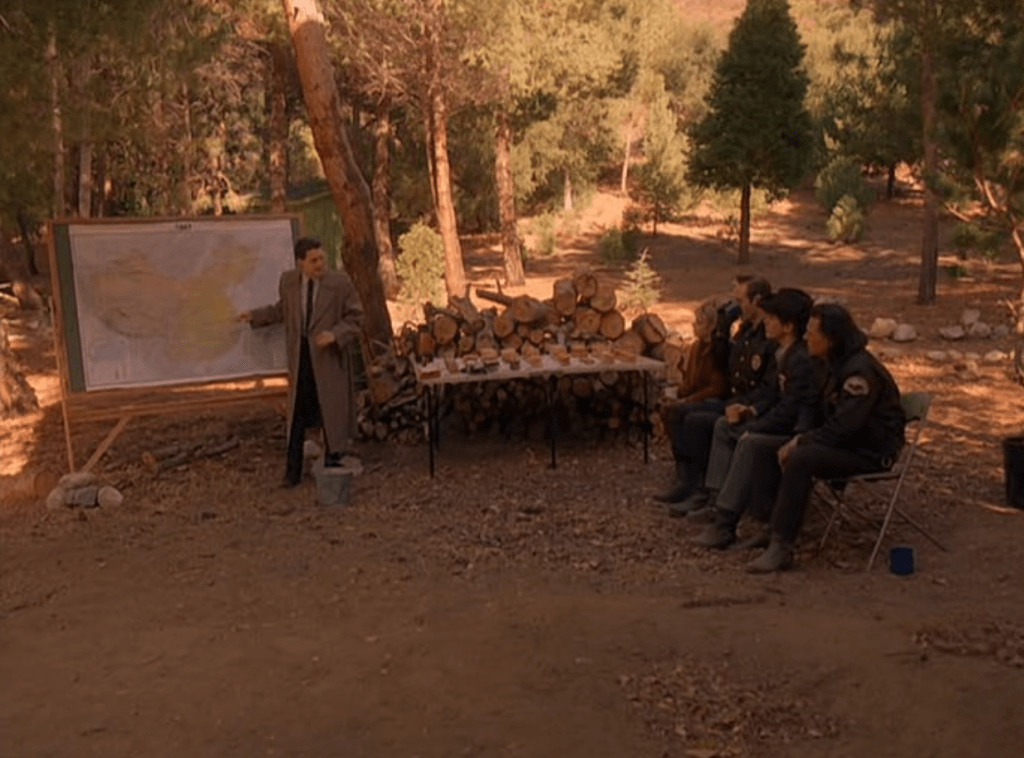
Kyle MacLachlan in front of a map of Tibet speaking to an audience made of Twin Peaks PD members
Agent Cooper presenting Tibet to local police. All rights reserved to CBS, Paramount, and/or other respective owners.

There are many reasons why I hold Twin Peaks dear other than the basic enjoyment of a TV show. Frost and Lynch’s blend of cozy and unsettling, grounded and esoteric, heartwarming and violent, makes for a unique atmosphere. It wouldn’t work just anywhere, though many great shows, movies and video games were inspired by Twin Peaks. As for TV shows, Carnivale and True Detective are my personal favourites, and Alan Wake is the one when it comes to video games. I’m mentioning these three because I also intend to write articles about them, in time. I’ve already touched True Detective Season 4 here.

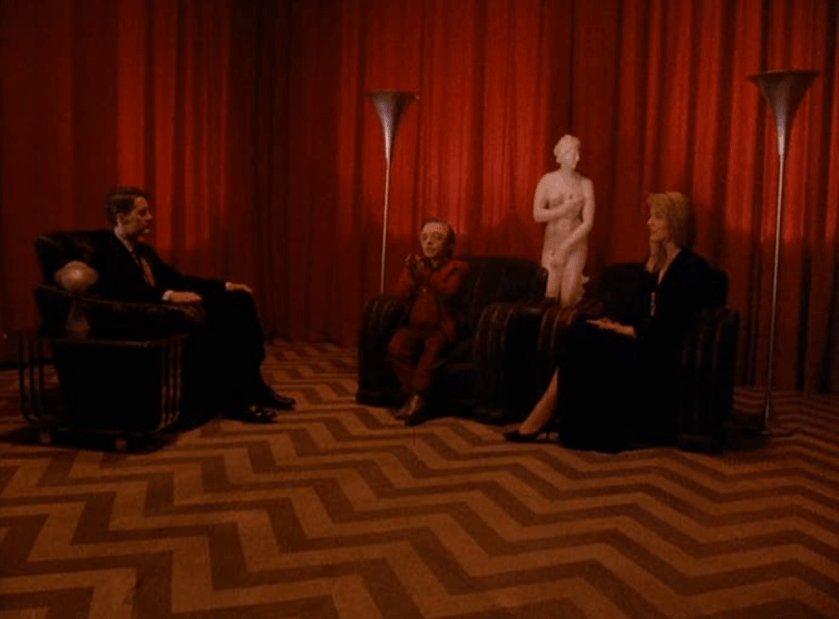
Scene from Agent Cooper's first dream in the Black Lodge with Th Man From Another Place and Laura Palmer doppelganger
The first dream in the Black Lodge. All rights reserved to CBS, Paramount, and/or other respective owners.

In dreams

David Lynch’s surreal style is great seen on the screen, but can it be translated onto tabletop? Some systems might be better than others, I can see a Twin Peaks-inspired game in World of Darkness, or Call of Cthulhu. But can you run a Lynchian game of Dungeons & Dragons, or Pathfinder? They are the kind of games where head on approach is preferable – you find monsters, you kill them, loot them, stick ’em in a stew… But the rules are not really accommodating to subtler modes of play.

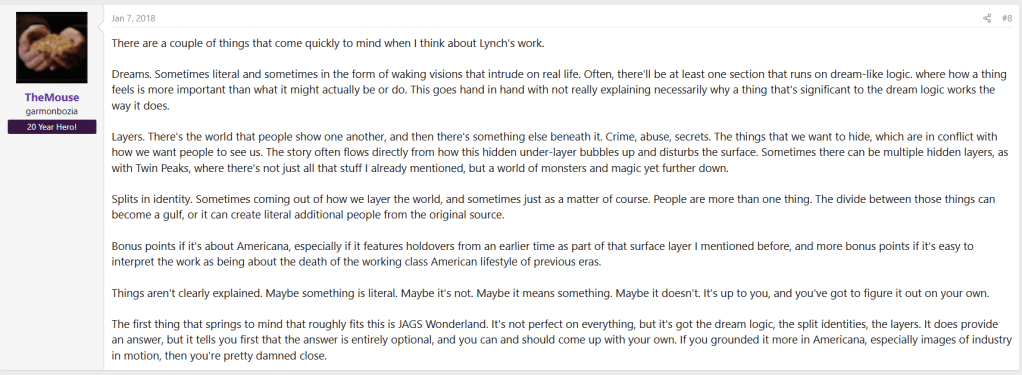
Screenshot of a RPGnet post describing Lynchian characteristis
A nice summary of Lynchian characteristics from rpg.net forums by user TheMouse.

If you want to try it anyway, above is a useful description of some Lynchian characteristics I found in an older thread on the RPGnet forum. Some are quite easy to achieve, others might be more difficult. A lot depends on your group, as always. I’ll also have to check some of the suggestions for other TTRPGs, such as JAGS Wonderland. If you are familiar with the game, leave a comment with your thoughts!

New subclasses

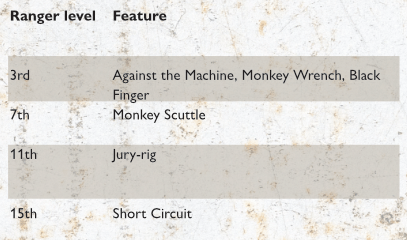
I’ve been working on a few options for 5e DnD, namely new archetypes for the existing classes. There’s a ranger conclave, and a barbarian path that are almost done. Also a bard college, and a druid circle that still need some work. To stay with the topic of David Lynch above, I’ve also been contemplating creating a Twin Peaks inspired subclass in the last few months. I’m not sure I’ll get to it, but Lynch’s passing has served as a reminder that I had plans in this direction.

Features of an upcoming ranger conclave
WIP features for the new ranger subclass.

Above is a teaser for the ranger conclave. It’s going to be less magical than those in Tasha’s and Xanathar’s. And a lot more setting-specific than your regular subclasses. While this limits its usability, I believe setting-specific options have their place in the game. If you play it once in ten campaigns, I’d say it’s still a win.

Arco

I’ve been playing this 2024 indie RPG in the last few weeks. It’s not that long, I just can’t dedicate that much time to gaming. However, Arco has it all: good story, great worldbuilding, humour. The graphics, soundtrack, and gameplay are just as great, though largely irrelevant for the kind of article I’m writing. I’m currently on my second playthrough, taking further notes, trying different approaches.

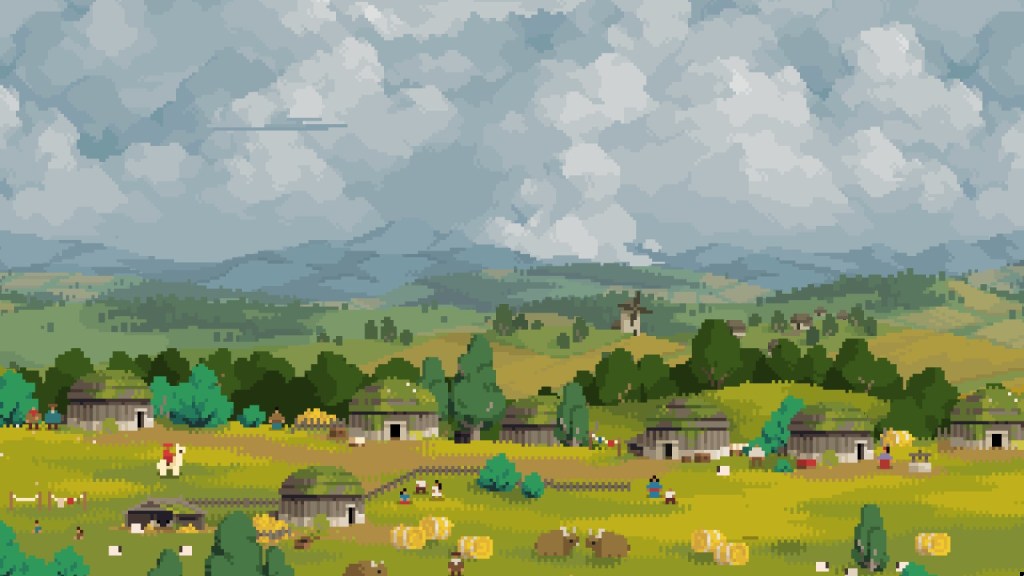
View of a peaceful village from the game Arco
The gorgeous pixel art of Arco. All rights reserved to Franek, Max Cahill, Bibiki, Fáyer, and their publisher Panic.

February

We’ll see what February will bring. I have too many unfinished projects on my desk and too little time to even write these short updates, but I’m determined to finish them.

What are you working on? Feel free to leave a comment and share this post on your favourite networks. It’s greatly appreciated. Thanks for reading and see you soon!

2024 in Review: Our Journey at Rashundai Games

Estimated reading time: 8 minutes

It’s already been two weeks since the world leveled up from 2024 to 2025. In another two weeks it will be a year since this blog has gone public with the first post. This will be a brief review of what this site achieved, what it didn’t, and what I hope it will achieve this year.

tl;dr

  • More frequent posting of shorter articles in 2025
  • Dungeon 24 continues on irregular schedule
  • At least 3 new Dungeon series articles planned
  • Whole new exciting series coming soon
  • Finally some game analyses!

Goals set and met

My goal when I started with this blog was at least one post per week. That changed to two per week with the addition of Dungeon 24. Which should get us at 104 posts total. And that’s not counting various random acts of writing I thought I would be committing.

There are 13 published posts on the site in 2024, far less than I expected. I’ve been quite optimistic, as I thought to have enough topics to cover, which was and still is true. What I didn’t have was the time to write all the longforms I envisioned. I am used to working with sources, citing (or at least checking) everything, polishing the language and revising if needed. When I publish something I want to be able to stand up for my work. The schedule I set for myself was rather unrealistic, as I’ve learned.

Dungeon 24

My apparent nemesis, the Dungeon 24 challenge. I stated in the beginning that this type of challenges isn’t really for me, and I was right. I managed for a few weeks but after that I started getting more and more behind the schedule. The last update was in September and it should cover the first half of March. I have more in my notebook, but couldn’t get to processing it for the blog.

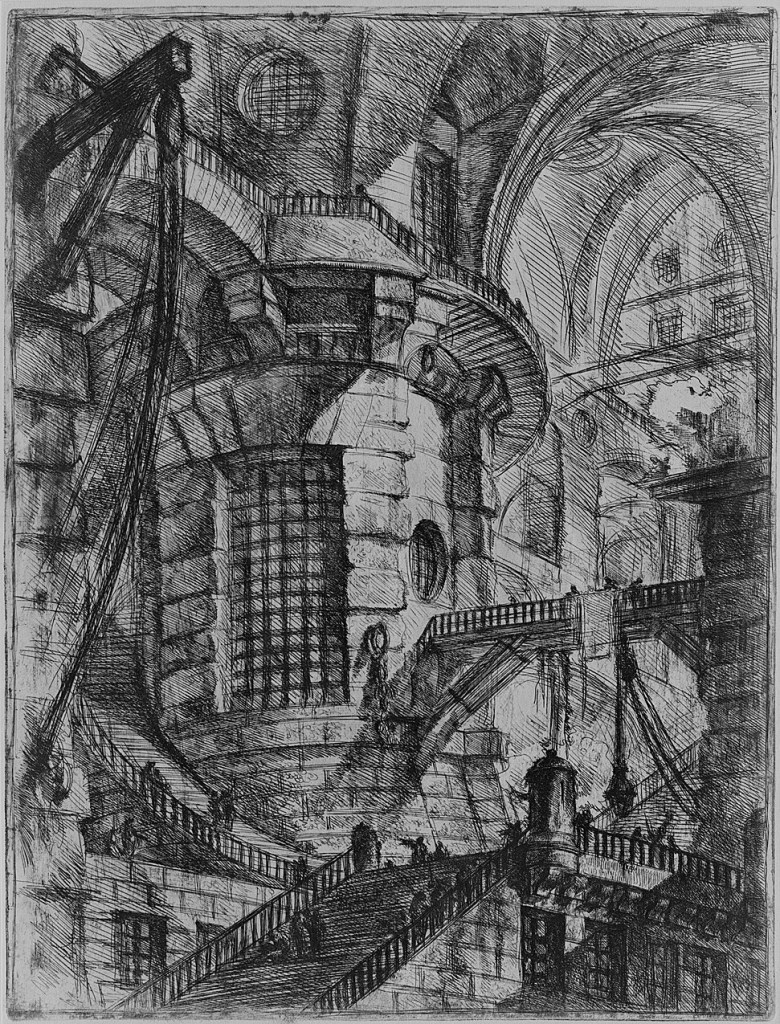
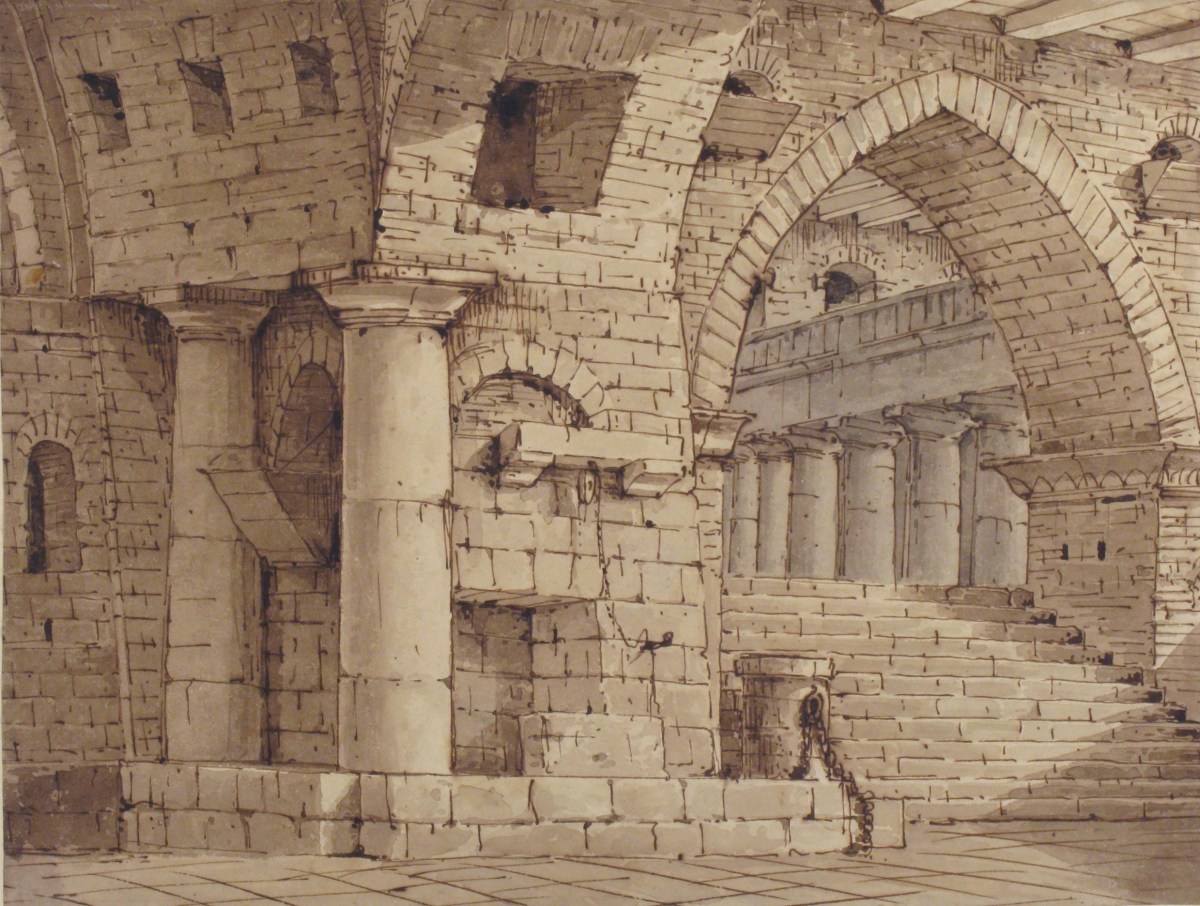
The Round Tower by Giovanni Battista Piranesi, 1761. An imaginary dungeon sketch.

Nevertheless I will continue with the dungeon this year until there are at least 365 rooms. There are still ideas I want to put in there, and I don’t want to leave it unfinished. It also serves as a laboratory and test tube for the Dungeon series of articles on this blog. The frequency of the updates will be irregular, same as with the other article types.

There’s one other thing worth mentioning. The article with the most views in year 2024 was the introductory post to Dungeon 24. Somehow my site is the number 3 result on Google, which is nice, I guess. I would rather have traffic for my other work, but if it helps people get to the site, it’s fine.

Dungeon series

I consider the Dungeon series the current flagship of the blog. The articles published so far offer my views on different aspects of dungeon design and functioning. In the three published articles I have discussed dungeon size and megadungeons, the way dungeons should and could be explored, and the Palimpsest dungeon concept. Dungeons, in their many forms, are an integral part of TTRPG experience for many, regardless of the system or setting. So far I’ve concentrated on fantasy settings, but many of the ideas presented in the articles should be useful for other types of settings as well. Anything can benefit from solid internal logic instead of theme parks composed of unrelated challenge sequences.

I have two more articles in various states of completion, that should be ready this year. In one I will elaborate on the Palimpsest dungeon concept. The other will deal with bringing life to the dungeon. At least three more exist as outlines on my to do list. These will deal with stuff like level interconnectedness and verticality, if that’s a real word. More topics will surely progressively arise from other activities, including the ill-fated Dungeon 24.

Different topics

Apart from the Dungeon series I managed to write three articles providing summaries of a certain topic. Each deals with a different area – settings, items, and general theory.

In Frozen Horrors I described a setting type notable for combining harsh environmental conditions and isolation with horror themes. I actually wanted to make several updates with more works, but didn’t find the time to do the necessary research. There are still movies, books, and video games that could fall into this sub-genre. Not all are suitable to take inspiration from, but that’s up to the readers of course.

Slingshots part I was a summary of this toy/weapon in various media. I’ve been particularly focused on how slingshots are explained and presented – viable weapon or novelty? Again there are other media that could have made the list, and I’m slowly working on an update. There will also be a Part II sometime this year, although it’s not a priority. It will deal more directly with the application of slingshots in your games and settings. I think an article on slings is in order as well, as a comparison between a real weapon that killed people on the battlefields versus what is a modern improvised weapon at best.

The article on using video games as a resource is a sort of necessary introduction to a type of article I plan on adding to the repertoire. As mentioned in the post itself, these won’t be game reviews as known from gaming blogs and magazines. Things like hardware requirements, controls, or replayability won’t matter as much as storytelling, ideas, and inspiration potential for your tabletop games.

What to expect in 2025

This year there are going to be some changes. There is a lot I still have to learn and fine-tune. So far I focused on longforms that required some research and thought on top of the idea and writing. This led to very sporadic updates. My goal is to be more active, so in addition to these longforms I will be posting shorter posts. Likely true blog posts with various thoughts and ideas that I might elaborate upon in the future.

I haven’t published any playable material, yet. There are several class options for D&D on my table I’d like to see finished, so these will have priority. Some need only cosmetic changes so they come in a nice package. Though it’s the contents, not the form, that matters, I wouldn’t want to publish it as bland text files. Other systems like 2nd edition Pathfinder and Mörk Börg will also receive some attention when possible. Unlike theory, which I believe to be mostly universal, different systems allow different supplements.

The main focus of the blog will remain on theory, as I intended from the beginning. For the longforms the Dungeon series will remain the main theme, so expect more in that vein. I have a few other avenues that I would pursue. Some I have outlined above, such as a follow-up to the article on slingshots. I also want to start another series of articles focused on different materials. Some that are readily available in most settings, some that are rare. I have some possibly controversial takes that might not suit everyone, but I very much look forward to exploring these ideas.

I will try to publish a few of the video game analyses I advertised. So far I haven’t finished any of those, even though I have a few in process. This year I plan on finishing at least some game articles. One hot candidate would be Arco, a fine RPG with a captivating Mesoamerican setting. Do check it out!

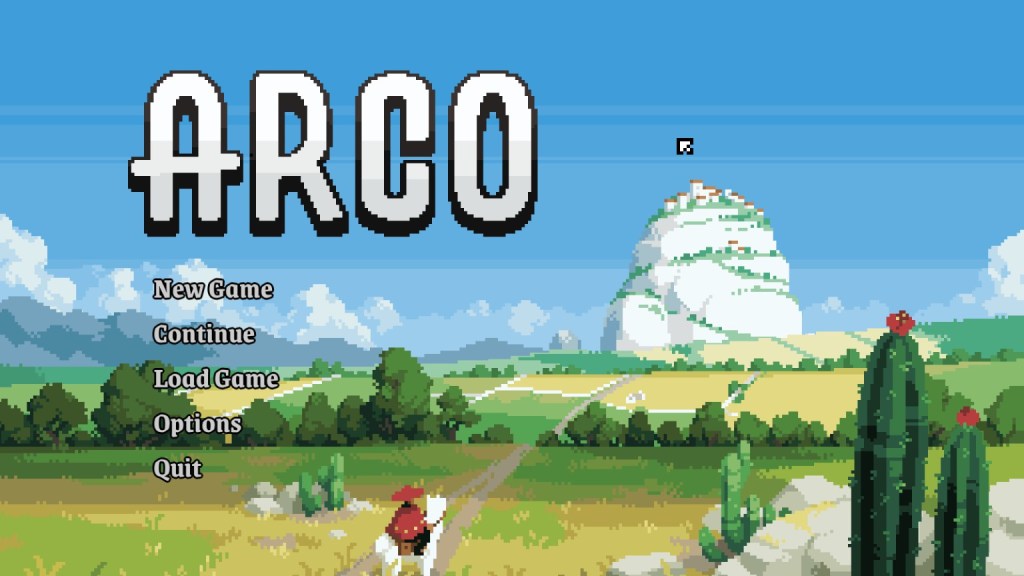
One of the menu screens. All rights reserved to Franek, Max Cahill, Bibiki, Fáyer, and their publisher Panic.

Final remarks

It would probably be a good thing to set concrete measurable goals for this year, though I am reluctant to commit to precise numbers. I think that with less focus on longforms and more shorter posts I could get at 30 articles this year. There will be the Dungeon series articles, and a new series that I’m keeping as a surprise until the first article is ready.

I also want to put more effort into promoting the site, so that it gets a little more life. For example the Frozen Horrors article had 3 likes out of only 4 views. This tells me that people find the stuff I write interesting if they find out about it.

With this in mind I would like to ask again to share the articles you like. We all have our networks and your sharing is the best way for the blog to spread. This is the kind of feedback I need to improve the site. That and the comments. Please take a moment to write down one or two sentences about what you liked, or even where you disagree. Having constructive discussions under the posts would be wonderful.

I would like to wish you all a fruitful and satisfying year 2025. May you achieve your goals and have lots of fun with TTRPGs or any other hobbies you have. Also take care of yourselves and your close ones, stay safe through the year!

Dungeons: Palimpsest Dungeon

What is a Palimpsest Dungeon, why make one, and what can it offer? How to make one, even? All this and more can be found in this article.

Estimated reading time: 9 minutes

This post is part of a series analysing several aspects of one of the recognizable parts of the TTRPGs we all love – the dungeons. The posts can be read in any order and they will be cross-linked when necessary. Throughout the series (and also elsewhere) “dungeon” is used as a technical term and can be used to describe any clearly defined environment containing multiple non-random encounters. These include natural caves, mines, keeps and castles, crypts, temples, ships and other vehicles, and many others.

This part will be about a concept that lends depth, complexity, and also integrity to your dungeon designs. What is a Palimpsest Dungeon, why make one, and what can it offer? How to make one, even? All this and more can be found below.

Palimpsest

One idea I strongly encourage is “palimpsest dungeon”. This paraphrase of the “palimpsest landscape” concept from historical geography or landscape archaeology seems perfect for creating interesting multi-layered dungeons that make sense. A “palimpsest” is a manuscript that had it’s original writing removed by scraping or washing and then overwritten with new text. Remains of the original text can be sometimes deciphered either by eye or by using modern recovery methods.

In landscape archaeology landscapes are viewed as results of successive actions by humans that have shaped the land. These activities include agriculture, construction, warfare, funerary and religious practices, and resource exploitation. Sometimes the old is removed, sometimes reused in a different way. This may be conscious and deliberate, or accidental.

A good example of palimpsest landscape would be a great barrow, where a warlord’s remains are interred. Rites are conducted on the site for a few generations. A thousand years later the warlord is long forgotten, and the local ruling class starts burying their dead around the barrow. Though of a different religion, they raise a shrine on top of the barrow and observe their own traditions there. After a generation the land is conquered and the conquerors strive to replace the religion present in the region. They remove the shrine and build their own on top of the barrow. After some events it becomes a site of pilgrimage, and a small temple complex is built surrounding the barrow. During construction some of the graves are unearthed and removed, but those untouched by foundation ditches remain. Eventually the site becomes abandoned, its purpose forgotten. New settlers come into the region and a small hamlet sprouts around the windmill built on a convenient mound.

Researchers “read” the landscape from the present backwards. Same as would a visiting party if they arrived in the hamlet described above. You on the other hand have to go from the beginning, setting the layers upon each other as you would a layer cake. With parts of layers missing, pockets of different stuff, and strange combinations. While you better not serve a cake like that to your birthday guests, your party should find it much more intriguing than a 20-centimeter high corpus of sponge.

Palimpsest dungeon

The same principle can (and should) be applied to dungeons. The “typical dungeon”, a complex of underground rooms and corridors, usually isn’t encountered in its original state. The mines were abandoned and overrun with monsters, goblinoids conquered the dwarven city, the once peaceful crypt has been taken over by a necromancer, etc. The layer encountered by the PCs is at least the second one, if not third or fourth. Even in a functioning dwarven underground city there might be parts that lay on top of older layers – old mine tunnels reused as fungus plantations, in turn overrun by mushroom-loving lizardmen.

Having more layers gives you depth on one hand, enabling more complex backstories, but also more options regarding the exploration of the dungeon. Old unused passages might offer shortcuts if found, burrowing monsters might create connections where there were none. Ancient temple underneath a crypt/monster lair/mine is an often used trope. And it makes sense.

Places are often settlet or used for a reason (no surprise there). That reason often stays valid for centuries, whether it’s military importance, environmental features, logistics, or anything cultural. On the surface, when we’re talking landscape, it’s obvious – hills, natural harbours, fertile fields, all these make sure a location will be settled again and again. With dungeons it’s similar. Natural caves will have their climate and water systems that make some areas more hospitable than others. Artificial dungeons were dug out and built with a specific purpose in mind, and this can be seen also by later inhabitants, even if used differently. Prison cells are effectively bedrooms, just not very comfortable. With some work a prison block can be used for living, especially if the beings living there are not too picky.

You might have already guessed that by creating all these layers you are in effect creating a series of dungeons with a common framework, but different contents. Not only it’s a fun exercise, you can also use these in different campaigns or with different groups.

Before you start making a palimpsest dungeon you probably have a few layers in your mind, possibly the latest one and the first one, or the most significant one. For a castle ruin it would be the present ruined state and the most interesting phase of its occupation, though there might be many different phases you want to take into account. Next you want to ask yourself questions such as “What happened between this and this?” or “How did it come to this?”, “What preceded this?”. During this process you might come up with further events leading to more layers.

Or not, not every dungeon needs to be multi-layered. Some dungeons in the sense of this article series aren’t meant to be palimpsests. You could treat a spaceship, or even a seafaring ship as a dungeon, and it would probably have just a single layer. Unless we’re discussing some kind of generation ship, or the Ship of Theseus. A tomb that’s been sealed since the burial also needn’t have more layers. It could be untouched by robbers, monsters, or anything else. The important thing to keep in mind is, as always, logic and consistency.

Keeping track

When designing a palimpsest dungeon it’s easy to lose yourself in all the layers. Especially in more complex and expansive dungeons it wouldn’t do to just note somewhere what the two or three layers are – you might have tens of layers, some only present in one room, others common for the entire dungeon.

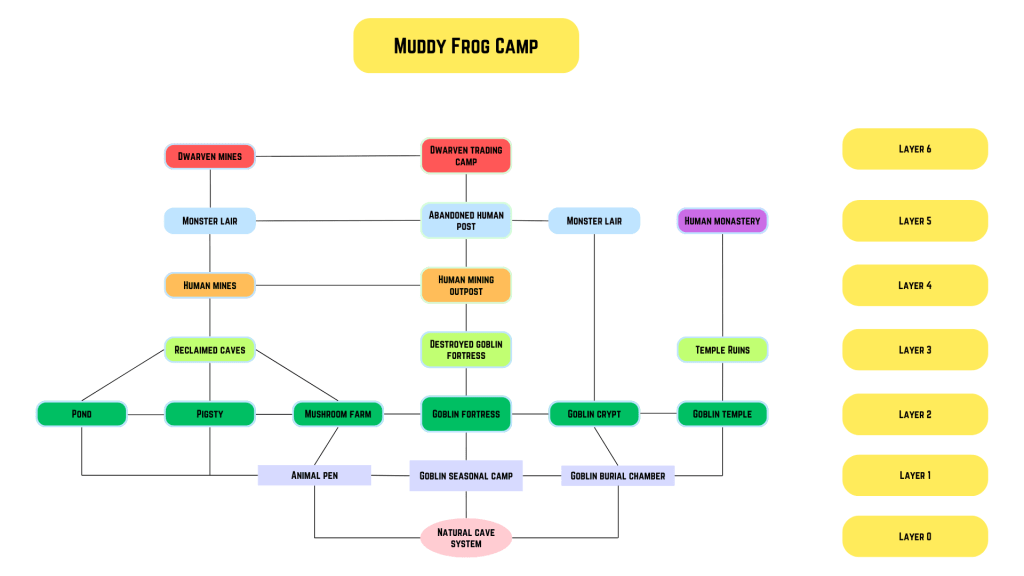
One way of keeping track is by labeling layers with a numerical code and making diagrams when necessary. You can find inspiration in the Harris matrix archaeologists use when describing contexts. Do you need to? Absolutely not, particularly not when you’re just preparing a one-shot dungeon for the Friday session with your friends. You might consider using stuff like this if you’re going to publish the dungeon, or if the dungeon is going to appear more than once in different scenarios.

a schematic showing different layers of a multi-layer "palimpsest dungeon"
Dungeon matrix for the Muddy Frog Camp, a dwarven mining and trading settlement.

Above is the matrix for a functioning dwarven settlement. Read from the bottom it shows the history of the site in chronological order. From top to bottom the order in which the party might uncover the past is shown. A more detailed overview will have its own article. Right now I can see that when creating the mine section of Muddy Frog Camp, I can use different layers from its past to flesh it out and create interesting encounters and environs. Traces of human mining activities, monster and animal bones, remains of animal enclosures. Creating the matrix (and past of the site) didn’t take that much time, but you can probably see the benefits already. The layers do not represent fixed time periods, one might span five centuries while another merely a few years. Some might also be invisible in the record, for example the mushroom farm or pond in our example, while others might leave a lasting and very clearly distinguished. The more permanent built-up areas such as the temple or goblin fortress are an example of lasting marks.

It is also possible to create a room by room matrix, and depending on the size of your dungeon, it might be a really extensive task. Again, if you’re going to publish your work, or reuse the dungeon in different phases of the campaign or different campaigns, it might be worth the time and effort. Otherwise the dungeon matrix above should be more than enough to help you create and keep track of your dungeon.

Conclusion

Palimpsest dungeon is a concept based on palimpsest landscape. Both describe the results of different consecutive periods of activity in an area, that build upon and sometimes replace the past activities. This creates a multi-layered environment that has depth, consistency, and a logical structure. The layers might be easily readable or only faintly detectable, both cases being useful for creating history and narrative.

To help with keeping track a “dungeon matrix” is proposed – essentially a diagram showing the layers of the palimpsest dungeon and its key characteristics. It is also possible to make a more detailed room-scaled matrix, but in many cases this leads to diminishing returns, as the amount of time and effort required would be inadequate to the benefits.

The terms “dungeon palimpsest” and “dungeon matrix” will be used on this site in future posts, so I hope you paid attention and that the explanations were sufficient. A post dedicated to the model Muddy Frog Camp is on the way, in which I will try to provide a more detailed overview of the whole process of planning, designing, and recording of the dungeon. Hopefully you found this article stimulating, I will be glad for any comments here in the comment section, or wherever you saw this shared. As always, thank you for reading, and if you liked the article, please share it on your social media!

Dungeon 24: Underground canal

Estimated reading time: 4 minutes (7 with room descriptions)

There hasn’t been an update for some while now, as life and work got in the way during summer. My Dungeon 24 is still alive though and I will post new parts of it when possible. We’re about six months beind the schedule, which should be fine as long as I change the pace to three rooms per day instead of one.

Last time we explored an abandoned temple of some forgotten pastoral cult. There was a breach in one of the alcoves with the sarcophagi of the priests opening into a natural cavern of some sort leading north. The other end of the cavern opens into a room in a style different than the small temple complex left behind, more similar to the upper level. Potentially deadly surprises await in both the natural cave and this maintenance cabinet of sorts.

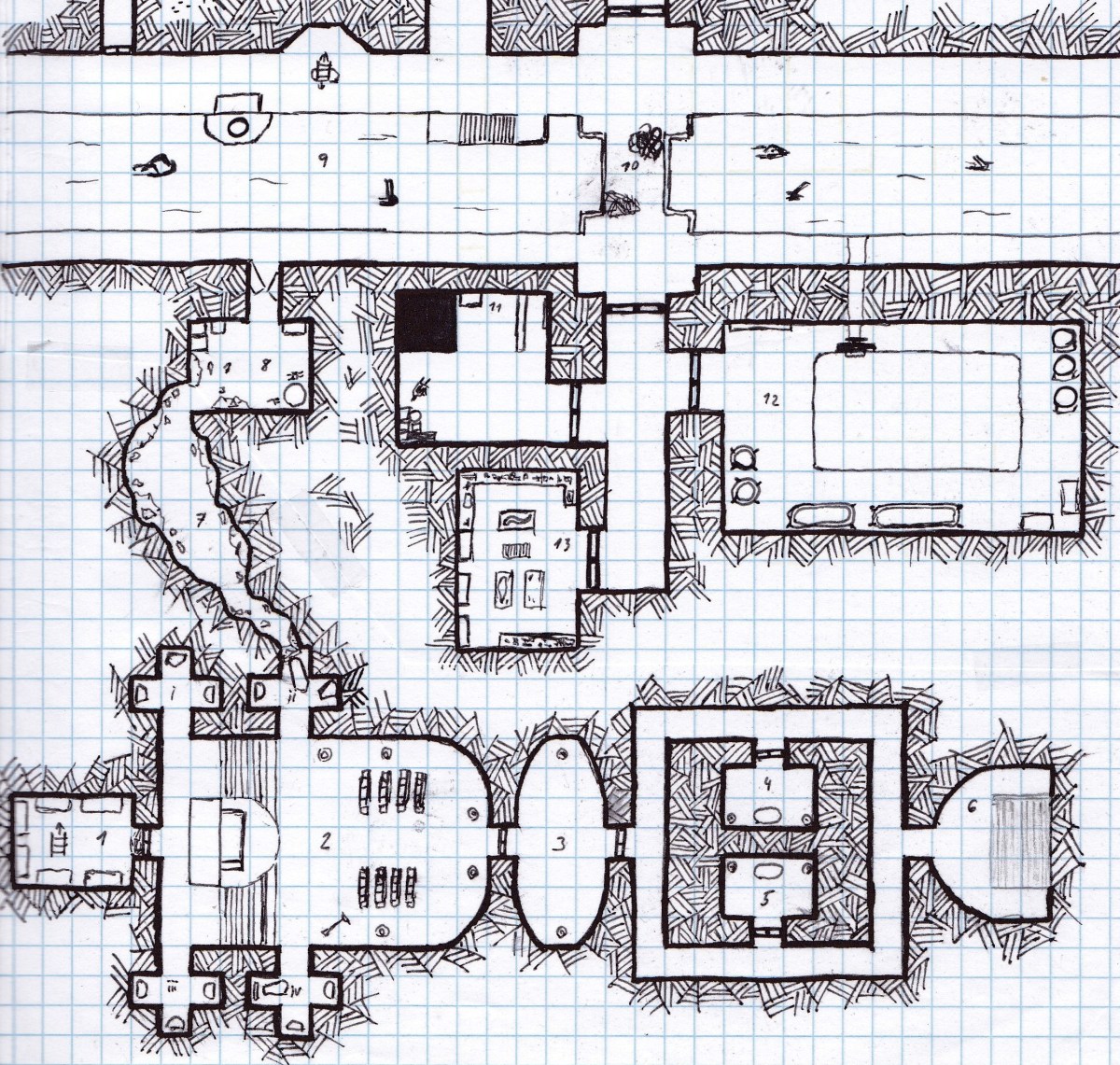
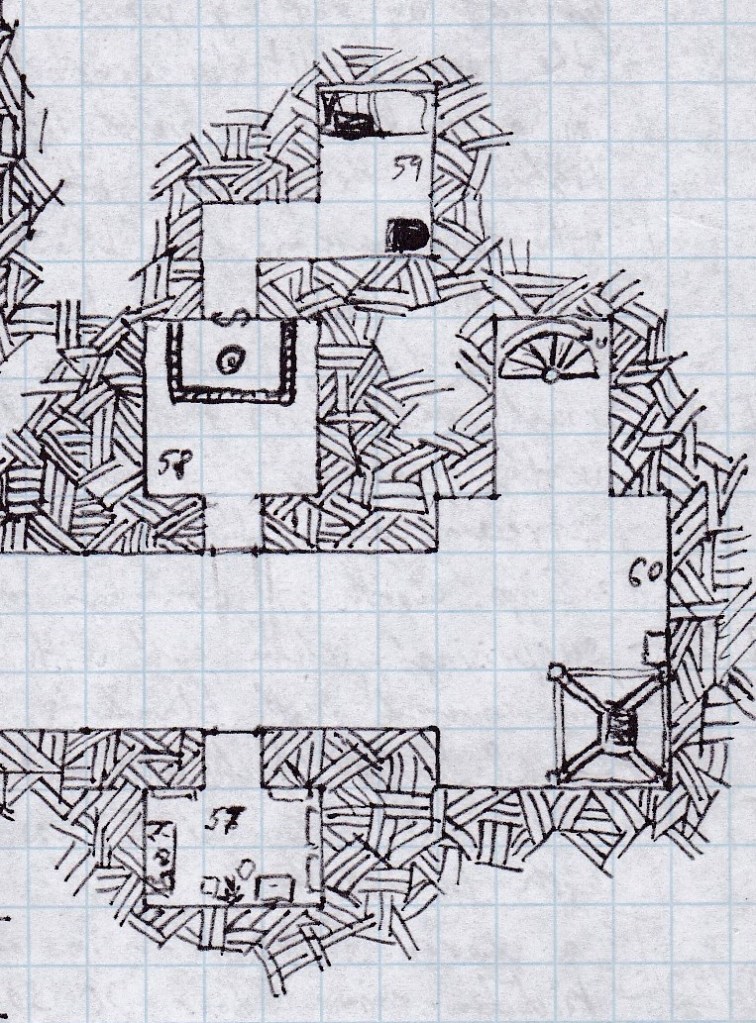
Behind the cabinet a spacious corridor opens, consisting for the most part of a water canal. The place seems to be some sort of access hub, with a ladder leading both up (II/59) and down, stairs for canal access, several doors and corridors. There is a bridge spanning the waterway that seems to be fortified by makeshift barricades. The canal itself continues a long way in both directions, with the current slowly moving westwards.

The floor so far. Goatherd temple in the south connected by a semi-natural cavern with the canal in the north.

South of the bridge there is a door opening into a short corridor with three more doors. There is an elevator lobby with a gaping pit where the elevator should land (the elevator being stuck one level above), infested by slugs from below. A strange room with a pool of disgusting water and similarly disgusting tubs and vats is behind the door across from the elevator room. Draining the pool into the canal reveals the remains of several spiky creatures, apparently long dead.

The last room on this side of the canal is locked. Opening the door requires the key or significant skill with mechanical locks. Behind the door is a relatively well equipped laboratory with plenty of alchemical apparatus, glassware and ceramics. Specimens spread the tables hint at a naturalist inclination of the occupant of this room.

Rooms

  1. Narrow natural cavern with high ceiling, both ends dug through by clawed limbs, heaps of rubble line the walls
    • E: One of the rubble heaps is a lurking rock slime, might attack loners or stragglers
  2. Small maintenance room, in SW corner a hole leading to natural cavern III/7
    • decrepit furniture – round table with 2 chairs in SE corner, several shelves and supply crates
    • E: one of the crates hides a sleeping juvenile otyugh – it is not immediately hostile but will defend itself when disturbed, running away through broken door to the north if things get ugly
    • T: 10-foot pole with a hook on one end in one corner; acid-resistant cloak under the otyugh
  3. Access and maintenance section of the underground canal
    • ladder leading up (II/59) & down
    • pump for the fountain above (II/58)
    • stairs leading into the canal
    • the canal is around 20 ft. deep, water is about quarter depth (5 ft.) and murky, odd stones, pieces of construction wood and other refuse stick out here and there from the slow but steady westward stream
  4. Bridge over the canal with barricades placed on both landings, alternate sides
    • T: Behind the barricade on the N side a half-full oil lantern can be found
  5. Elevator room
    • control panel is broken, the elevator itself is stuck one level above, blocking the shaft upward
    • the shaft downwards leads one level down after 30 ft.
    • counter in NE corner, behind a shelf with remains of stamps and ink bottles
    • the whole room is slimed over
    • E: at any time 1d4 large and 1d10 small slugs are crawling all over the room, entering from below, not hostile
    • T: 2 usable intact stamps and a full ink bottle on the shelf
  6. Large room with a pool and several vats and tubs of varying sizes
    • pool connected to the canal by a pipe, there is a lock mechanism operated by a wheel – needs a bit of oil but operable
    • the pool is 10 ft. deep, half-filled with stinking soupy water, clumps of mold floating on the surface
    • when the lock is opened the pool is drained into the canal and the remains of 6 cave urchins appear, all dead for some time
    • the tubs and vats contain mostly disgusting fluids of greenish or yellowish tint, only one contains a skeleton of a small humanoid covered in strange bite or claw marks all over the bones
  7. Locked (DC 35) laboratory, mostly intact and possibly still in use, with oil lamps ready to be lighted around the room
    • counters around most of the room, 3 large tables in the center
    • on one table a dissected slug, one other occupied by a large tentacle
    • floor grill in the middle of the room leads down one level to the sump

This is it for the southern side of the canal. Next update will look behind some of the doors that can be seen across the waterway. I’m keeping the descriptions quite vague for now, but there should be a picture slowly coming together. After all this is done, I will compile everything together with more explanations and a lot detailed descriptions.

As always thanks for reading this far, feel free to comment and share or your favourite social networks, and don’t forget to follow us so you don’t miss any updates!

Dungeons: Size matters

Estimated reading time: 9 minutes

This post is part of a series analyzing several aspects of one of the recognizable parts of the TTRPGs we all love – the dungeons. The posts can be read in any order and they will be cross-linked when necessary. Throughout the series (and also elsewhere) “dungeon” is used as a technical term and can be used to describe any clearly defined environment containing multiple non-random encounters. These include natural caves, mines, keeps and castles, crypts, temples, ships and other vehicles, and many others.

This part will be about dungeon size. Why does it matter, what should it be based on, and what other aspects of gameplay should be based on it. And of course I will mention megadungeons as well.

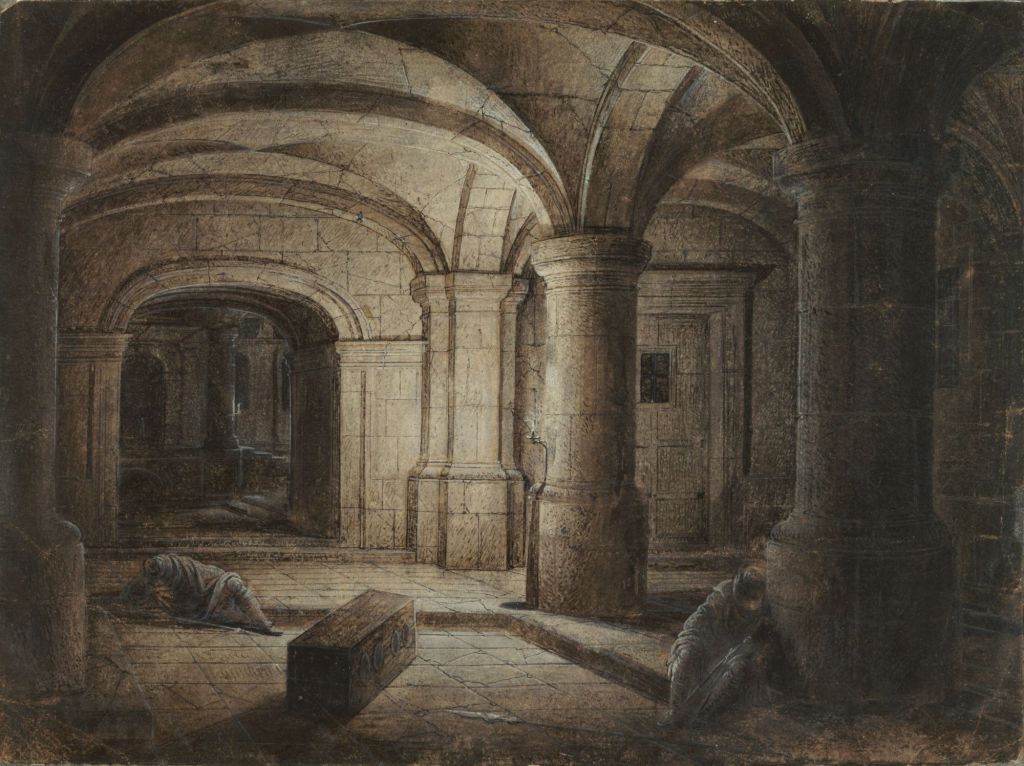
The Crypt of a Church with Two Men Sleeping by Hendrick van Steenwijck the Younger.

Dungeon scale

How large should a dungeon be? Obviously that should correspond with the needs of your story and plot, but let’s say you have that figured already. Then the size depends on the dungeon – a small local monastery will be different from a regional centre of an order, as will an emperor’s tomb differ from that of a struggling merchant. Some places should be smaller than people expect, while others are often imagined too simplistically.

Often used as dungeons are various underground settlements, whether it’s a dwarven delve, or a goblinoid den. The space required would depend on the social structure of the inhabitants, and the range and scope of activities present. Though it is by no means a rule, more (economically) complex societies usually take up more space. In less complex societies there might be little to no distinction between communal areas, food preparation areas, work areas, and sleeping quarters. Your primitive goblins might occupy a couple of natural caves with only one of them different from the others, taken by their leader. In contrast a dwarven delve would have many separate sections with different purposes, and you probably wouldn’t find a craftsman preparing food in the same room he works in. Even a workshop could have multiple rooms or even levels, and of course housing could range from Spartan-style cubicles to lavish many-roomed residences. Fifty goblins might take up three to four caves, while fifty dwarves might use three to four rooms per unit just as housing (family or individual). Best keep that in mind when designing settlements.

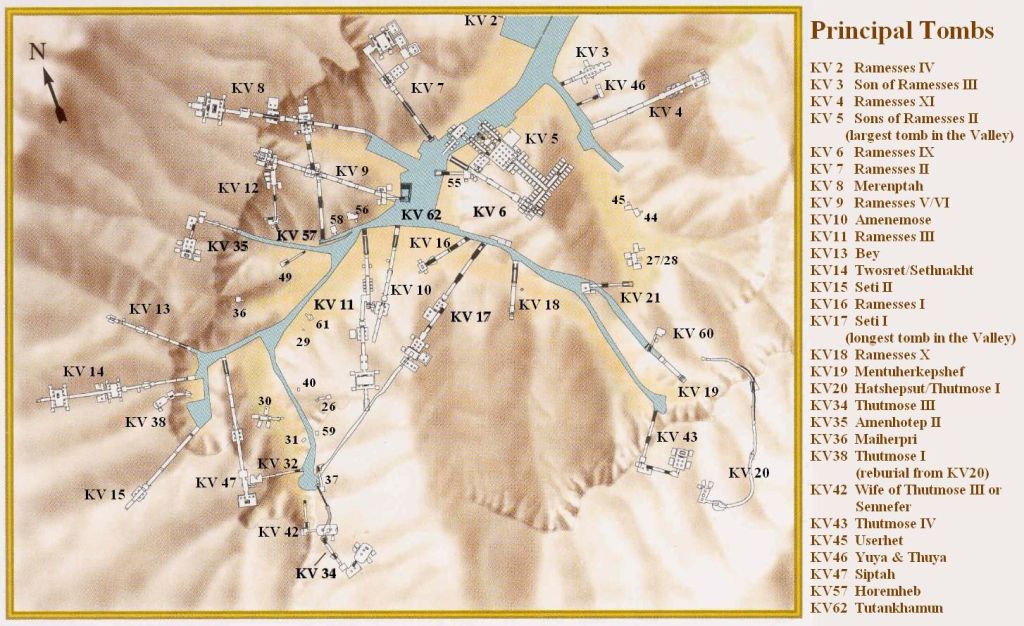
What about tombs? It really depends on their purpose, among other things. When a tomb serves only to inter the remains of a deceased person, you don’t need a lot of rooms – maybe one burial chamber and some room(s) for burial goods, even though these can take up a lot of space in some cases. It is different if the tomb is a place where rituals are still performed – the number of rooms can grow if you have to accomodate the living as well as the dead. Below is a map of the Valley of Kings, where you can see the plans of each tomb. A more detailed interactive version can be found on this great site.

Map of the Valley of Kings with miniature tomb plans
Map of the Valley of Kings in Egypt with miniature tomb plans. All rights reserved to Journey to Egypt and/or other respective owners.

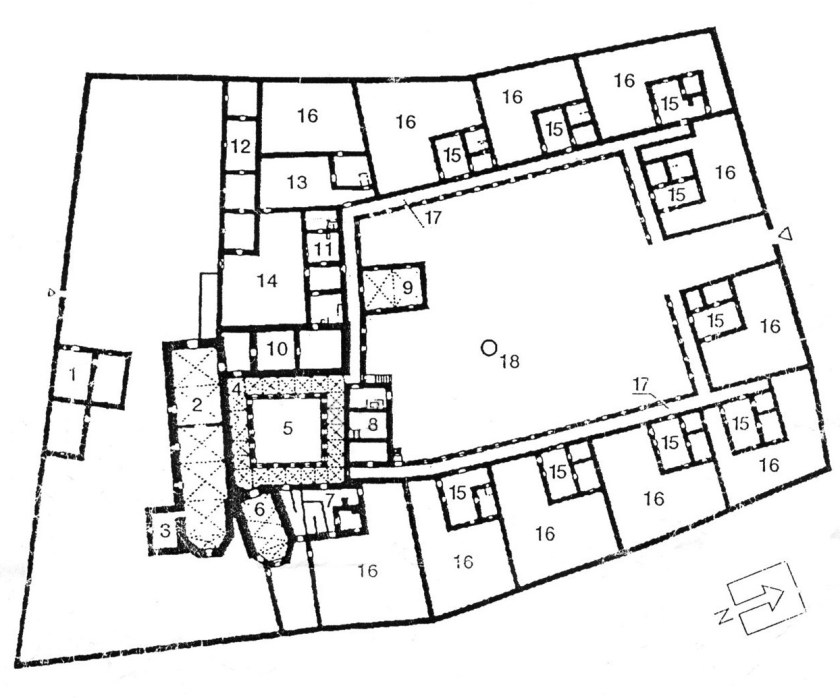
With this we get to temples and shrines. Again a temple needn’t consist of a great number of rooms. A main room (think nave in churches, or naos in Ancient Greek temples) is quite enough for many forms of worship. Often some additional rooms such as a shrine or sacristy will be present. If the temple is part of a monastery, the room count will be significantly higher – a monastery for 15 monks can easily have around 70 rooms, including spaces like gardens.

Plan of a Carthusian monastery
Plan of the Lapis Refugii Carthusian monastery in Slovakia. For the descriptions and lots of other information visit the site. All rights reserved to Kláštorisko, c.a. and/or other respective owners.

Room categories

Let’s say you make a dungeon with 20 rooms and only three are vital to the quest, and maybe another five you can imagine as optional. In a very simplified treasure hunt the three would be the key room, the guard room and the treasure room. You have to get the key, then defeat the guard and then take the treasure. Along the way you would find optional rewards or encounters. But there should be more rooms than those, simply because that’s how it would be. In a castle there would be living quarters, kitchens, dining rooms, bathrooms, armories, storerooms, music rooms, libraries and studies, workshops, and a whole lot more that needn’t be part of the quest. But they of course could be. An enemy from an important room might flee to an originally unimportant one, but now the bathroom has purpose as well. More rooms also means more potential for exploration, which some players might find more interesting than encounters.

It surely is a lot of work and it might seem like a waste of time if you don’t even plan on the party visiting the extra rooms. But like in the #Dungeon23 and #Dungeon24 challenges, rooms don’t have to be described with twenty sentences each. Simple “pantry” or “servant bedroom, empty” will do, and you can always come up with something should the need arise. If the room wasn’t important in the first place, you needn’t make it too much detailed all of a sudden. Random charts and generators could help, but they make things, unexpectedly, random. So not for everyone and every setting.

When preparing a dungeon it is wise to note which rooms will be essential (main quest), which will be optional (side quests or bonus loot, lore, etc.), and which rooms are there because it makes sense, but they don’t have much to do with your adventure.

Room effectivity

Sometimes five well-crafted rooms offer more than three dozen dull ones. The amount of time the party spends on one room will of course vary. We can call this “room effectivity”. The important thing is to focus on productive time, i.e. time spent progressing with the plot, learning about the world, obtaining gear or resources. Not all combat encounters are productive, although they certainly can increase the time spent in a room.

Non-combat encounters increase room effectivity nicely. A prisoner in a cell, or a hermit angling for blind fish in an underground lake might offer clues, sidequests, or at least a nice change of pace from exploration. They can be revisited to fulfill some errand received (getting keys for the prisoner). Or the NPC encountered might have answers to something found further in the dungeon. The hermit might know a lot about his surroundings, even if he keeps to the lake. He might even know about another way into the underground city, now that the main tunnel is blocked.

Puzzles also count. We can divide them into two main groups – environmental puzzles, and designed puzzles. I will dedicate another article to puzzles entirely, so here I will just say that by designed puzzles you can understand various mechanisms that have to be overcome for something to happen – these often don’t make sense in a dungeon. The environmental variety is created by circumstances and environment. When the drawbridge is broken the party needs to find another way across the chasm, perhaps using stuff found around. Both varieties increase room effectivity and therefore the time spent in the dungeon.

One of the worst puzzles in Atlantis: The Lost Tales by Cryo. All rights reserved to Cryo Interactive Entertainment and/or other respective owners.

Megadungeons

One of the issues I’d like to address, especially since this series of articles is based around the challenge aiming to create a megadungeon (see Dungeon 24). Megadungeon is a concept that promises sessions upon sessions of exploration and encounters. It’s one thing to create room after room, level after level, filled with whatever seems interesting at the moment, and another thing for the whole to make sense. What’s the relation between levels 2 and 10? How do they (that is, their inhabitants) interact? Why are there 12 (or 50) levels, anyway? Why is there an elven tomb sandwiched between an orc fortress and dwarven mine?

Settlements can easily give you a lot of rooms – a small community of intelligent beings can occupy hundreds of rooms. I suggested earlier that structures with lots of similar rooms such as settlements, necropolises, or prisons, are good as a backbone for your megadungeon. Be careful not to overdo it by making the whole dungeon one large prison with hundreds of similar cells, or a large dormitory with copy-paste rooms. First of all keep in mind that even such places needn’t be completely uniform in their design, even if only thanks to time and use. Misuse, decay, and damage can also bring variety to an otherwise repetitive spaces.

One thing that makes megadungeons believable, interesting, and less randomly put together is a concept I’m borrowing (and reverse-engineering) from landscape history researchers, such as landscape archaeologists and historical geographers. I call it “Palimpsest Dungeon” and there will be a whole article dedicated to this, so I will keep it rather short here.

The core principle is that a Palimpsest Dungeon has multiple succesive layers (not levels!) that overlap. Each one can change the one(s) below in its entirety or just partially, and new qualities can emerge from the interactions of these layers. This way you can get a dungeon that is ancient, extensive, and full of things to explore without it looking like you just wanted to create a massive dungeon.

Conclusion

Regarding dungeon size first and foremost think how large it should be while still making sense. Don’t create temples that have hundreds of rooms just because you want the dungeon to last a few sessions. Either use sensible sized dungeons (whether it’s a tomb, temple, mine, whatever) and maybe make the exploration and encounter parts more complex. Use non-combate encounters and puzzles to make the dungeon last longer. Or create a Palimpsest Dungeon with multiple overlapping layers, if you absolutely need to have 18 levels and 486 rooms.

What’s your take on Dungeon Size? Do you prefer sensible dungeons, or just want lots of rooms to explore and defile? Are you perhaps one of those rare characters who strive to create expansive dungeons that make sense? Leave a comment and share with your friends!

Resource: Video Games

An introduction to video game analyses that will be appearing on the blog. More coming soon!

Estimated reading time: 9 minutes

Video games and TTRPGs have a long history that needs no introductions. Many great computer role-playing games (cRPGs) are based on TTRPG systems or at least their settings, as you probably know well enough. Like other media, video games can be a great resource for your game, and sometimes the less obvious choices can be more interesting. Everyone got some inspiration from some cRPG they played, but great gems to add to your game can be found in any video game genre, and even in those that are not really good as video games.

The other strong point I’d like to make is that video games are very accessible and in my opinion can make TTRPGs more accessible as well. Not everyone starts with ASCII Dwarf Fortress or Space Station 13, but there are tons of games even casual gamers or non-gamers recognize. You are probably thinking about some examples right now. On the other hand not everyone who wants to play TTRPGs is a devoted tabletop gamer, well-versed in all the editions and different systems. Many times your friends are not even avid readers, having read perhaps Lord of the Rings or Harry Potter because everyone read it at the time. They might play video games though, and through them you can explain TTRPGs, whether it’s the mechanics or general principles. I know I have had players whose only connection to TTRPGs was through video games, and the experience helped them get into tabletop gaming.

In this series of articles you will find not exactly reviews, but rather analyses of different video games. Sometimes they will be in-depth, sometimes I will only cover a select mechanic, piece of lore or storytelling, or just make stat blocks for a few interesting monsters. The selection of covered games is not really governed by any principle other than what I find interesting to write about, but if there is a game you would like me to have a look at, please leave a comment and we’ll see about it!

Genres

As I stated above, the obvious genre choice is cRPG. Some amazing titles fall into this category and surely some of them will appear on this blog. There is, however, more to video games than role-playing games, that can be used in your tabletop games. The closest to cRPGs in terms of TTRPG relevance is the triad of adventure, action, and strategy games.

Adventure

Adventure games usually share much with cRPGs in terms of rich story and worldbuilding. What’s usually missing is the progression of the main character(s), but even this is not always true. Adventure games also often rely on puzzles and item combination rather than combat or other contests. Exceptions exist, but generally the are not that common. There are action adventures where there’s combat and platforming interwoven into the adventuring part, like the Legend of Zelda games. There are RPG-adventure hybrids that are not exactly RPGs, but contain many RPG elements, such as character selection, levelling, and combat, with the Quest for Glory series being a wonderful example.

The very beginning of the VGA Quest for Glory I. All rights reserved to Sierra Entertainment and/or other respective owners.

Obviously you can take inspiration from the story, puzzles, or characters in an adventure game. You can also focus on the visual side of these games. Unique environments, fantastic creatures, or spectacular spell effects all find their place in adventure games. Especially in later 90’s and early 00’s with studios such as Cryo there has been a trend of beautiful graphics and wondrous locations that can give you a creative boost.

Action

Action games come in many flavours, from simple shoot-’em-ups or fighting games through platformers and shooters, metroidvanias and souls-likes, to action RPGs. They even differ inside their category, mainly when it comes to depth of the story and worldbuilding. Story is not top priority in these games, but there are exceptional titles with top-notch storytelling – pick any title from Supergiant Games for an example.

Even if an action game isn’t an “action RPG”, RPG elements are often present. Most of the time it’s some form of character progression or selection, and equipment management. Having multiple choices isn’t that common, though again, not unheard of.

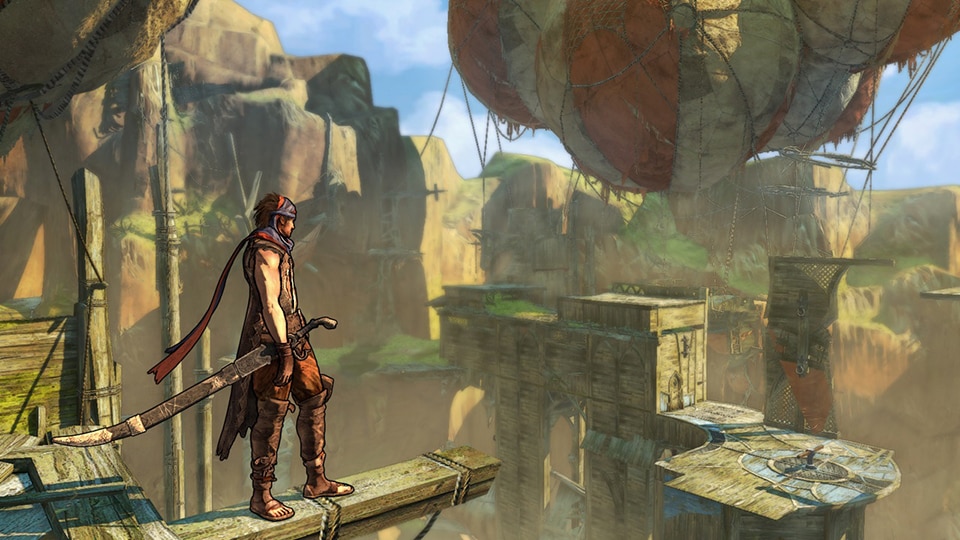
The Prince enjoying a beautiful view in Prince of Persia (2008). All rights reserved to Ubisoft and/or other respective owners.

The various subgenres offer different experiences, but concerning what they can offer your tabletop gaming needs, they are quite similar. Environment and level design, puzzles, enemies, weapons and spells, or character options are some of the features that can be found in most action games. Of course the weapons will be different in a shoot-’em-up like Tyrian from those in Doom or Prince of Persia. The environments will also be of a quite different scale. Can you use them all for inspiration? That’s up to you!

Strategy

As with action games, there is a large spectrum of strategy games at your disposal. The basic distinction is whether they are real-time or turn-based, and this often dictates other parameters of the game. They can be peaceful with little to no fighting involved, or full-scale wargames. The emphasis can be on tactical decisions or large-scale strategy, micro- or macromanagement. Whatever the case, usually there is enough inspiration to be found for your tabletop game in any strategy.

Tactical strategies are often closest to TTRPGs, and the inspiration probably works both ways. As with action games, you can pick enemies, weapons, spells, and all sorts of other options from tactical strategy games. Whether real-time (Commandos, Desperados) or turn-based (UFO, Jagged Alliance, The Banner Saga), they offer plenty of options that can inspire you. RPG elements are often present in the turn-based camp, not so much in real-time games.

Builders such as The Settlers, Cultures, or Anno series offer different scale and experience. While combat is commonly present, it’s usually much simpler than in tactical strategies, and only supplements the main focus of these games – building settlements, bases, kingdoms. Exceptions exist, with Stronghold being a good example of a builder with heavy emphasis on combat of the siege variety. Usually mid-scale economics play a large part in this type of games. They can be used as an exercise in settlement design, and for learning how to think in a slightly larger scale than party-level in your worldbuilding.

Just another day in Crusader Kings 2. Also a good plot hook for your next adventure. All rights reserved to Paradox Interactive and/or other respective owners.

The 4X or grand strategy games are the next step in scaling upwards. Often the focus of these strategies are whole nations, worlds, or planets. The Civilisation series and games by Paradox Interactive are good examples of this subgenre. Again you can get inspired concerning the large-scale matters of your TTRPG. The way kingdoms and empires interact, the issues that need solving both inside and across borders – all of this you can try out in this kind of strategy games before using at your table. Just start a game of Crusader Kings, let the time flow, and you’ll have tons of ideas for your setting in the first ten minutes.

Other genres

What other video game genres you can get inspiration from? Well, the obvious answer is “anything you feel inspired by”! Like racing games with car tuning and championships? Maybe you can use similar ideas but in your game it’s chariots instead of racecars. What about other simulators, such as train simulators or fishing simulators? I bet you can see where this is going. You can also cater to your players’ preferences if you know what genre they like and add just a few noticeable traits from there.

What to use?

You can choose between two approaches. You can lift an element as it is in the source game, i.e. a monster, and use it at your table. Give it stats, maybe figure out its place in your world. Your players will recognize it and either scold you for laziness or praise you for using something they liked elsewhere. Best make sure the second option is more probable before you do this. If you know your players you might have an estimate, but you probably don’t want to do this for your first session with a new group. Either way you should be careful with this approach, as after the twentieth monster and fifteenth item from the games your players love, it might get quite annoying.

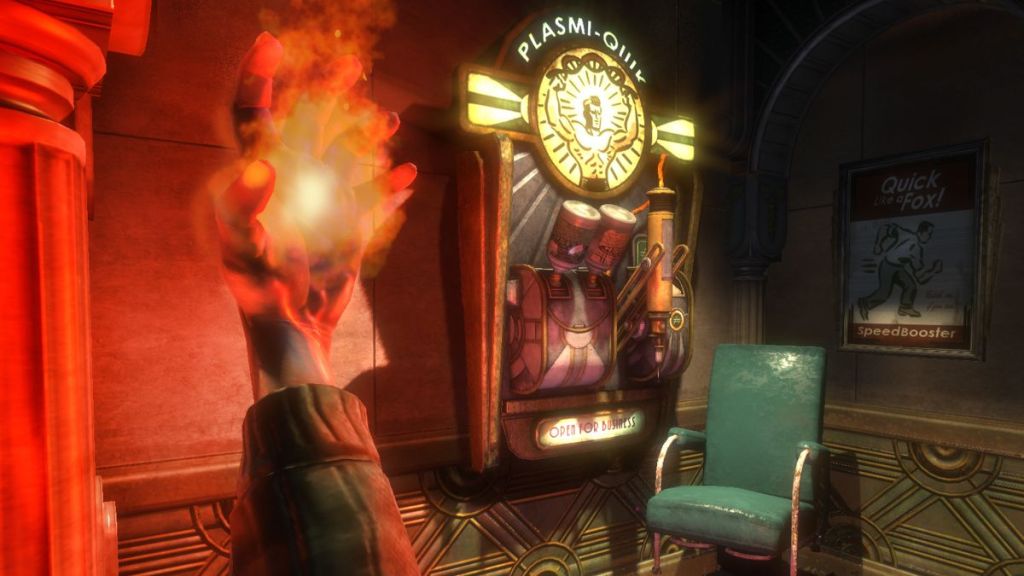
A plasmid vending machine in Bioshock (2007). All rights reserved to 2K Games and/or other respective owners.

The other approach is to analyze what makes the element you like work, and then build upon that. Let’s say you like plasmids and tonics from the Bioshock series. They are essentially consumables that grant spells or spell-like abilities, and are commonly available from vendors. Don’t use the terms “plasmid” or “tonic”, invent a different set of effects, maybe a different delivery method. Someone might still see the inspiration, and you make no claims otherwise, but it should fit better in your setting, and not come off as a rip-off. This is of course applicable to any source of inspiration, not just video games.

I have to say one of the best campaigns I experienced as a player was heavily based on Icewind Dale, where the DM essentially copied most of the plot and added his own elements (a lot, to be fair). But what you get with this approach is often a clash between your players’ expectations and your adaptation. If you’re lucky, you will only be reminded of this a few times each session.

Final remarks

It is quite possible that there’s nothing new for you in this article. You are probably familiar with video games and have used them as inspiration at least sporadically in the past. In that case you may consider this article an obligatory introduction, in which I state my goals and methods. If, on the other hand, you are not at home with video games, you might want to check some out as there are many original ideas scattered around.

As mentioned in the beginning, there will be analyses of video games in the future. Some of the games mentioned in this post will surely have their own articles, and there are many more I would like to write about. I hope you will find the articles interesting and inspiring. First of these will be posted soon, so you might want to follow the blog so you don’t miss anything!

Dungeon 24: Goatherd temple

Estimated reading time: 2 minutes (4 with room descriptions)

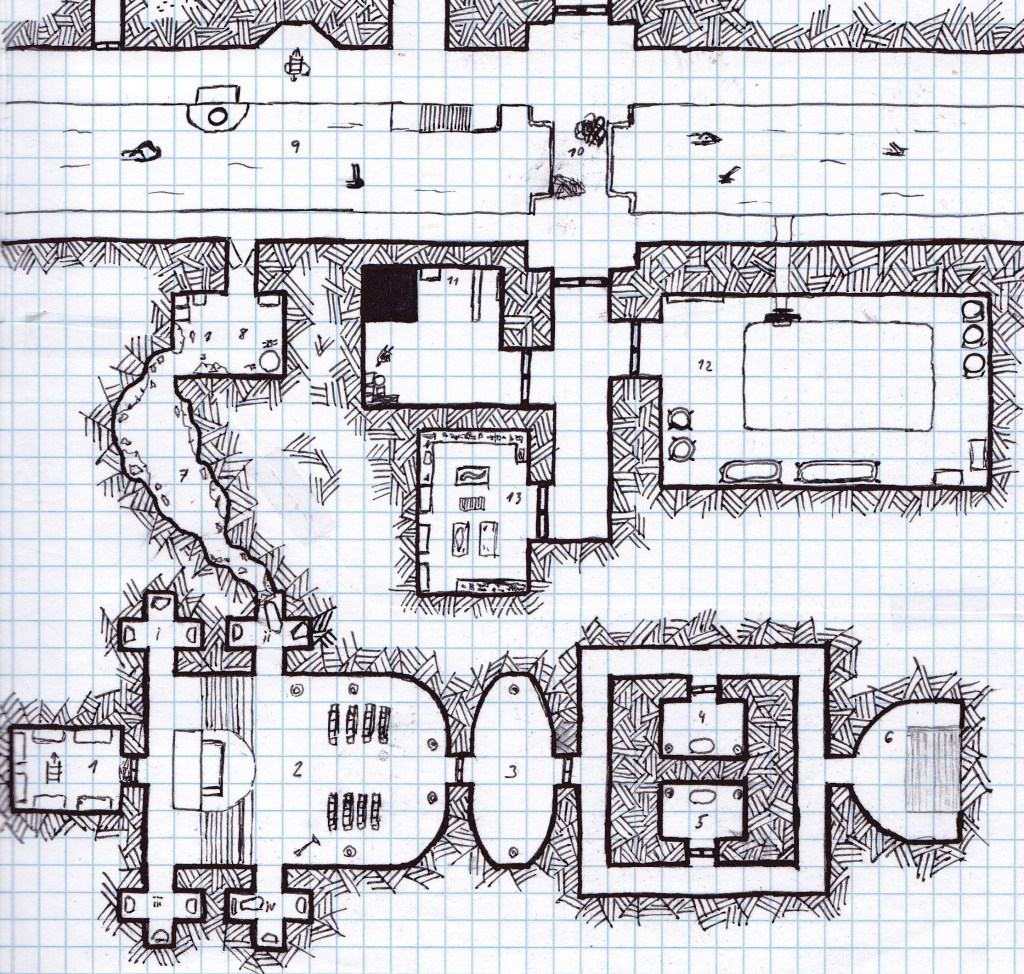
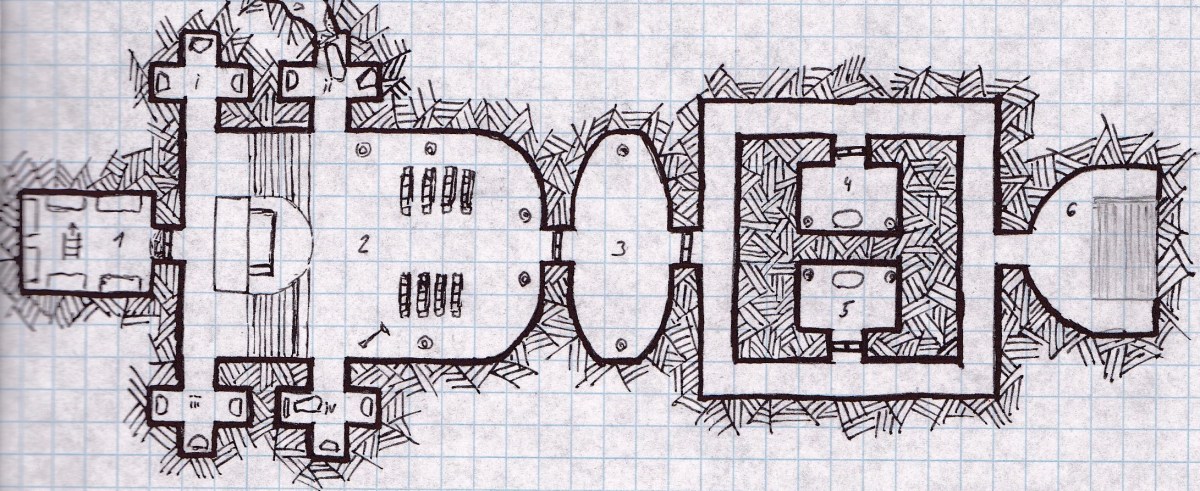
As I mentioned in the last update, in March we’ll see some more action. In this post a new level of the dungeon begins, one that is lower than the prison level we finished last time. Six rooms are featured in this update, together forming one complex. The drawing style is a little different from the last level. I’m trying out new techniques in pursuit of raising the quality of the maps. Since I’m sharing them with the world, they could use more attention.

I started below room II/49, or the isolation cell in the gnomish part of the abandoned prison. A shaft leads down from there some 25 ft., first few feet furnished with iron rungs, then a rope ladder leading into a rectangular room with six sarcophagi. The tomb contains the bodily remains of six high priests of a long-vanished cult, and can be left by a door on the eastern side of the room. Someone barricaded the door with slabs of stone that probably come from the ceiling.

The door leads to the nave of a temple. Four alcoves in the shape of a cross contain more sarcophagi, and on the other side of the nave the door leads to an anteroom. One of the alcoves has been breached somehow from an adjacent natural cave (we’ll get to it in the next update). The antechamber is plain and leads to another two rooms serving as shrines for artefacts. One is still present, the other is missing. The whole temple is decorated with murals depicting pastoral scenes, mostly with goats. Some murals are damaged, in the main nave it’s mainly the faces of people that are defaced. In the easternmost room a wide stairway leads down to lower levels.

Plan of the first 6 rooms on this level
The temple of goatherds.

The temple has been abandoned long ago, althought it seems the tombs haven’t been looted. Whoever made the access shaft to the tomb probably found it wise to barricade the door. The party is free to loot the sarcophagi, but this should prove difficult enough. With a trap to soften the robbers and then a mummy inside, each sarcophagus could be their last. The horn in room 4 is free to take with no strings attached.

Rooms

  1. Tomb with 6 sarcophagi, there’s a rope ladder dangling from a hole in the ceiling
    • the door is blokced from the inside with large stone slabs, probably from the ceiling
    • each sarcophagus contains the remains of a high priest – there are glyphs documenting their names, rank, and deeds
    • potential grave-robbers might want to open the sarcophagi, though each is trapped and the mummified corpses come to life when tampered with
    • T: each corpse is adorned with jewellry, some have ceremonial regalia such as a dagger or scepter
    • E: up to 6 mummified high priests
  2. Temple nave with pews, altar, and 4 alcoves with sarcophagi
    • the altar is on a raised dais
    • the walls are covered in faded murals depicting pastoral scenes, faces deliberately damaged
    • alcoves – ii has 1 toppled sacrophagus behind which a tunnel leads to III/7; one sarcophagus in alcove iii contains a simple lapis lazuli necklace
  3. antechamber, walls covered in murals showing goatherds and scenes from goat husbandry
  4. small shrine, on the altar is a goat’s horn with silver fittings, murals on walls show flocks of goats, sheep, and cattle
    • T: horn of animal friendship (1 use/day, as spell cast from 5th level slot – 5 animals affected, works only aboveground)
  5. small shrine with empty altar, walls defaced, but remains of hunting scenes can be seen
  6. room with a wide flight of stairs leading one level down

In the next update we’ll have a look at the cave leading from the breached alcove. What will avait intrepid explorers in the darkness behind the toppled sarcophagus? Follow the blog or our social networks so you don’t miss anything!

Dungeon 24: Gnome refuge

The February #Dungeon24 update is finally ready. This time we’re dealing with a community of swamp gnomes.

Estimated reading time: 3 minutes (7 with room descriptions)

I’ve been neglecting the dungeon in the last few weeks, and it’s already April. By now there should be around 90 finished rooms. The schedule seems quite unrealistic, so I will just post these whenever I finish a batch. I’m slowly changing the style, as I’m trying out a more detailed approach. Either way these drawings are only wips, I will be redrawing everything at the end of the year or so.

We entered the southern prison block last time and from the few corner cells described not much could be guessed about it. The next few rooms should clarify things.

This prison block is occupied by a small group of swamp gnomes. Their leader is Čitlo [chit-loh], a sorcerer of some skill. The others are mostly simple fisherfolk and craftspeople. They prefer to be left alone, having sought the solitude of the abandoned halls of the complex. The swamp gnomes visit the surface to fish and forage, and once in a while descend to lower levels as well. They keep away from dangerous areas. When asked about the other block, they remain mostly silent or try to change the subject.

Balok the dwarf sometimes trades with them, but their relationship is not that of equals – he sees them as someone who is tolerated and potentially exploited, when possible.

Map of the southern prison block
The southern prison block. You can see I added details to most rooms.

Rooms

  1. Twin cells remade into a single room by removing the central partition and covering the bars.
    • the room is inhabited by a single swamp gnome
    • contains a seaweed pallet, some coil baskets of various sizes; in one corner a series of shelves is fashioned ou of an old fishing net, still with floats and sinkers
  2. Former kitchen; it is divided by bars with 1 dispensing window on the N side – now reinforced by additional bars bound by locked chain
    • The “outer” part is empty, only 1 rickety chair stands in NE corner
    • The “inner” part serves as a sty for 5 eggslugs, that are using what originally served as a cooking fireplace as an egglaying nest; there are remains of foodstuff and organic refuse all over the room
  3. Former larder, now used for storing fodder for slugs – seaweed, food remains, etc.
    • T: when searched thoroughly (DC 30) a brazen button similar to the one from I/25 is found
  4. Another room fashioned from two cells, the central barred partition is removed untidily, with remains of bars still visible; outside bars covered with blankets
    • home to two swamp gnomes, brother and sister
    • two crude seaweed pallets in S part of the room; small table with chairs, few seaweed baskets, a beaten keg made into a chest
    • on the table there is a figurine similar to those in I/4
  5. storeroom turned into living quarters
    • home to a single swamp gnome, an old stone carver
    • N part of the room taken by a crude seaweed pallet, in SW corner a small seaweed rug on the floor, little chips of stone in every corner and nook, dust everywhere
    • on the rug a set of tools and half-finished stone carvings
  6. former chapel, now common room for the swamp gnomes
    • in the alcove is an altar used as a counter for food preparation
    • basin in the middle is usead aas a fireplace – there are potstands, tripods, etc. in and around it
    • usually at least two gnomes on kitchen duty; more if it’s meal time or there’s a matter to discuss
  7. originally a workshop, now the room serves as the swamp gnome leader’s quarters
    • divided by a screen made of sailcloth, behind the screen is a pallet, table and chair and a small chest
    • N wall lined with shelves with various trinkets and containers, SE corner occupied by a corner workbench
    • the swamp gnomes’ leader Čitlo is rarely in his quarters, more often supervising other gnomes’ activities or spending time in the common room (II/46)
  8. isolation cell reused as a storeroom; it is full of seaweed bundles tied with coarse ropes and twines
    • T: one of the bundels in the back, under several others, is a hidden stash (DC 30), containing the following: 78 gp 51 sp in various coinages, 2 healing potions (unlabeled), wand of Reduce person
  9. isolation cell remade into secret access shaft to lower levels
    • the door is locked, key is worn by Čitlo
    • the room is empty, in SE corner a roughly cut shaft with rungs set into the stone
  10. former utility closets, now larder
    • shelves, boxes, and sacks containing various foodstuffs – undergorund and coastal
  11. utility closed turned into a toilet, a screen divides the room
    • behind the screen is a toilet leading to a lover level, climbable by small creatures, though filthy and leading to a sump
  12. another converted twin cell, housing a single swamp gnome woman
    • right in front of the door is a standing loom
    • in SW corner is a table and 2 chairs, a large shelf at the S wall, smaller chest on the opposite side, seaweed pallet and coil basket near E wall
  13. twin cell remade into tannery
    • there are 2 frames with stretched skins along the N wall, 2 vats along S wall, 2 drying rackswith fish skins in W part of the room
    • Some scraping tools hanging from the frames, and softening hooks on the walls
  14. Twin cell rebuilt into a room, it serves as housing to a pair of swamp gnomes
    • There’s a larger pallet, a table with 2 chairs, a large coil basket and a chest, one shelf on the N wall
    • The occupants are leatherworkers/tanners and spend most of their time in the tannery (II/53)
  15. Room made from twin cells, occupied by a single gnome
    • Caringly repaired furniture – 2 shelves, a table and 2 chairs, a chest, and a pallet
    • On the table and shelves are various woodworking tools – saws, knives, planes, a hammer and nails, etc.
  16. Corner cells remade into another room, a couple with child lives here
    • Screens divide the room into sections, N has a larger pallet and a cradle, center part has some chests and a table with chairs
  17. small workshop with a work table, equipped shelves, and a chest
    • door is locked and barred (1 key for each needed)
    • inside is a corpse of a dwarf engineer
    • the workshop is equipped well enough for most basic craft and maintenance needs
    • T: the dwarf has a dagger, shortsword, and small crossbow with 6 bolts in the quiver; also some jewellery (worth 7 gp total) and coins (2d4 gp in different coinages)
  18. Fountain room – large basin with a fountain; there is no water and the basin is dirty
    • “secret” door behind the basin (DC 35) leading to fountain maintenance
  19. Maintenance room for the fountain
    • apart from some machinery there is a shaft leading down
  20. Lift room
    • the lift is broken, but the shaft can be used to climb up two levels (better access from the top with a rope)
    • there are also stairs leading up, but only one level, and the door on top is locked
Eastern part of the level with stairs and lift
Several exits to different levels are located in this part of the level.

This concludes the prison level of the compound. Another set of inhabitants was introduced, the swamp gnomes. A detailed description of this subrace/heritage will be the content of another post in the future. So far the dungeon didn’t offer much in the way of dangers, but I’m not working on a room-by-room chain of encounters. We’ll see how this goes in the next few months. April is round the corner and I have to start on March, still. I guess I can do a lower level for March and make it more dynamic.

As always, thanks for reading and you’re welcome to like and comment, and share the post and our site on your favourite social media!