Estimated reading time: 10 minutes
In this episode of my Lorwyn-Shadowmoor series I will take a look at the merrows of Lorwyn. As you probably know, Wizards of the Coast announced a new D&D supplement for 2026. In this series of articles I present my predictions and anticipations. I wanted to finish this before June, in time for a Mermay contribution, but I worked on other things instead. Then vacation came, more work, and you know the rest. But the series is back on and this time we take a dive into the waters of Lorwyn.
Merrows, as Lorwyn merfolk are called, differ from those of some other MtG planes. On planes such as Zendikar or Ixalan the merfolk are bipedal. Lorwyn (and Shadowmoor) merrows resemble those of Dominaria, with fish tails and without legs. While not a problem for a card game, in a TTRPG where things should make at least some sense, having a party member unable to walk might prove challenging. I’m quite curious how the team at Wizards is going to handle this. So let’s dive into the Merrows of Lorwyn.
Merrow Lanes and Dark Meanders
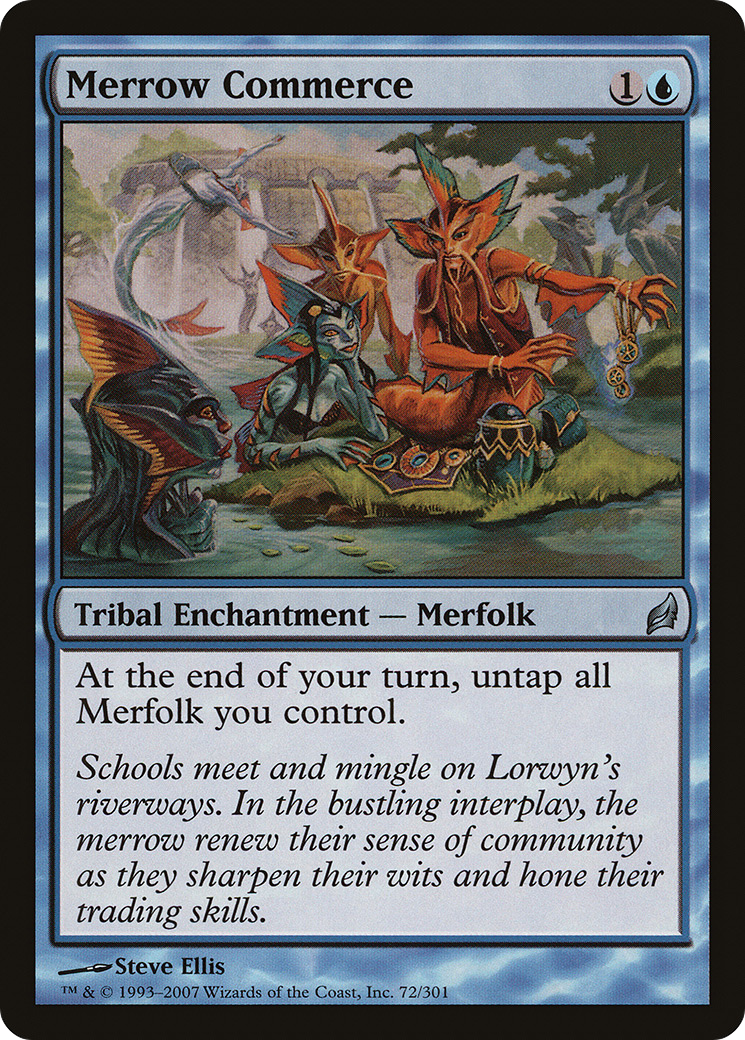
I start these articles with an overview of the tribes’ society, but this time some geographical context is in place. As I said before, the merrows of Lorwyn are bound to bodies of water due to their morphology. This is fine for a non-player species, but could prove difficult in a traditional D&D game. On Lorwyn the merrows make use of rivers (called “merrow lanes”), the largest of which is called Wanderwine; and Dark Meanders, a series of underground rivers crisscrossing the plane. These connect all the water bodies on the plane, including wells.
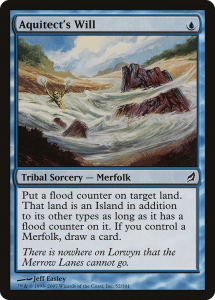
When the waterways don’t lead to where the merrows need to be, there’s another solution – flooding. To this end they employ aquitects, mages potent in creating new waterways where they’re needed. This is something that quite exceeds the power levels of low to mid D&D campaigns in many settings. If accounted for in a suitable setting, it might be possible to pull it off. Though again probably better to have aquitects as NPCs than the player characters.

Society
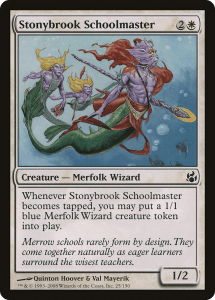
The merrows of Lorwyn value knowledge and learning, and so their society is centered around the wisest of their scholars. Merrows gravitate towards these mentors called “reejerey”, and form loose but recognized schools. These have different interests and values. In Lorwyn there are five known merrow schools: Inkfathom, Paperfin, Silvergill, Stonybrook, and Weirwinder. New ones could be invented for the D&D supplement. The schools obviously have their specializations. Inkfathom school for examples delves into the Dark Meanders. Paperfin seems to focus on black ops, Silvergill merrow safeguard travel along the lanes.

Being mostly blue-aspected, the merrows embody the usual scholarly traits of blue mana in Magic. They covet secrets of all kinds, revere the knowledge of the past, and make no qualms about revising the past. Stealing and even destroying sources of knowledge is fair play for the merrows. In this sense they are quite a meddling bunch, though generally they are among the good guys of Lorwyn.
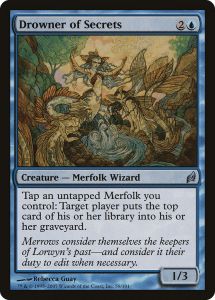
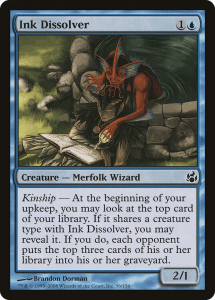
Trade of goods and ideas is another area which the merrows consider their forte. They use the rivers to transport passengers as well. Ideal as NPCs that offer services to the party. I can imagine a lot of boons the adventurers could get from the merrows this way. For example fast and (mostly) safe travel through the Dark Meanders, or arcade-style pop-up merchants.
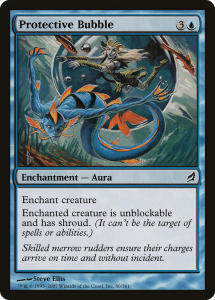

The merrows are probably on good terms with at least the kithkin and the elves. Probably less so with the others, but then again the others are less “sociable” in general. To the kithkin and elves the merrows provide transport services, and they also share their healing powers. And their policing of the waterways is also a service that’s probably well received by most.
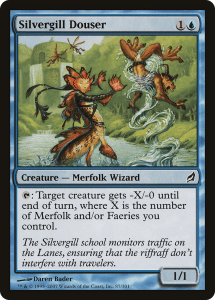

You can see there’s more to the merrows than their morphology that makes them ideal for NPCs instead of player characters. They are bound to water features, yet can travel from one to another easily. As keepers of lore and history they have much to offer, and much to possibly request, making them natural quest-givers. Their water-based limitation nicely overcomes the age-old problem o powerful characters sending weaker ones on quests they could do better themselves. Not everything is accessible from water. A merrow can provide healing, transport, knowledge, or rare commodities from far away. It just makes more sense to have them as non-player characters.
Equipment
As with the kithkin I will analyze the various arms, armour, and other implements we can connect with the merrows. In D&D equipment and loot plays a large role, so it’s important to know what to expect. Some of these might be rare and sought after by the other tribes.

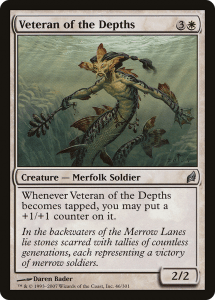
Scholars and wizards first and foremost, the merrows don’t use much hardware. Half of the times they are depicted holding nothing. Sometimes they are casting a spell. When they hold anything in their hands, often it’s not a weapon, but a scroll, staff, poultice, lantern, or even a branch. This of course corresponds with their general theme.
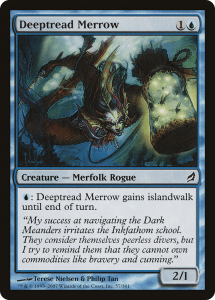
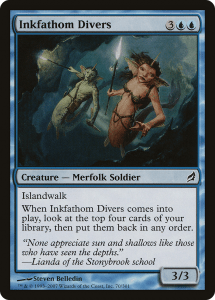
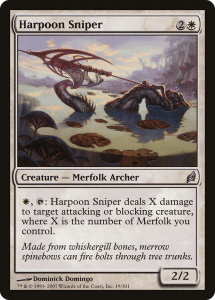
There are of course merrows who are more conventionally armed. We can see spears and serrated blades for close combat. Some have a knife or dagger on them, but these are probably for utility purposes. There are also some ranged weapons in the form of a blowgun, and a heavy-duty spine bow. Nice idea for an exotic weapon that’s still easy to understand and imagine.
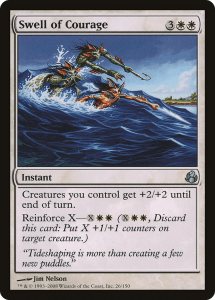
If all that’s too tame, there’s the card Swell of Courage. One merrow wields what looks like an enlarged fishing hook, another has a magical spear, the third some kind of axe. Two of them wear turtle shell pauldrons and the axe-merrow has a turtle shell shield. This one’s a bit of an outlier, but there’s no reason to discard it. Maybe the fish hook’s taking it a bit too far, what do you think?
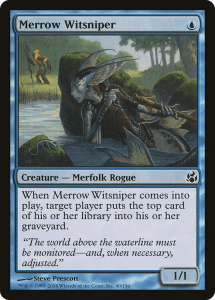
The turtle shell armour pieces above are the only armour pieces we can see on Lorwyn merrows. The Merrow Witsniper is wearing some kind of tight, presumably leather, harness, but it’s probably not armour. Others wear swimwear or light clothing, sometimes a robe. It makes sense not to put too much fabric on yourself when you spend most of your life underwater. We also see various charms and baubles, as well as pouches. But mostly the merrows do what you would if you went swimming. They wear as little as possible.
What about other stuff? There’s a pearl, that probably has some magic properties. A staff that makes sense for a wizard. What about the branch in the hands of Veteran of the Depths? A status symbol, charm, or just something they picked up while swimming? You can probably see the potential. There are also lots of options for various water travel related utility charms.
Magic
Merrows are one of the more magical tribes in Lorwyn. There are however not that many spells we could count as “theirs”. They share the blue aspect with the fae, and so while there is a lot of blue spells, many don’t feel like what merrows would use outside of MtG.
Those sorceries and enchantments that can be linked to the merrows give us a fairly uniform picture. Their magic is usually not one of direct violence. Instead they use their art for gaining knowledge and negation. This is hardly surprising to any Magic: The Gathering players, but I’m assuming my readers are primarily D&D players. In terms of D&D schools of magic we are dealing with divination, abjuration, and transmutation mostly. Some illusion and enchantment make sense as well.
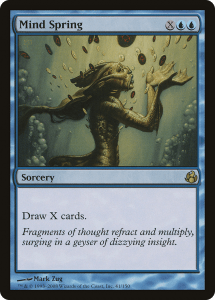

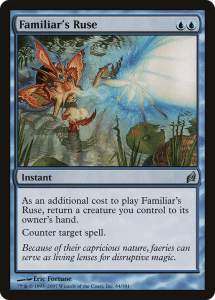
Effects that make you draw cards would fall under divination. They mostly deal with gleaning insights, searching, and other similar stuff. A staple of blue players in MtG is counterspell. In D&D there’s a single spell called unassumingly Counterspell. MtG has tons of counterspell flavours, and perhaps the same could be done here. Different situations, requirements, and other parameters could make each an interesting variation on the common principle of negating a spell. Look at Familiar’s Ruse below, which canonically uses a fairy as a catalyst.
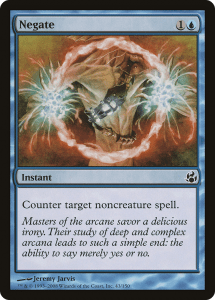
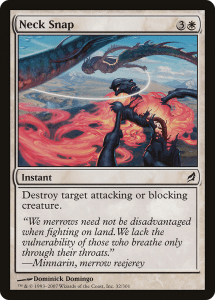
And we mustn’t forget the few out-of-place spells, that clearly should be from the school of evocation. It makes sense to have some at your disposal, even if you prefer indirect means. Especially in D&D environment casters are expected to have at least some offensive spells. We are shown a few of those in Lorwyn at the merrow disposal. The Neck Snap would work either as a spell, or as a magical item. Scattering Stroke, though a spell counter, looks on the card art as a jet of heated water or something similar.

Summary
The merrows of Lorwyn are one of the “good guys” by most standards. They seem to have mostly good relations with other tribes. Trade of things and ideas, and recording, collecting, and adjusting knowledge, are their two main interests. Their unique morphology would make them quite difficult to fit in a normal D&D campaign. Normal in the sense that there’s a group of characters traveling mostly on dry land. It would require quite some work to prepare the campaign in a way that enables merrow players to do what others can. And after such treatment it might be too merrowcentric for the other to enjoy fully.
Therefore I find the merrows to be ideally suited to being NPCs. Wise mentors, guides, almost omnipresent traders, even assassins. The merrows are an important part of Lorwyn, but you better leave them out of your party.
This is where I usually list the subspecies based on the Lorwyn-Shadowmoor lore for the tribe. Since I’m advocating the NPC treatment, I won’t go into stats. Have a quick recap of what the various merrow schools seem to be focused on instead:
- Silvergill – maintaining and guarding the lanes, trade?
- Inkfathom – exploring and navigating the Dark Meanders
- Paperfin – hard to say from the one card, but since it’s a rogue, I would say black ops – assassinations, espionage, procurement of guarded knowledge
- Stonybrook – let’s say diplomacy and teaching? They have the banneret and schoolmaster cards
What do you think? Do you agree merrows should be NPC-only? Or would you go to the great lengths needed and do your best to implement them as a playable species? Leave a comment and stay tuned for the Shadowmoor counterpart!
Final remarks
While there is lore available on Lorwyn-Shadowmoor and its denizens, a large part of my analysis is based on card art and flavour text. Therefore a lot might be a matter of artist license rather than conscious worldbuilding decisions. Sometimes that is preferable. We’ll see in the official supplement how the specific issues will be resolved.
The cards used as illustrations were obtained on Scryfall and all rights to them are reserved to Wizards of the Coast and/or other respective owners.
The author is not affiliated with Wizards of the Coast or any other party mentioned in the text.
 Rashundai Games
One thought on “D&D: Lorwyn Merrows”