Estimated reading time: 12 minutes
Welcome back to my series dedicated to Lorwyn-Shadowmoor, a dual plane from Magic: the Gathering. An official supplement by Wizards of the Coast has been announced and I have taken up the very unofficial quest to speculate and predict the outcome. Last time I summarized the kithkin of Lorwyn. New let us move past the Great Aurora and see how the kithkin changed. Shadowmoor, the darker aspect of the dual plane, is a place of constant dusk and gloom. The tribes’ negative characteristics are amplified and positive ones are muted.
For kithkin this means a transformation from a proud and honourable folk to paranoid sadistic xenophobes. Certainly not pleasant to be around, unless you are one of them. They fear the other tribes (not entirely unreasonably) and counter by doing their best to make others fear them. Let’s take a closer look at these little evil darlings.
Society
Shadowmoor kithkin society is still a very close-knit one, probably even more than before the Aurora. They benefit from the thoughtweft, which is even stronger in Shadowmoor than before. Along with guidance from their leaders this fills the kithkin with zealous hatred and fear for all outsiders.
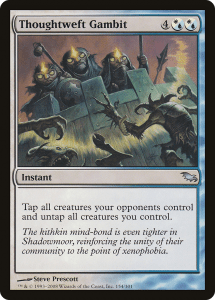
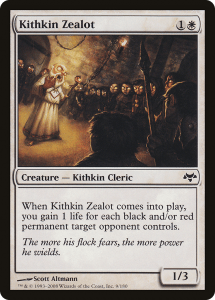
Gone is the image of heroic little folk in a world of weirdos. Now the kithkin are the weirdos, as former weirdos shifted into true monsters. And the kithkin have no restraint in following them.
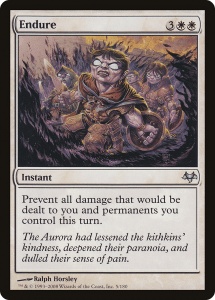

The clachans are now called “douns”, and instead of cozy rustic villages they resemble fortresses. It’s one of the dual plane’s most interesting traits, that there are counterparts to most places, beings, and features. The doun names reflect this nicely. Goldmeadow became Mistmeadow, Kinsbaile is Kinscaer, Burrenton changed into Barrenton, Ballyrush into Ballynock. The change is sometimes semantic (Mistmeadow) or just meant to sound darker, as with Kinscaer. Cloverdell changing into Thistledown is the most significant name transformation.
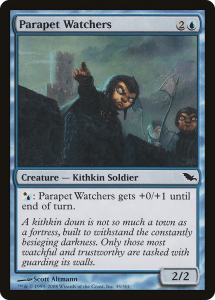
The clachan Dundoolin from Lorwyn apparently has no Shadowmoor counterpart. This opens some space for speculation. Maybe Dundoolin in Shadowmoor is… Dundoolin. The name is gloomy enough as it is, with “dun” supposedly meaning the dull grey-brown colour, and “doolin” possibly meaning “dark pool”, if the inspiration is from Irish. It could mean that Dundoolin is not as much affected by the Great Auroras. Or it could be just an oversight that I’m reading too much into. Either way it will be interesting to see how this will get handled in the release.
Traps
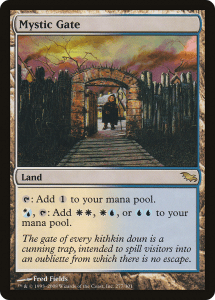
As you have probably seen on the Mystic Gate card above, Shadowmoor kithkin lay traps. They have in this sense channeled their inner kobolds, because it seems they really love setting traps of all kinds. This is again a shift from their Lorwyn counterparts, who stand up to their foes in a fair fight. In Shadowmoor the kithkin avoid direct confrontation as much as possible.
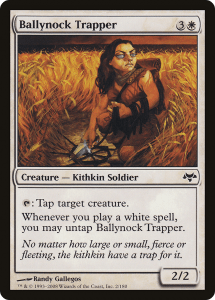

This fondness for traps can of course be used nicely in a D&D game. Shadowmoor kithkin might have a trait centered on setting traps, and maybe bonuses on finding and disarming them. Entering a doun undetected could also make a fine challenge. Taking their paranoid nature into account, any place in kithkin reach could be trapped up to eleven.
On the cards we see simple snare traps, and the doun entrances are protected by pitfall traps. Certainly other trap types could be found in the kithkin arsenal. Various log traps, dart traps, and even traps spewing the various powders and concoctions of the kithkin come to mind.
Equipment
The equipment used mirrors the tactics of the user. In Lorwyn we have seen mostly soldiers and knights with regular infantry or cavalry weapons and armour. In Shadowmoor we see an increase in the number of clerics and wizards. There are fewer soldiers and knights (only one knight!), but they still seem to be ready for heavy close combat. There are swords and shields, various types of armour.
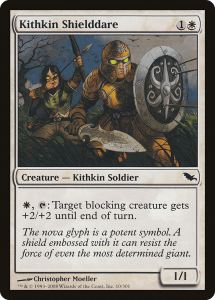
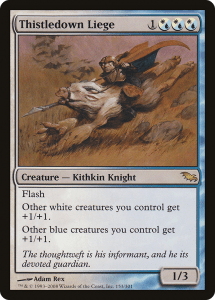
What we also see, though, is an increased use of axes and even halberds. Regular spears are swapped for harpoons, or spears with wicked-looking blades. The overall feel you get from armed kithkin is that they either skulk around, or wait until the enemy gets past the traps and finish the rest.
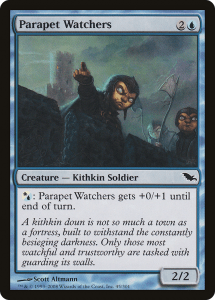

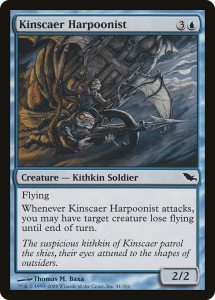
The kithkin of Shadowmoor still have air forces at their disposal, though presumably minus the plovers. What they have though are balloons that either drop their powdery payload, or carry a rather nasty looking oversized crossbow with harpoon bolts. It wouldn’t be a stretch to expect those crossbows (scorpios?) used on the ramparts of a doun, either.
Scarecrows
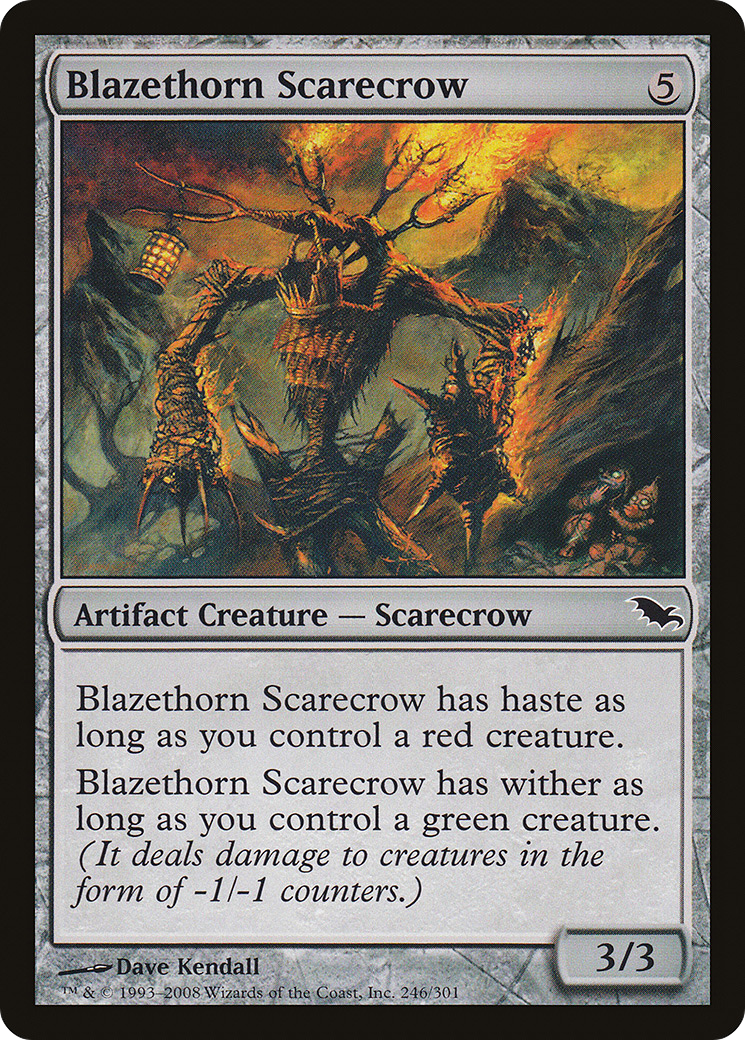
Another thing the Lorwyn kithkin presumably don’t use, while their darker counterparts do, are the scarecrows. At least there are no scarecrow cards in the Lorwyn block. In Shadowmoor there are 23 different scarecrows. They can perhaps be classified into three distinct groups: a) proper scarecrows made of wood, wicker, straw, and cloth; b) skulkin, made of wood and hard animal remains, such as bones, antlers, and hooves; and c) flying scarecrows.
They are all supposedly made by kithkin specialists called cobblesmiths. Some might have been made by the gwyllion hags, or even other scarecrows. But mostly they’re constructs the kithkin make to help with their chores, twisted either on purpose or by the powers of Shadowmoor into nightmarish contraptions. Actually, I would make them appear in Lorwyn as well in the D&D supplement, as obedient if quirky servants. And have their twisted versions roam the mists of Shadowmoor.
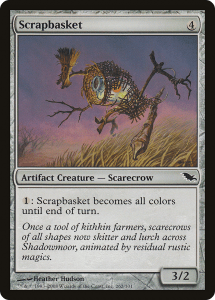

The scarecrows, although made by the kithkin, aren’t exactly obedient. It seems they tend to go off rampaging on their own, fueled by the malevolent energies of the plane. This means several things in a D&D sense. It provides a steady supply of enemies of various forms and power level, that are not “sentient”. You don’t have to come up with explanations, it’s just a roaming scarecrow. Not exactly my kind of thing, but it would be a gold mine to some. You can find enough low level plot hooks just by starting at “rogue scarecrow”. And you could make cobblesmith into a class option, with some variant of “turn undead” tailored to scarecrows, and of course the means to create your own. That sounds like a lot of fun and I should put it together before someone else does.
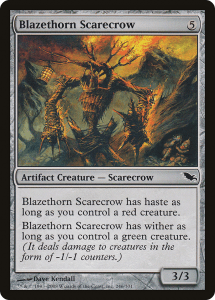
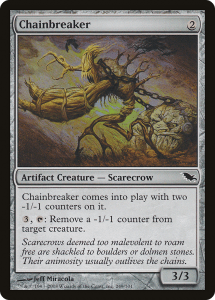
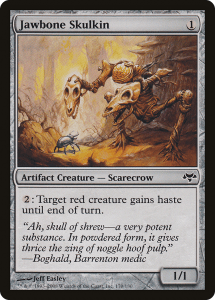
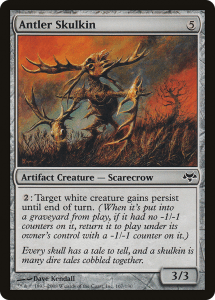
The skulkin are a nice variation on the “common” scarecrows. Using body parts they have a fetish or totemic feel to them, and it seems the parts used influence the properties of the finished construct. They might or might not be made by someone other than the kithkin, the gwyllions seem most likely, as some of the flavour texts are by one of their kind.
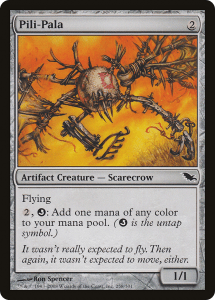
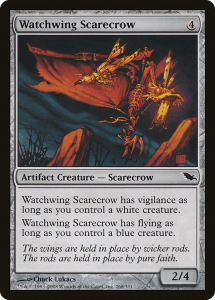
And finally, the flying kind. It’s quite a neat idea, have you ever fought a flying figurine made of wood, wicker and cloth scraps? Lucky you never did! There are four of them in the Shadowmoor block, so flying scarecrows are definitely a real threat.
It’s probably easy to tell how much I like the scarecrows in Shadowmoor (scarecrows in general, actually). I think they’re great with tons of uses in a D&D campaign. Not only as enemies, but as quest givers, quest objectives, random NPCs, or just parts of the scenery. There is really a lot you can do with them, thanks to their customisability.
Magic
Kithkin magic is never one of direct destruction, and the same applies in Shadowmoor. D&D-wise their magic is all enchantment and abjuration, with some divination and transmutation thrown in. Especially in Shadowmoor the kithkin seem to avoid direct confrontation as much as possible, but when it’s necessary, they have some buffing capacity through their spells.
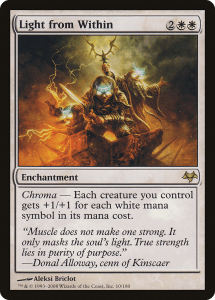
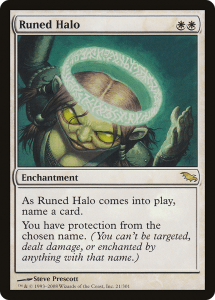
Dispelling seems also quite prominent in kithkin spell arsenal. Since many of the foes kithkin might face use various forms of enchantments and illusions, this is also something worth having at your disposal. You don’t really have to come up with new spells for this, just give some flavour to existing ones.
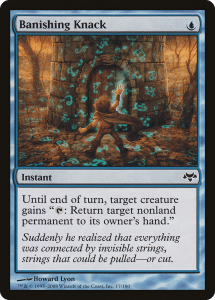
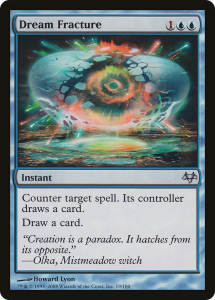
Kithkin apparently like to put others to sleep. To this end they employ their somnomancers. In D&D it would be a very narrow specialization, as there are not many sleep spells to choose from. Perhaps if there were several kinds with different range, radius, saves. Maybe we’ll get that in the supplement. Either way a somnomancer would probably work well together with the fairies, putting things to sleep so the fairies can harvest its dreams.
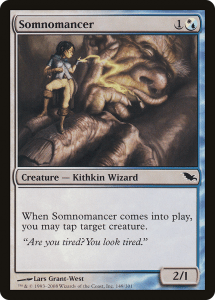
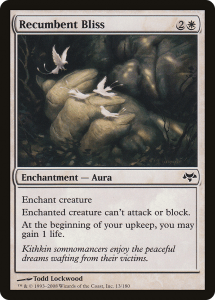
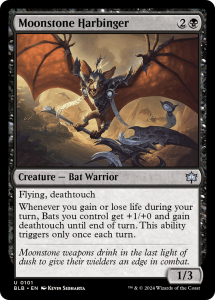
Divination is also a favourite pastime of the kithkin. Their wizards use a substance known as moonstone to bolster their auguries. Not much is known about moonstone, other than it’s rare and doesn’t occur in the Lorwyn aspect of the plane. It would make a fine quest item, and you could create various artifacts using moonstone as their base. The only other moonstone occurence in MtG is Bloomburrow, where it’s used by the bats. There might not be any link between the two, but it would be interesting to see what will Wizards come up with.

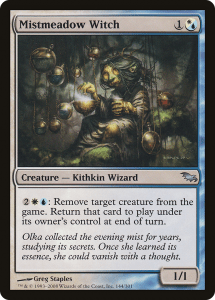
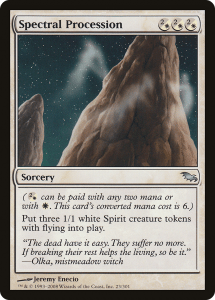
Another interesting flavour of kithkin magic users would be the mistmeadow witches. Masters of vanishing into mist, they are an elusive quarry. Perhaps the mists could have other uses as well? And the witches have other talents as well, such as summoning spirits.
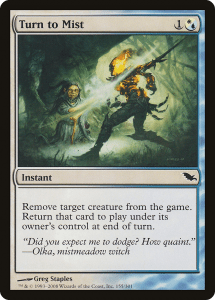
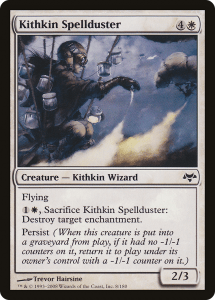
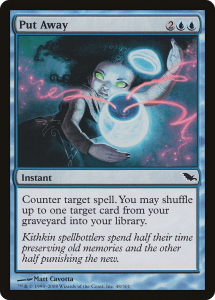
We can see other forms of kithkin magic, from levitating shields to capturing spells in bottles. As in Lorwyn, kithkin love various powders and concoctions. I have already shown the spelldusters, and on the skulkin cards flavour text speaks of powdered bones potency. Powders are generally a nice alternative to potions, and you could easily replace some of the potions in your game with them.
Summary
Even in Shadowmoor the kithkin are probably the most relatable. Minus the xenophobic paranoid sadist part, I hope. However wicked their minds might be, they’re the least alien. That makes them a good choice for beginner players. Unlike in Lorwyn they can’t really be a majority party species, because they would probably murder the minority. I can imagine all-kithkin parties, or perhaps parties where the kithkin are a minority and have to work together with others, even against their nature and nurture.
There needn’t be many stat changes from their Lorwyn cousins. I suggested Dexterity as their main Ability Score Increase of +2, and then one other based on clachan. Or, in the case of Shadowmoor, doun. Thoughtweft and ambidexterity as traits, with thoughtweft stronger than the one Lorwyn kithkin have. Probably the whole species could have some stealth-related trait. The subspecies based on douns could remain mostly the same, but some changes would be logical. Check out my suggestions below:
- Mistmeadow – +1 WIS, proficiency in stealth and perception, vanishing
- Barrenton – +1 STR, proficiency with smith’s tools, fire resistance, mountaineering
- Ballynock – +1 CON, traps and ambushes
- Dundoolin – +1 INT, bonus language, proficiency in 2 INT skills
- Kinscaer- +1 CHA, bravery and leadership related traits
- Thistledown – +1 WIS, proficiency in nature, animal handling
Mistmeadow remains the one for stealth, mainly thanks to mistmeadow witches and their vanishing tactics. Barrenton probably still is the one closest to red mana, and could be left as is. Maybe with some mountain affinity. Ballynock loses its affinity for animals, and instead focuses on laying traps and ambushes alike. Kinscaer is no longer the heroic clachan Kinsbaile seemed to be, but still places a lot of importance on leadership and purpose. Thistledown is hard to read from the two cards that are there, but it might have replaced Ballyrush in their animal affinity. You can see I left Dundoolin there, even though there are no mentions of it in Shadowmoor. I’m going with my pet theory that Dundoolin doesn’t change that much during Great Auroras. The name stays the same, as does their scholarly inclination. Only they’re little horrors now instead of friendly little guys.
And that could be it for now. I spent more time on Shadowmoor kithkin than on their Lorwyn counterpart. I’m still working things out with each new article. So what do you think? Would you make more changes to the doun-based subspecies? Do you think it possible to have these kithkin as player characters, or rather as NPCs? Leave a comment and don’t forget to subscribe!
Final remarks
While there is lore available on Lorwyn-Shadowmoor and its denizens, a large part of my analysis is based on card art and flavour text. Therefore a lot might be a matter of artist license rather than conscious worldbuilding decisions. Sometimes that is preferable. We’ll see in the official supplement how the specific issues will be resolved.
The cards used as illustrations were obtained on Scryfall and all rights to them are reserved to Wizards of the Coast and/or other respective owners.
The author is not affiliated with Wizards of the Coast or any other party mentioned in the text.
 Rashundai Games
One thought on “D&D: Shadowmoor Kithkin”